
Fundamental Rights, Duties and Directive Principles
Answer in short
Fundamental Rights, such as equality before law (Article 14) and protection of life and liberty (Article 21), are promises a citizen can take to court. Fundamental Duties, added in 1976, ask citizens to respect the Constitution, protect nature and value our heritage. Directive Principles are goals for the government, like justice and good living standards, that courts cannot enforce.
Stuck on a question? Take a photo and Lagnever AI explains it step by step. Try it for 7 days for ₹2. Get it on Google Play
Three organs and three tiers
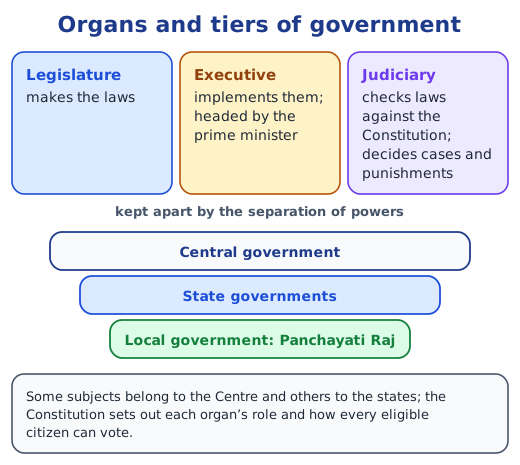
The chapter first recalls Grade 6. Government has three organs: the legislature makes laws, the executive, headed by the prime minister, carries them out, and the judiciary checks that laws agree with the Constitution and decides when a law is broken and what punishment is needed. Keeping them apart, the separation of powers, lets each work properly. There are also three tiers, central, state and local (Panchayati Raj), with some subjects reserved for the Centre and others given to the states. The Constitution defines each organ’s roles and accountability and lays down an electoral system so that every eligible citizen can vote.
Rights, duties and directive principles
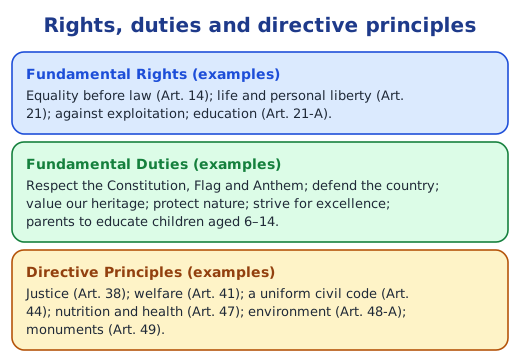
Three other core parts of the Constitution are shown in Fig. 10.14. Fundamental Rights include the right to equality (Article 14, equality before law), the right to freedom (Article 21, protection of life and personal liberty), the right against exploitation and the right to education (Article 21-A). Fundamental Duties ask every citizen to follow the Constitution and honour its ideals, its institutions, the National Flag and the National Anthem; to defend the country and serve when called; to value our composite culture; to protect the natural environment and be kind to living creatures; to strive for excellence; and, as a parent or guardian, to give a child aged six to fourteen the chance to be educated. The Directive Principles of State Policy sum up the framers’ social and economic vision: justice (Article 38), a welfare government (Article 41), a uniform civil code (Article 44), nutrition and public health (Article 47), protecting the environment and wildlife (Article 48-A) and protecting monuments (Article 49). All the Fundamental Rights and Duties are printed in full at the start of every NCERT textbook.
Rights or directive principles?
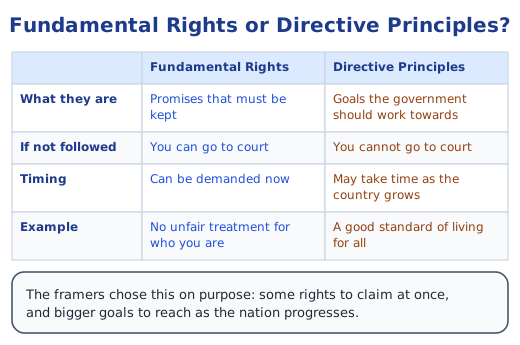
The two work differently. A Fundamental Right is a binding promise: a person treated unfairly because of their identity can take the matter to court, and the judge can set it right. A Directive Principle is a goal, such as a good standard of living for everyone; if the government does not work towards it, no one can complain to a judge. The framers chose this on purpose: some rights to claim at once, and larger goals to reach step by step as the country grows.
Equality for women
On 22 November 1949, Begum Aizaz Rasul told the Constituent Assembly that Indian women were glad to step into complete equality with men. She said this was not a new idea invented for the Constitution but an old Indian ideal, weakened for a time by social conditions, which the Constitution now affirmed. She was most likely thinking of the right to equality: Article 14 (equality before law), with Article 15, which bars discrimination on grounds including sex.
A living document
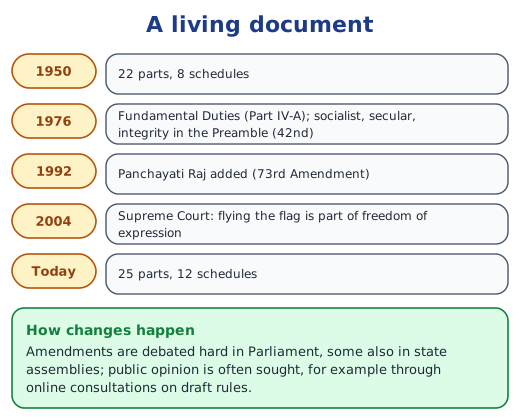
The makers knew that new laws and rules would be needed over time. Any change, called an amendment, is debated thoroughly in Parliament, some also in state legislative assemblies; the public’s views are often sought, and some changes start from popular movements. Fundamental Duties arrived as Part IV-A in 1976, and Panchayati Raj followed in 1992 through the 73rd Amendment. Courts also shape how the Constitution is read: in 2004 the Supreme Court held that flying the national flag is part of the freedom of expression, so citizens may fly it with respect at home. The government also invites comments on draft rules, as in the 2023 MyGov consultation shown in Fig. 10.15. Today the Constitution has 25 parts and 12 schedules, up from 22 parts and 8 schedules in 1950.
Why it matters
Knowing our rights helps us stand up to unfair treatment, knowing our duties reminds us what we owe the country, and the Directive Principles let us judge whether governments are working towards a fairer India. How the Constitution was made is in making of the Constitution, and its values in the Preamble and its values. Answers to every question are in the NCERT solutions for Chapter 10; see also the full Chapter 10 notes.
Practice
-
Which Article gives equality before law?
Show answer
Answer: (a) Article 14
-
Article 48-A, a Directive Principle, is about:
Show answer
Answer: (b) Protecting the environment and wildlife
-
If the government does not follow a Directive Principle, a citizen:
Show answer
Answer: (b) cannot go to court about it
-
Why did the framers make some rights enforceable and others only goals?
Show answer
Answer: They wanted some rights that people could claim at once, the Fundamental Rights, and some bigger goals, the Directive Principles, that might take time to reach as the country progressed.
-
Name two Fundamental Duties.
Show answer
Answer: Any two: abide by the Constitution and respect the National Flag and Anthem; defend the country; value our composite culture; protect the natural environment; strive for excellence; as a parent or guardian, educate children aged six to fourteen.
Questions students ask
What is the difference between Fundamental Rights and Directive Principles?
Fundamental Rights are binding promises: anyone treated unfairly because of their identity can turn to a court, and the judge can protect them. Directive Principles are goals the government should try to achieve, such as a good standard of living for all, but you cannot go to court if it does not.
What are some examples of Fundamental Duties?
To follow the Constitution and honour its ideals, its institutions, the National Flag and the National Anthem; to defend the country; to value our composite culture; to protect forests, lakes, rivers and wildlife; to strive for excellence; and, for parents or guardians, to give children aged six to fourteen the chance to be educated.
How is the Constitution changed?
Through amendments, which are debated thoroughly in Parliament before they are accepted; some also need debate in state legislative assemblies. The public’s views are often sought, for example through online consultations, and some changes begin with popular movements. Fundamental Duties (1976) and Panchayati Raj (1992) were added this way.
Stuck on a question?
Take a photo and Lagnever AI explains it step by step. Try it for 7 days for ₹2.
Get it on Google Play Open in browser
For parents: after the trial, the plan renews monthly by UPI or card autopay. You can cancel anytime in the app.