
Class 7 Social Science Chapter 11: From Barter to Money Notes
This chapter in five lines
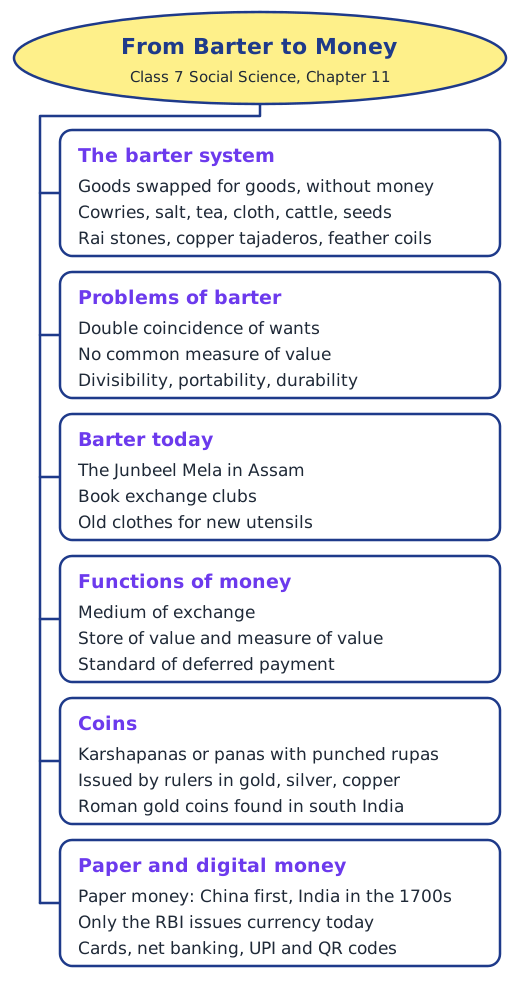
From Barter to Money explains how people first exchanged goods directly, through barter, and why its problems, such as the double coincidence of wants and the lack of a common measure of value, led to money. Money works as a medium of exchange, a store of value, a measure of value and a standard of deferred payment, and it has changed from cowries and coins to paper notes and digital payments like UPI.
What is this chapter about?
The chapter opens with the economist John Maynard Keynes, who described money as something that connects today with tomorrow. It then asks how people in the past, who grew crops and made goods such as carnelian beads, exchanged them for the things they needed. Its three Big Questions ask how exchange took place before money, why money came into existence, and how money has changed its form over time.
The barter system
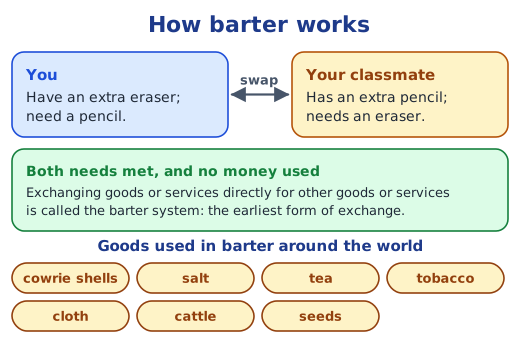
Before money, people exchanged goods or services directly for other goods or services: the barter system. If you have a spare eraser and need a pencil, while a classmate has a spare pencil and needs an eraser, a swap meets both needs. Salt, cloth, tea, tobacco, seeds, cattle and cowrie shells all served, and some places had unusual money, like the giant Rai stones of Yap Island. Read the barter system.
Problems of barter
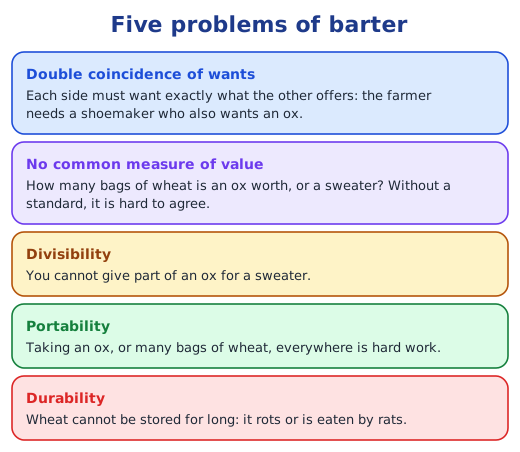
A farmer who needs shoes, a sweater and medicines but has only an ox shows the trouble. He must find someone who wants an ox, swap it for bags of wheat, carry the wheat around and bargain at every step. Barter needs a double coincidence of wants; it has no common standard measure of value; and goods often fail on divisibility (an ox cannot be split), portability (it is hard to carry) and durability (wheat rots).
Barter today
Barter has not vanished. At the three-day Junbeel Mela in Morigaon district, Assam, which began with gatherings of the Tiwa, Karbi, Khasi and Jaintia chiefs in the 15th century, hill people still swap produce and handmade goods for rice cakes and food from the plains. Book exchange clubs and vendors who give new utensils for old clothes are other examples.
Functions of money
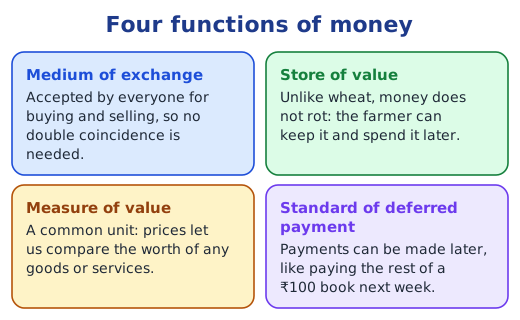
As more kinds of goods were traded over longer distances, people needed a common medium of exchange, and money came into existence. It also acts as a store of value, which can be saved, a common measure of value that lets us compare prices, and a standard of deferred payment, so that a payment can be made later. Read functions and forms of money.
The journey of money
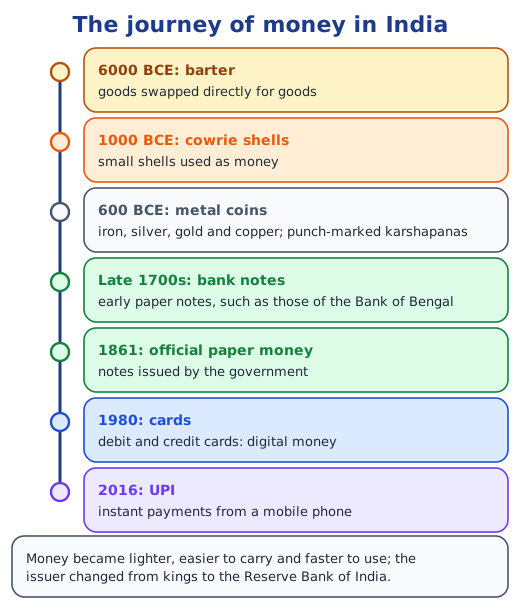
A broad timeline of money in India runs from barter around 6000 BCE to cowrie shells around 1000 BCE, metal coins around 600 BCE, official paper money in 1861, debit and credit cards from 1980, and UPI in 2016. Each step made money lighter, easier to carry and quicker to use.
Coins
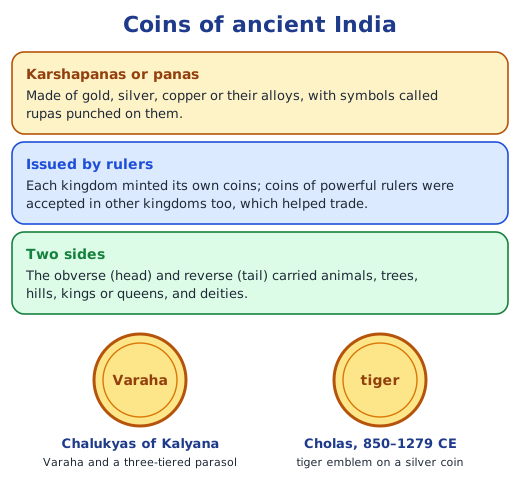
India’s ancient coins, called karshapanas or panas, were made of gold, silver, copper or their alloys and carried punched symbols called rupas. Rulers controlled minting, each kingdom had its own coins, and both sides of a coin bore motifs such as animals, trees, rulers and deities. Roman gold coins found in Tamil Nadu and Kerala show a sea trade that favoured India. Read coins of ancient India.
Paper and digital money
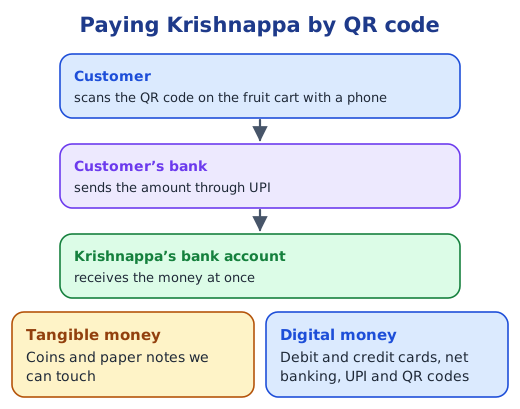
Carrying and storing large numbers of coins was hard, so paper money, first used in China, reached India in the late 18th century. Today the Reserve Bank of India controls the issue of currency. Money now also takes intangible, digital forms: Krishnappa, a fruit seller, displays a QR code that customers scan to pay straight into his bank account, and debit and credit cards, net banking and UPI work the same way.
Before we move on
Barter came before money, with many commodities used in exchange. Its limits led to money as a medium of exchange, and money has kept changing, from shells and coins to paper notes, and now to new ways of paying such as QR codes. Answers to every question are in the NCERT solutions for Chapter 11.
Key terms
| Term | Meaning |
|---|---|
| Barter system | A way of exchanging goods and services directly for other goods and services, without using money. |
| Money | The common tool that everyone accepts for making and receiving payments for goods and services. |
| Commodities | Goods that people trade, buy and sell, such as salt, tea or cloth. |
| Double coincidence of wants | A situation in which two people each have what the other wants and can swap directly; barter depends on it. |
| Common standard measure of value | An agreed worth that lets the value of different goods and services be compared; barter lacks one. |
| Divisibility, portability and durability | Whether a thing can be split into parts, carried from place to place, and stored for a long time without spoiling. |
| Medium of exchange | Something everyone accepts in payment, which makes buying and selling easy. |
| Standard of deferred payment | Money’s use for payments made later, such as paying the rest of a price next week. |
| Minting | Producing coins; a mint is the place where a nation’s coins are made. |
| Currency and denominations | A country’s system of money, such as Indian rupee coins and notes; denominations are its units, like ₹10 or ₹100. |
| Digital money | Money in electronic form, moved by debit and credit cards, net banking or UPI instead of coins and notes. |
Topics in this chapter
Practice
-
A system of exchanging goods without money is called:
Show answer
Answer: (b) Barter
-
The need for each person to want exactly what the other has is called:
Show answer
Answer: (b) Double coincidence of wants
-
Wheat that rots in storage shows which problem of barter?
Show answer
Answer: (b) Durability
-
Ancient Indian coins were called:
Show answer
Answer: (b) Karshapanas or panas
-
Which body controls the issue of currency in India today?
Show answer
Answer: (c) Reserve Bank of India
-
In which year was the ₹ symbol adopted?
Show answer
Answer: (c) 2010
Questions students ask
What are the main topics of Class 7 SST Chapter 11?
How people exchanged goods before money through barter, and the commodities they used; the problems of barter, such as the double coincidence of wants; barter that survives today; why money came into existence and its four functions; and the journey of money in India, from cowries and coins to paper notes and digital payments.
Is From Barter to Money in the new NCERT Class 7 Social Science book?
Yes. It is Chapter 11 of Exploring Society: India and Beyond, the Class 7 Social Science textbook Part 1 (Reprint 2026-27), on pages 229 to 246, in the theme Economic Life Around Us.
Why did money replace barter?
Because barter became too hard as the kinds of goods grew and trade spread over longer distances. Each exchange needed a double coincidence of wants, there was no common measure of value, and many goods could not be split, carried or stored. Money, accepted by everyone, solved these problems.
What are the functions of money?
Money is a medium of exchange that everyone accepts; a store of value that can be kept and used later; a common measure of value that lets us compare prices; and a standard of deferred payment, so that payments can be made later.
Stuck on a question?
Take a photo and Lagnever AI explains it step by step. Try it for 7 days for ₹2.
Get it on Google Play Open in browser
For parents: after the trial, the plan renews monthly by UPI or card autopay. You can cancel anytime in the app.