
The barter system
Answer in short
The barter system is the exchange of goods or services directly for other goods or services, without money. It was the earliest form of exchange, using things like cowrie shells, salt, cloth and cattle. But barter needs a double coincidence of wants and lacks a common measure of value, and goods may not be divisible, portable or durable.
Stuck on a question? Take a photo and Lagnever AI explains it step by step. Try it for 7 days for ₹2. Get it on Google Play
Exchange before money
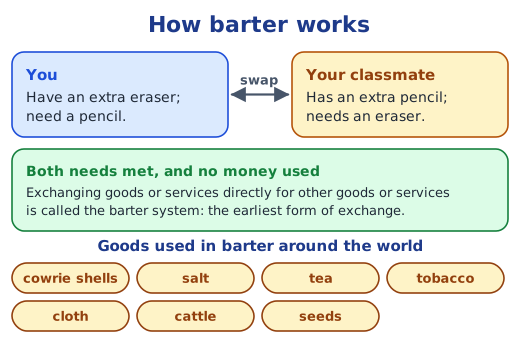
People have always needed things they could not make themselves. Before money, they traded goods or services for other goods or services, which is called the barter system. Suppose you have a spare eraser but no pencil, while a classmate has a spare pencil but forgot their eraser: a swap meets both needs. Barter was the earliest form of exchange, and evidence of it comes from all over the world. Today we buy and sell with coins and notes, and with mobile phones and computers.
What people used
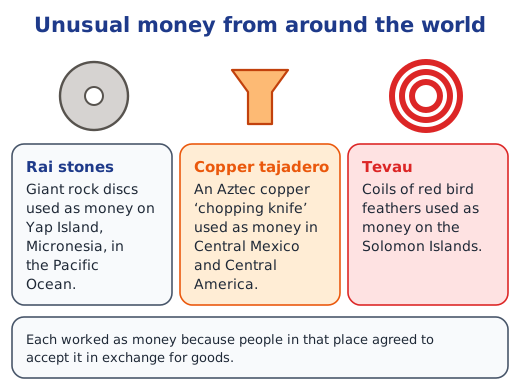
Many commodities, goods that people trade, buy and sell, served in exchange: salt, cloth, tea, tobacco, seeds, cowrie shells, and cattle such as cows, goats, horses and sheep. Some places had unusual money. On Yap Island in Micronesia, in the Pacific Ocean, people used huge rock discs known as Rai stones; the Aztecs used a copper tajadero, shaped like a chopping knife, in Central Mexico and parts of Central America; and on the Solomon Islands, coils of red bird feathers called tevau served as money.
The farmer and the ox
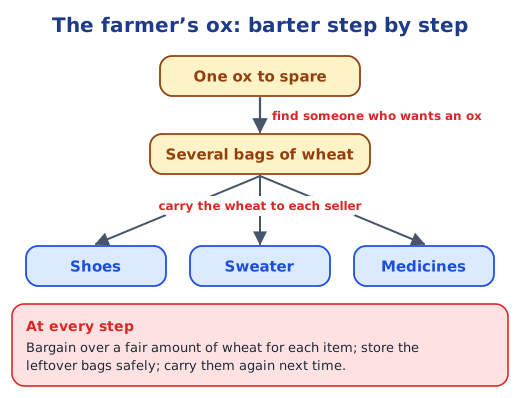
Imagine a farmer in a place where people barter. He needs new shoes, a sweater and medicines for his grandmother, but all he can spare is an ox. First he must find someone who wants an ox, and handing over a whole ox for one pair of shoes would hardly be fair. So he may swap the ox for several bags of wheat, haul the wheat from place to place, and bargain each time over how much wheat buys the shoes, the sweater or the medicines. Whatever wheat is left must be stored safely and carried along again the next time he needs something.
Five problems of barter
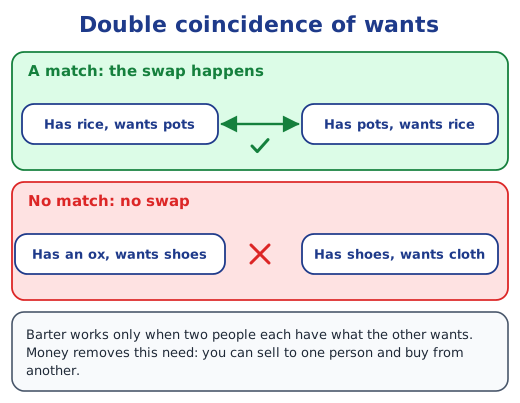
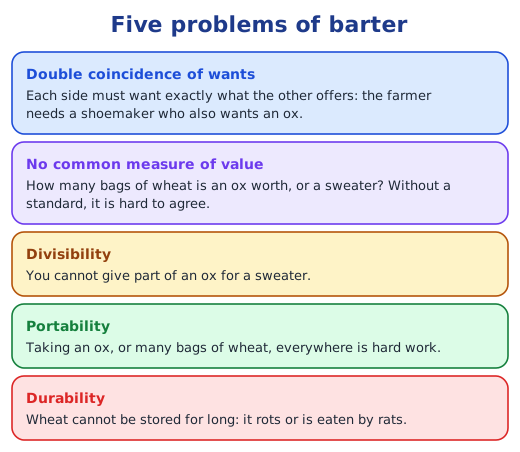
The story exposes barter’s weaknesses. The double coincidence of wants: each side must want exactly what the other offers, and a single person willing to give shoes, a sweater and medicines for an ox is almost impossible to find. No common standard measure of value: without an agreed worth it is hard to settle how many bags of wheat equal an ox, and if one side feels cheated, there is no deal. Divisibility: no one can give part of an ox for a sweater. Portability: leading an ox everywhere is a burden. Durability: wheat cannot be kept for long, because it rots or is eaten by rats.
Barter today
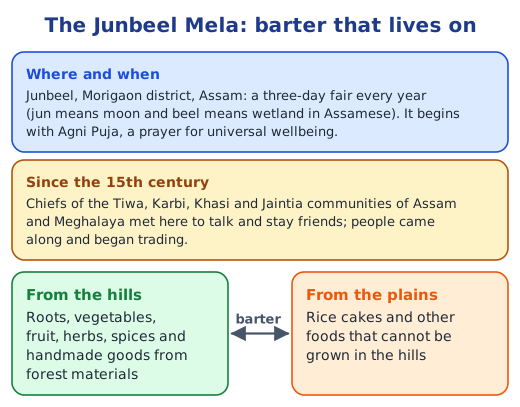
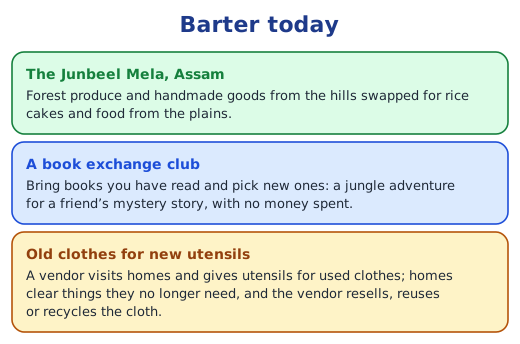
Money has replaced barter almost everywhere, but not completely. The Junbeel Mela at Junbeel in Morigaon district, Assam, whose name comes from the Assamese words for moon (jun) and wetland (beel), is a three-day yearly fair that opens with Agni Puja, a prayer for the wellbeing of all. From the 15th century, chiefs of the Tiwa, Karbi, Khasi and Jaintia communities of Assam and Meghalaya met there to discuss political matters and keep friendly ties; people gathered around them, and the meeting grew into a fair. Bartering starts early in the morning, with roots, vegetables, fruit, herbs, spices and handmade goods from the hills swapped for rice cakes and other food from the plains.
Book exchange clubs, where readers trade books they have finished for new ones, are another kind of barter. So is the old custom of a vendor going from house to house giving new utensils for used clothes: households clear out things they no longer need, and the vendor resells, reuses or recycles the cloth.
Why it matters
Understanding barter shows why money is so useful: it removes the need for a perfect match, sets prices, and lets us divide, carry and save value. How money does this is in functions and forms of money, and India’s early coins in coins of ancient India. Answers to every question are in the NCERT solutions for Chapter 11; see also the full Chapter 11 notes.
Practice
-
Which of these is NOT named in the chapter as a commodity used in exchange?
Show answer
Answer: (c) Plastic cards
-
Rai stones were used as money on:
Show answer
Answer: (b) Yap Island in Micronesia
-
The Junbeel Mela is held in which state?
Show answer
Answer: (b) Assam
-
What is the double coincidence of wants?
Show answer
Answer: A situation in which two people each have exactly what the other wants, so they can swap directly. Barter depends on it, and such matches are hard to find.
-
Why is wheat a poor thing to save for future exchanges?
Show answer
Answer: It is not durable: stored wheat can rot or be eaten by rats, so its value is lost before it can be used.
Questions students ask
What is the barter system?
It is a way of exchanging goods and services directly for other goods and services, without using money. If you have an extra eraser and need a pencil, and a classmate has an extra pencil and needs an eraser, swapping them is barter. It was the earliest form of exchange.
What are the limitations of the barter system?
It needs a double coincidence of wants; no agreed common measure of value exists to settle fair amounts; many goods cannot be divided into parts; carrying goods such as cattle or grain around is hard; and goods such as wheat cannot be stored for long.
Where is barter still practised today?
At the Junbeel Mela in Morigaon district, Assam, a three-day annual fair where hill communities swap produce and handmade goods for rice cakes and food from the plains; in book exchange clubs; and when vendors give new utensils for old clothes.
Stuck on a question?
Take a photo and Lagnever AI explains it step by step. Try it for 7 days for ₹2.
Get it on Google Play Open in browser
For parents: after the trial, the plan renews monthly by UPI or card autopay. You can cancel anytime in the app.