
Coins of ancient India
Answer in short
Coins were among India’s earliest forms of money. Ancient coins, called karshapanas or panas, were made of gold, silver, copper or their alloys and had symbols called rupas punched on them. Rulers controlled their minting, and both sides carried motifs such as animals, trees, rulers and deities. Roman gold coins found in south India reveal a thriving sea trade.
Stuck on a question? Take a photo and Lagnever AI explains it step by step. Try it for 7 days for ₹2. Get it on Google Play
The first coins
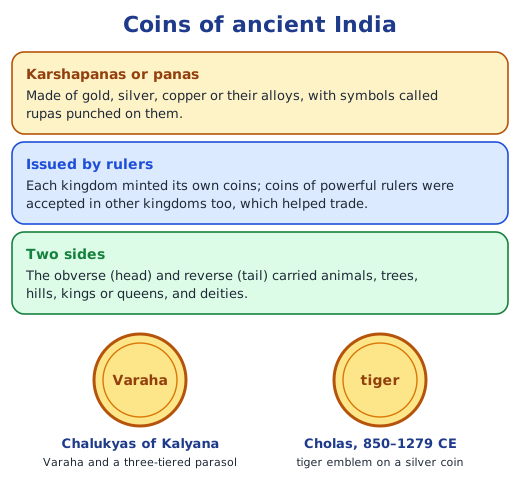
The timeline of money in India shows that coins were among its earliest forms, from around 600 BCE. In those days rulers issued coins for the people of their kingdoms, so each kingdom had its own coinage, and the ruler alone controlled minting, the making of coins. Over time, coins issued by strong rulers began to be used in other kingdoms too, which made trade across regions easier.
Karshapanas and panas
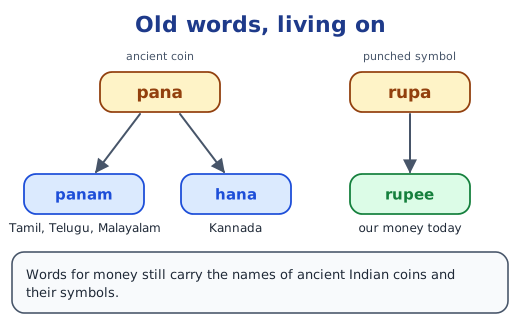
The coins were made of precious metals such as gold, silver and copper, or of their alloys, metals made by mixing two or more metals, which makes coins stronger. They were called karshapanas or panas, and they had symbols punched on them called rupas, a word that sounds like our rupee. Forms of the word pana still mean money: panam in Tamil, Telugu and Malayalam, and hana in Kannada. Ancient coins were often alloys of silver and copper; today’s coins are alloys made largely of iron, with chromium, silicon and carbon mixed in exact amounts.
Heads and tails
Every coin has two sides: the obverse, or head, which bears the main design, and the reverse, or tail. Ancient Indian coins showed animals, trees and hills, kings or queens, and deities. Coins of the Chalukyas of Kalyana, for example, show Varaha, an avatar of Vishnu, on one side and a decorated three-tiered parasol on the other, while a silver coin of the Cholas, who ruled from 850 to 1279 CE, carries their tiger emblem.
Roman gold in the south
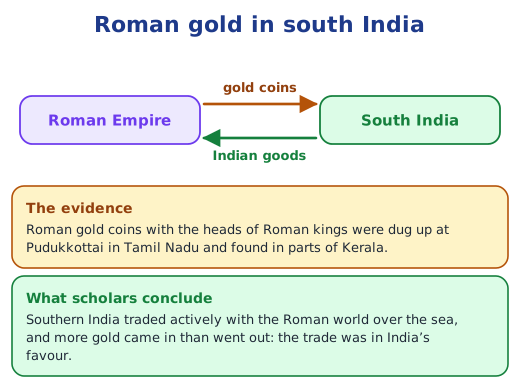
Coins also reveal trade. Gold coins bearing the heads of Roman kings have been excavated at Pudukkottai in Tamil Nadu, and Roman coins have turned up in parts of Kerala too. They show that southern India traded busily with the wider world by sea, and because so much gold came in, scholars conclude that the trade was in India’s favour. The use of coinage itself helped India’s sea trade grow.
Annas, paise and the rupee sign
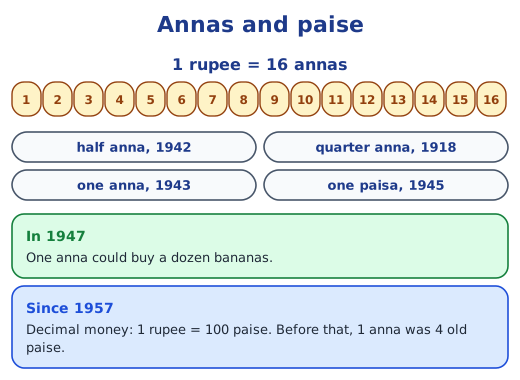
Not long ago, a rupee was divided into 16 annas, and a dozen bananas cost just one anna in 1947. The book shows a half anna of 1942, a quarter anna of 1918, a one-anna coin of 1943 and a one-paisa coin of 1945. In 1957 India moved to decimal money, with 100 paise to the rupee. Today’s coins come in different sizes for different denominations, with both Hindi and English on each, and special coins mark important national events, such as 75 years of independence.
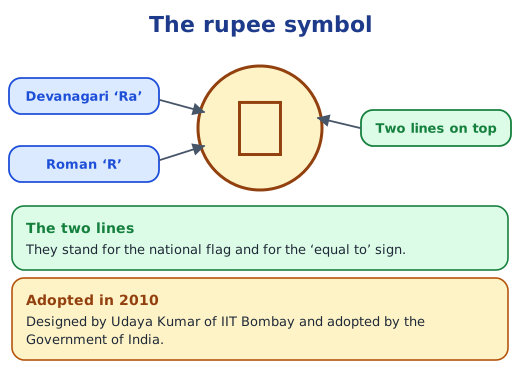
The Government of India adopted the ₹ symbol in 2010. Designed by Udaya Kumar of IIT Bombay, it blends the Devanagari ‘Ra’ with the Roman ‘R’, and its two lines on top stand for the national flag and the ‘equal to’ sign.
Why it matters
Coins are small, but they record who ruled, what people believed and whom they traded with, so historians read them like documents. You can start a small collection by gathering old coins from family and neighbours and noting each one’s metal, year and designs. How coins fit into the larger story of money is in functions and forms of money, and barter in the barter system. Answers to every question are in the NCERT solutions for Chapter 11; see also the full Chapter 11 notes.
Practice
-
What were the symbols punched on ancient Indian coins called?
Show answer
Answer: (b) Rupas
-
Which emblem appears on the Chola silver coin in the chapter?
Show answer
Answer: (b) Tiger
-
How many annas made one rupee?
Show answer
Answer: (c) 16
-
What does the find of Roman gold coins at Pudukkottai tell us?
Show answer
Answer: That southern India traded with the Roman world by sea, and that Roman gold flowed into India in return for Indian goods, so the trade was in India’s favour.
-
Describe the rupee symbol.
Show answer
Answer: Adopted in 2010 and designed by Udaya Kumar of IIT Bombay, it combines the Devanagari letter ‘Ra’ with the Roman letter ‘R’, topped by two lines that stand for the national flag and the ‘equal to’ sign.
Questions students ask
What were the features of ancient Indian coins?
They were called karshapanas or panas and were made of gold, silver, copper or their alloys. Symbols called rupas were punched on them. Rulers controlled their minting and issue, and the obverse and reverse carried motifs such as animals, trees, hills, kings or queens, and deities.
Why have Roman coins been found in India?
Southern India traded with the Roman world over the sea. Roman gold coins bearing the heads of Roman kings have been dug up at Pudukkottai in Tamil Nadu and found in parts of Kerala, and scholars conclude from them that the trade was in India’s favour.
Which modern words come from the names of ancient coins?
The ancient coin pana lives on as panam in Tamil, Telugu and Malayalam and as hana in Kannada, all meaning money. The chapter also points out that the symbols punched on ancient coins were called rupas, a word that sounds like our rupee.
Stuck on a question?
Take a photo and Lagnever AI explains it step by step. Try it for 7 days for ₹2.
Get it on Google Play Open in browser
For parents: after the trial, the plan renews monthly by UPI or card autopay. You can cancel anytime in the app.