
NCERT Solutions Class 7 Social Science Chapter 11: From Barter to Money
Answers to every question in Chapter 11, From Barter to Money, of Exploring Society: India and Beyond, the Class 7 Social Science textbook Part 1 (Reprint 2026-27): the Big Questions, the opening question, all seven Let’s Explore activities, all four Think About It boxes with the other questions in the text, and all nine Questions and activities. Page numbers follow the book (pages 229–246). Short notes: Chapter 11 notes.
The Big Questions (page 229)
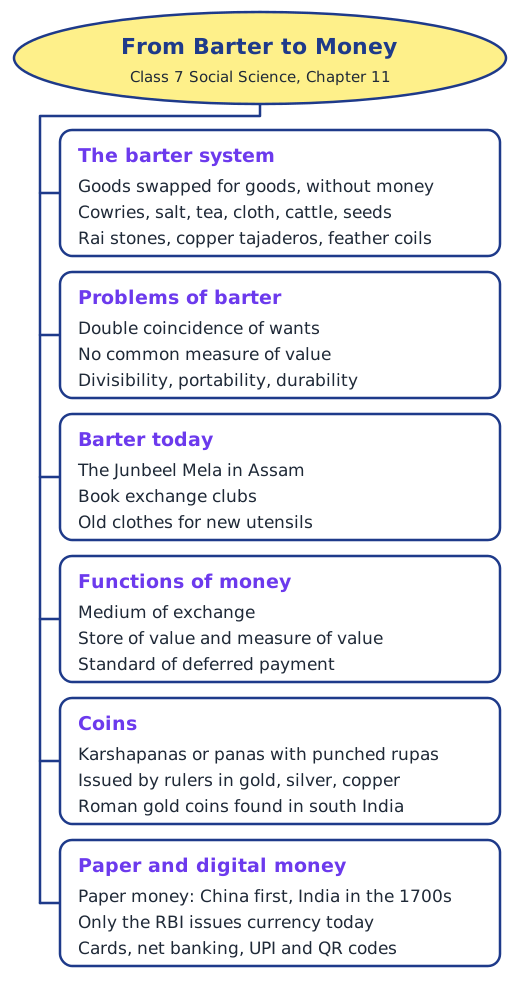
1. How did exchange take place before money? Through barter: people swapped goods or services directly for other goods or services, using commodities such as salt, cloth, tea, tobacco, seeds, cattle and cowrie shells.
2. Why did money come into existence? Barter was hard: it needed a double coincidence of wants, had no common measure of value, and many goods could not be divided, carried or stored. As trade grew in variety and distance, people needed a common medium of exchange that everyone accepted.
3. How has money transformed over time? From goods and cowrie shells to metal coins, then paper notes, then debit and credit cards, and now digital payments such as UPI and QR codes, becoming lighter, easier to carry and faster to use.
Opening question: how did people exchange grain or carnelian beads? By barter, swapping grain for beads, cloth, tools or other goods they needed, and by using commodities such as cowrie shells that many people accepted.
Let’s Explore (page 231)
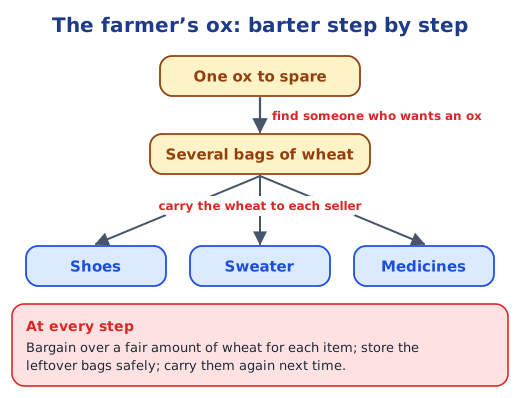
Exchanging the ox. The farmer would first have to find someone who wanted an ox. An ox is worth far more than a pair of shoes, so he would need a chain of exchanges, such as the ox for bags of wheat, and then the wheat for each item. The difficulties: finding willing partners, carrying heavy wheat to many places, bargaining over a fair amount every time, and storing the leftover wheat and carrying it again later.
Think About It (pages 232–233)
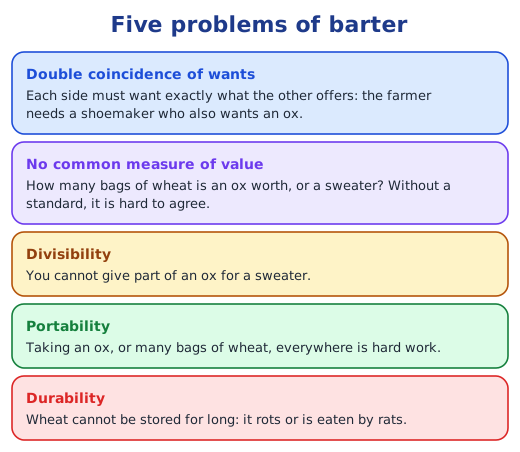
Types of difficulties: finding a partner who wants what you have (double coincidence of wants); agreeing on fair amounts (no common measure of value); being unable to split the ox (divisibility); carrying the ox and the wheat (portability); storing wheat without it spoiling (durability); and the time and effort of many trips.
One person offering shoes, a sweater and medicines for the ox? Very unlikely: that person would need to have all three things and also want an ox at that moment.
Instances of double coincidence of wants: the farmer needs a person who wants an ox and has wheat; then a shoemaker, a sweater seller and a medicine seller who each want wheat. Lack of a common measure of value: deciding how many bags of wheat an ox is worth, and how much wheat equals a pair of shoes, a sweater or the medicines.
Think About It (page 234)
How money helps the farmer: he can sell the ox once, to anyone who needs it, for money; pay each seller the exact price; compare prices easily; carry money without effort; and save what is left without it spoiling.
Let’s Explore (page 236)
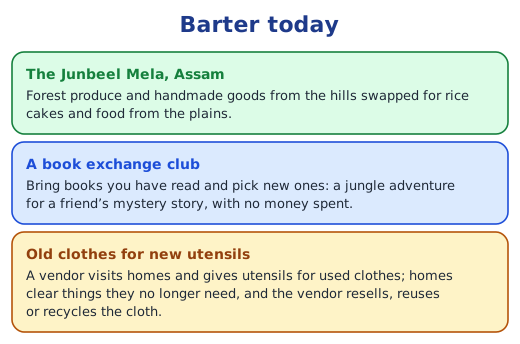
Barter around us (sample). Vendors who give steel utensils for old clothes; children passing on old textbooks in exchange for other books; neighbours swapping vegetables from their kitchen gardens; and, in some villages, grain given to a barber or carpenter at harvest in return for their work through the year. People usually feel both sides gain and things get reused, but they must bargain over fair amounts, and sometimes one side feels the swap was unequal.
Think About It (page 237)
A ₹100 book with ₹50 in your pocket. You could borrow the rest from a friend or family member, ask a parent to pay the rest digitally, ask the shopkeeper to keep the book until you return with the money, or look for a cheaper second-hand copy. If the shopkeeper knows and trusts you, you could pay ₹50 now and the rest later; that uses money as a standard of deferred payment.
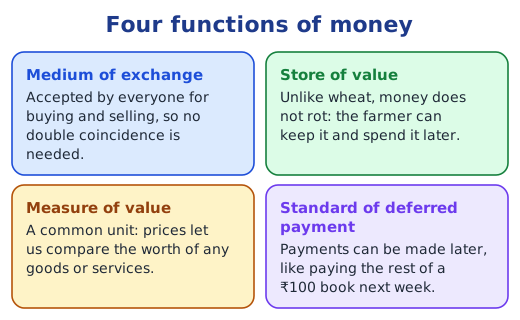
Let’s Explore (page 238): the timeline
Changes in money: it moved from goods (barter) to shells, then metal coins, paper notes, plastic cards and finally digital payments on a phone. It became lighter and easier to carry, harder to forge, faster to use and less tangible, and the power to issue it passed from rulers to the Reserve Bank of India.
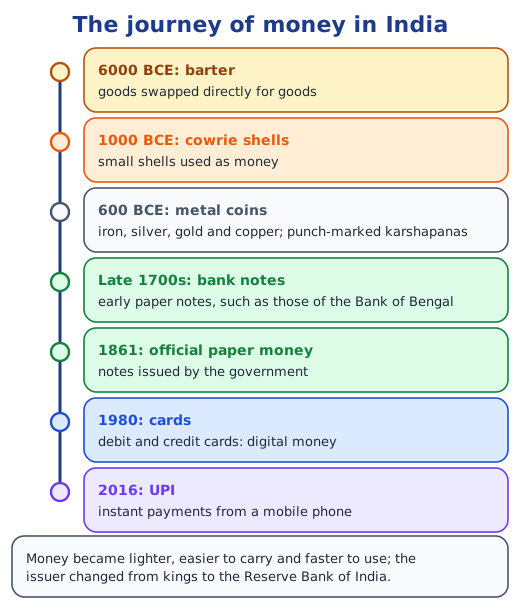
Page 239: does this word sound familiar?
Rupa sounds like rupee, the word for our money today. Variations of pana survive too: panam in Tamil, Telugu and Malayalam, and hana in Kannada.
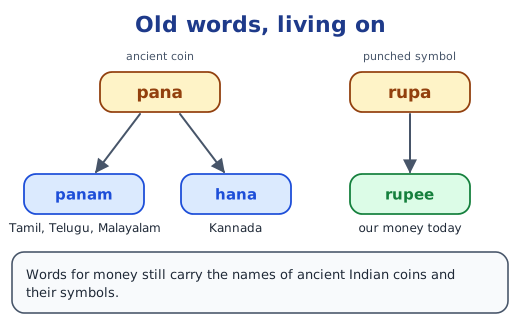
Let’s Explore (page 239): Roman coins in Pudukkottai
Conclusions: southern India traded with the Roman world by sea; Roman merchants paid in gold for Indian goods; the gold coins were valued for their metal, whoever’s head they bore; and since gold flowed into India, the trade was in India’s favour.
Let’s Explore (page 241): collecting old coins
A plan for the group project. Make a table with columns for the coin’s value, metal, year, obverse and reverse. Observations might include: older coins are often heavier, and a ₹1 coin from before the early 1990s may be cupro-nickel, while later ones are steel; coins from 2011 on carry the ₹ symbol; the Lion Capital of Ashoka appears on many coins; and some coins mark special events. Guesses, such as why metals or sizes changed, can be checked on the RBI website, in coin catalogues, at a museum or with elders who used the coins.
Let’s Explore (page 241): paper money
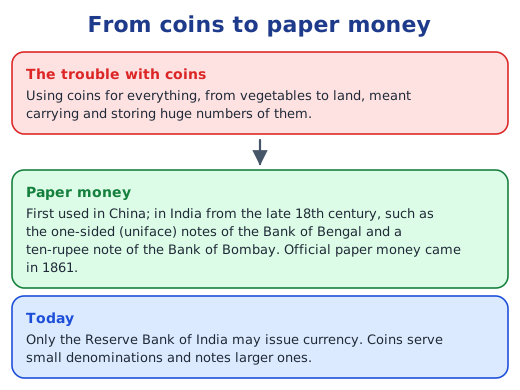
Problems with coins for every exchange: carrying sacks of coins for large purchases such as land; finding safe places to store them; the time needed to count them; the risk of theft on the road; and the amount of metal needed to make so many coins.
Let’s Explore (page 242)
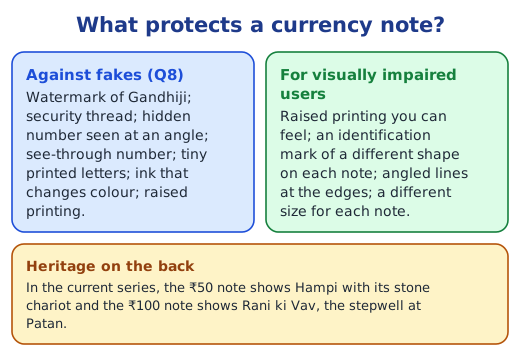
Heritage motifs: in the current series, the ₹50 note shows Hampi with its stone chariot (Karnataka) and the ₹100 note shows Rani ki Vav, the stepwell at Patan (Gujarat). Features for visually impaired persons: raised (intaglio) printing of Gandhiji’s portrait and the Ashoka Pillar emblem; an identification mark of a different shape for each denomination, such as a raised triangle on the ₹100 note; angled lines at the edges (four on each side of the ₹100 note); and a different size for each denomination. The RBI’s MANI app can also identify notes using a phone camera.
Questions and activities (pages 244–245)
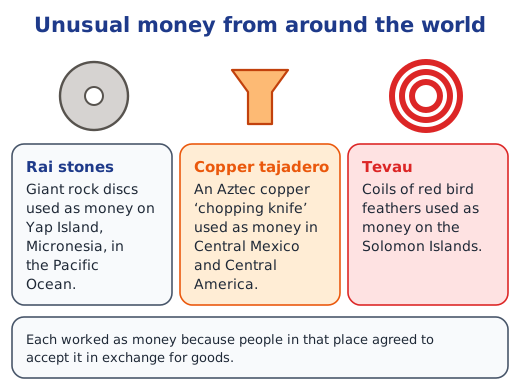
1. In barter, people exchange goods or services directly for other goods or services, without money, like swapping a spare eraser for a spare pencil. Commodities used included salt, cloth, tea, tobacco, seeds, cowrie shells and cattle such as cows, goats, horses and sheep; elsewhere, Rai stones (Yap), copper tajaderos (Aztecs) and feather coils (Solomon Islands) served as money.
2. The need for a double coincidence of wants; no common standard measure of value; the problem of divisibility (goods like an ox cannot be split); portability (goods are hard to carry); durability (goods like wheat spoil in storage); and no easy way to pay later.
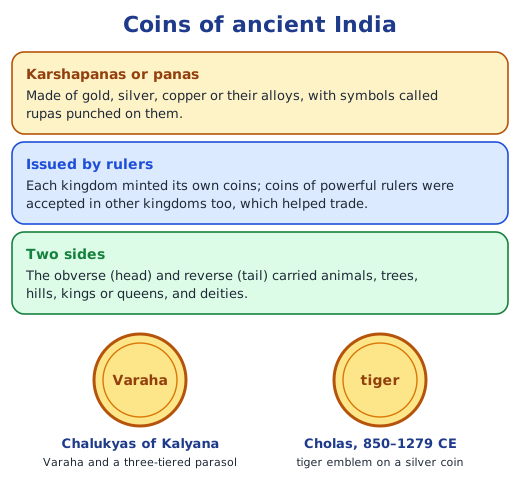
3. They were called karshapanas or panas and were made of gold, silver, copper or their alloys; symbols called rupas were punched on them; rulers controlled their minting, so each kingdom had its own coins, though those of powerful rulers were accepted widely; and their obverse and reverse carried motifs such as animals, trees, hills, kings or queens and deities, like the Chalukya Varaha and parasol and the Chola tiger.
4. From direct barter (around 6000 BCE) to commodity money such as cowrie shells (around 1000 BCE); then metal coins (around 600 BCE); paper notes from banks in the late 18th century and official paper money from 1861; debit and credit cards from 1980; and digital payments such as net banking, UPI (2016) and QR codes. Each form was easier to carry, store and use than the one before.
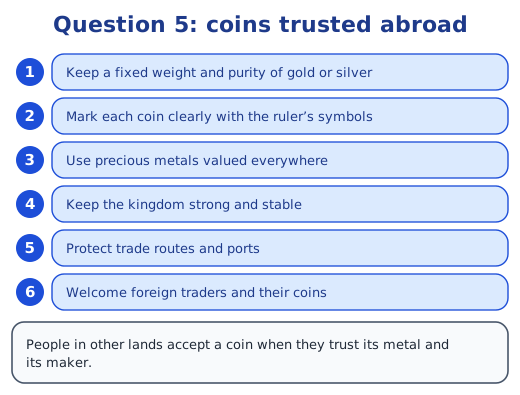
5. Rulers could keep a fixed weight and purity of metal in each coin; stamp clear marks showing who issued it, so traders trusted its value; use gold and silver, which were valued everywhere; keep their kingdoms strong and stable; protect trade routes and ports; and welcome foreign traders, accepting their coins too, as Roman coins in south India show.
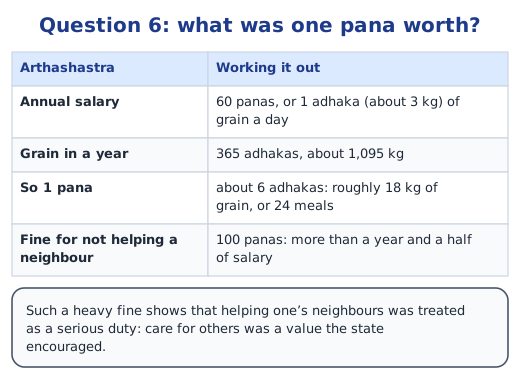
6. A salary of 60 panas a year equals one adhaka (about 3 kg) of grain a day, or 365 adhakas (about 1,095 kg) a year. So one pana was worth about 6 adhakas, roughly 18 kg of grain or 24 meals: a pana had real buying power. The fine of 100 panas for failing to help a neighbour was more than a year and a half of such a salary, which shows that helping neighbours was treated as a serious duty and that care for others was a value the state encouraged.
7. A sample skit. A village market. A farmer with rice wants a pot; the potter wants fish, not rice; the fisher wants cloth. Everyone is stuck. An old trader holds up a handful of cowrie shells: “These are small, last for years, are hard to fake and easy to count. Sell your rice for shells, and buy the pot with them.” The potter agrees to take shells because the fisher will take them too. Soon everyone fixes prices in shells, and the market runs smoothly.
8. Features include a watermark of Gandhiji’s portrait and the denomination; a security thread that changes colour when the note is tilted; a hidden (latent) image of the denomination seen at an angle; a see-through register where the numeral lines up when held to light; tiny printed letters (micro-lettering); colour-changing ink on the numeral; raised (intaglio) printing; and number panels whose digits grow in size. Making or using fake notes is a crime.
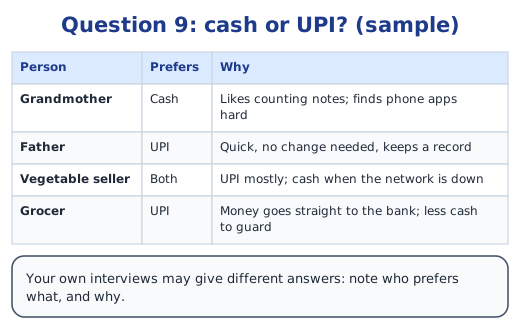
9. A sample survey. A grandmother prefers cash because she likes counting notes and finds phone apps hard; a father prefers UPI because it is quick, needs no change and keeps a record; a vegetable seller uses both, UPI mostly and cash when the network is down; and a grocer prefers UPI because money goes straight to the bank. Your own interviews may differ: note who prefers what, and why.
Short notes and more practice are on the topic pages: the barter system, functions and forms of money and coins of ancient India.
Practice
-
Which coin was one-sixteenth of a rupee?
Show answer
Answer: (b) Anna
-
Roman gold coins were excavated at Pudukkottai in:
Show answer
Answer: (b) Tamil Nadu
-
The Junbeel Mela begins with:
Show answer
Answer: (a) Agni Puja
-
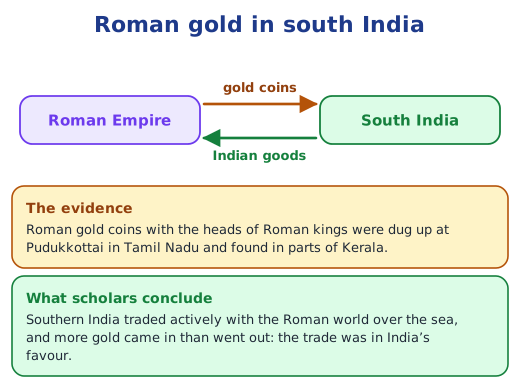
Why is money called a store of value?
Show answer
Answer: Because it can be kept for a long time without spoiling and used to buy things later, unlike stored grain, which can rot.
-
What does a QR code on a fruit cart allow?
Show answer
Answer: Customers can scan it with a mobile phone and pay digitally, and the money goes directly into the seller’s bank account.
Stuck on a question?
Take a photo and Lagnever AI explains it step by step. Try it for 7 days for ₹2.
Get it on Google Play Open in browser
For parents: after the trial, the plan renews monthly by UPI or card autopay. You can cancel anytime in the app.