
Functions and forms of money
Answer in short
Money is a medium of exchange that everyone accepts, a store of value for later, a common measure of value that lets us compare prices, and a standard of deferred payment. Its form has changed over time: from cowrie shells and metal coins to paper notes, now issued under the RBI, and digital money such as cards and UPI.
Stuck on a question? Take a photo and Lagnever AI explains it step by step. Try it for 7 days for ₹2. Get it on Google Play
Why money came
There is a saying that necessity is the mother of invention. As people exchanged more kinds of goods, and over longer distances, barter could not keep up, and a common medium of exchange became necessary. That is how money was born, and as its use for buying and selling spread, it became the accepted way of paying.
Four functions of money
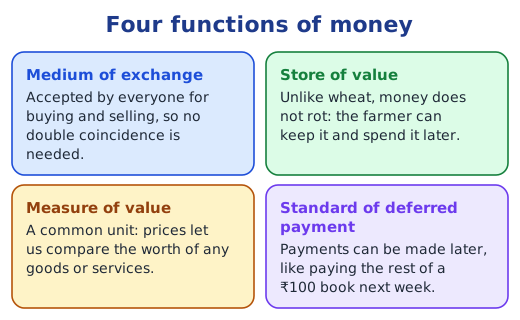
Money does four jobs. It is a medium of exchange, accepted by everyone, so no one has to find a person who wants exactly what they have. It is a store of value: a farmer who sells his ox for money can keep the money and buy things later, whereas wheat would rot. It is a common measure of value, a common denomination, since prices let us compare the worth of goods and services. And it is a standard of deferred payment: if a book costs ₹100 and you have only ₹50, the shopkeeper may agree to let you pay the rest later, because both of you know exactly how much is owed.
Money keeps moving
Money passes from hand to hand. Parents pay shopkeepers for the products they buy; shopkeepers pay salaries to their workers; and the workers use the same money to buy everyday essentials and pay their children’s school fees. One person’s spending becomes another person’s income.
The journey of money
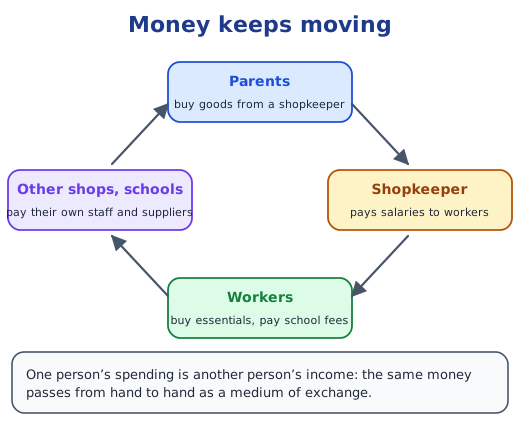
Fig. 11.10 gives a broad timeline for India: barter from about 6000 BCE, cowrie shells from about 1000 BCE, metal coins of iron, silver, gold and copper from about 600 BCE, official paper money in 1861, debit and credit cards from 1980, and UPI in 2016. At every step money became lighter, easier to carry and quicker to use. Early coins were issued by rulers, and India’s first coins are described in coins of ancient India.
Paper money
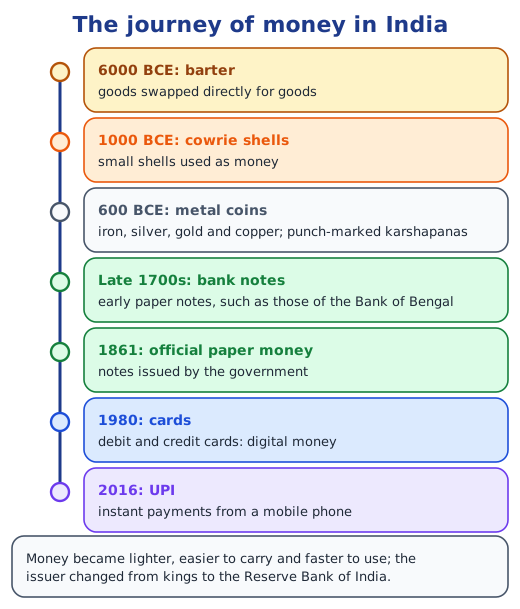
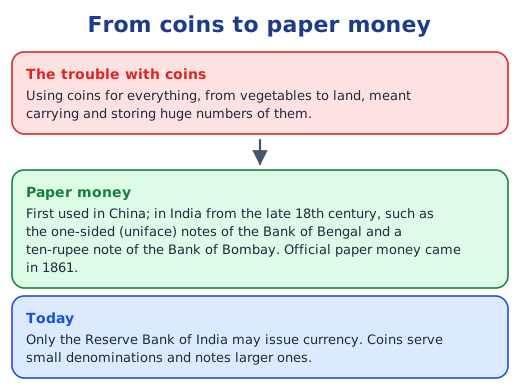
When coins were used for everything, from vegetables to land, carrying and storing large numbers of them became a problem. Paper money, first used in China, solved it, and it reached India in the late 18th century; early examples include one-sided (uniface) notes of the Bank of Bengal and a ten-rupee note of the Bank of Bombay. Today the Reserve Bank of India controls the issue of currency, and no one else may legally issue it. Coins serve the smaller denominations and notes the larger ones.
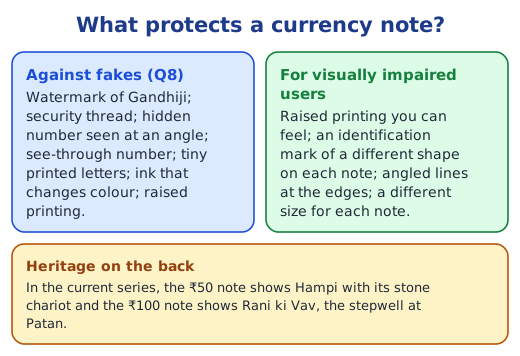
Notes are designed to be hard to copy, with a watermark, a security thread, colour-changing ink and other features, and they carry raised marks that help visually impaired people identify them. Their backs show India’s heritage: in the current series, Hampi’s stone chariot is on the ₹50 note and Rani ki Vav, the stepwell at Patan, is on the ₹100 note.
Digital money
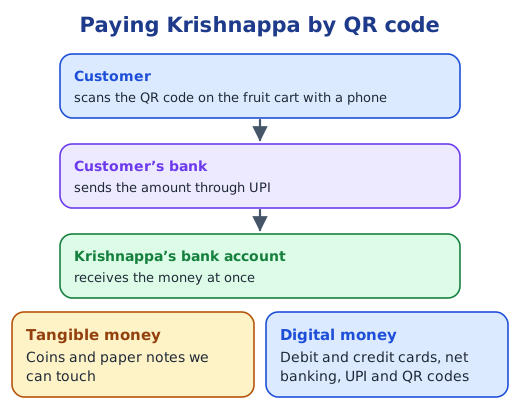
Money has also taken forms we cannot touch. Krishnappa sells seasonal fruit from a cart that displays a small card with a QR code; customers scan it with their phones and pay, and the money goes straight into his bank account. Such digital money exists in electronic form. Debit cards, credit cards, net banking and UPI (Unified Payments Interface) all move money directly from one person’s bank account to another’s.
Why it matters
Knowing what money does helps us use it well: to save, compare prices and pay on time, and to choose sensibly between cash and digital payments. Barter, which money replaced, is in the barter system. Answers to every question are in the NCERT solutions for Chapter 11; see also the full Chapter 11 notes.
Practice
-
When a shopkeeper lets you pay the rest of a book’s price next week, money acts as a:
Show answer
Answer: (c) Standard of deferred payment
-
Paper money was first used in:
Show answer
Answer: (b) China
-
UPI stands for:
Show answer
Answer: (b) Unified Payments Interface
-
How does money act as a store of value?
Show answer
Answer: Unlike wheat, which rots, money can be kept for a long time and used to buy things later, so the value of today’s sale is saved for the future.
-
Why did paper money replace coins for large payments?
Show answer
Answer: Carrying and storing a large number of coins was difficult, especially for big purchases such as land, while notes are light and easy to carry and store.
Questions students ask
What are the four functions of money?
Money is a medium of exchange accepted by everyone; a store of value that can be kept and used later; a common measure of value, since prices let us compare goods and services; and a standard of deferred payment, because people accept it for payments made later.
How has money changed over time in India?
From barter (around 6000 BCE) to cowrie shells (around 1000 BCE) and metal coins (around 600 BCE), then paper notes issued by banks in the late 18th century and official paper money from 1861, then debit and credit cards from 1980, and UPI from 2016.
Who issues currency in India?
The Reserve Bank of India (RBI) controls the issue of currency, and no one else may legally issue it; coins and one-rupee notes are made by the Government of India and put into circulation through the RBI. In ancient times, by contrast, each ruler issued the coins of their own kingdom.
Stuck on a question?
Take a photo and Lagnever AI explains it step by step. Try it for 7 days for ₹2.
Get it on Google Play Open in browser
For parents: after the trial, the plan renews monthly by UPI or card autopay. You can cancel anytime in the app.