
Class 7 Social Science Chapter 3: Climates of India Notes
This chapter in five lines
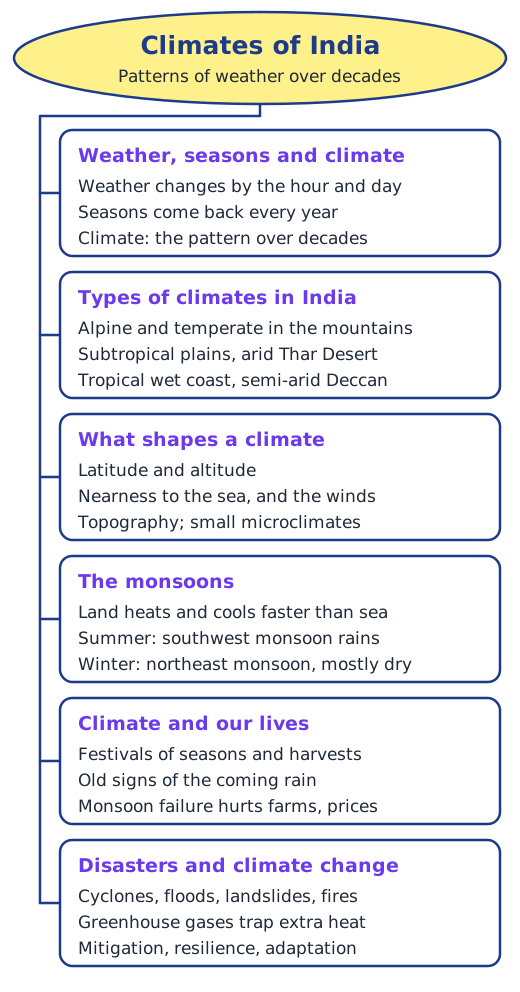
Climates of India explains how the long-term pattern of weather differs across India, from the alpine Himalayas to the arid Thar Desert and the tropical wet western coast. Latitude, altitude, nearness to the sea, winds and topography shape each climate. Monsoon winds, which reverse with the seasons, bring most of the rain. The chapter also covers climate disasters and climate change.
What is this chapter about?
The chapter opens with an old Sanskrit verse, a subhashita, that prays for timely rain and an Earth rich with crops. Rain at the right time has always mattered in India. The chapter explains what climate is, why India has so many climates, how the monsoon works, how climate shapes our lives, and how disasters and climate change are linked to it.
Weather, seasons and climate
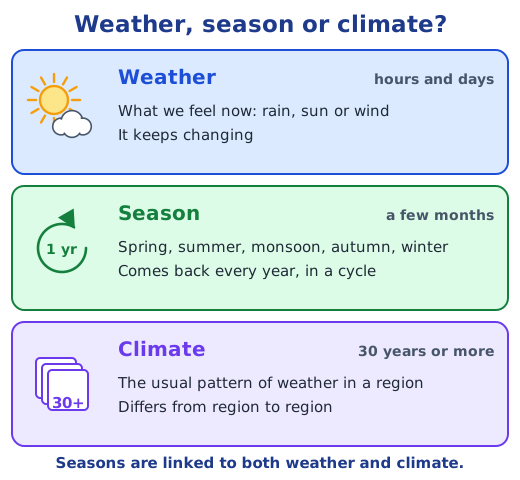
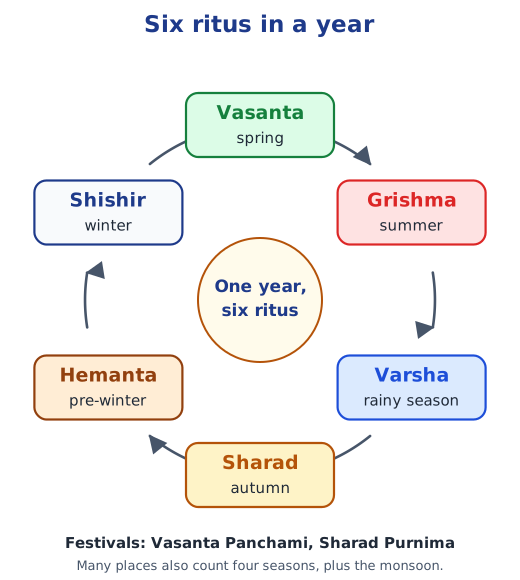
People often say climate when they mean weather. Weather is what we feel from one hour or day to the next, and it keeps changing. Climate is the pattern of weather a region has over a long time, several decades at least, and it differs from region to region. Seasons sit in between: each lasts a few months and recurs every year, so they are linked to both. Across most of the world there are four main seasons, but India also has a rainy season, the monsoon. Traditionally the year has six ritus: vasanta (spring), grishma (summer), varsha (rainy season), sharad (autumn), hemanta (pre-winter) and shishir (winter), with festivals such as Vasanta Panchami and Sharad Purnima. Crops, food, clothes, flowering trees and even animal fur change with them.
Types of climates in India
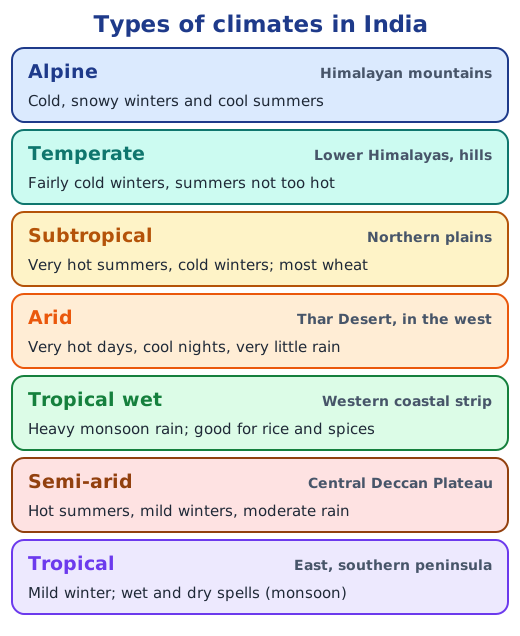
India’s climate is as diverse as its land. The high Himalayas are alpine: winters there are cold and snowy, summers cool, while the lower Himalayas and other hills are temperate, which is why hill stations draw people escaping the heat. The northern plains are subtropical, with scorching summers and cold winters, and grow most of India’s wheat. The Thar Desert is arid: very hot days, cool nights and little rain. The western coastal strip is tropical wet, good for rice and spices; the Deccan Plateau is semi-arid; and eastern India and the southern peninsula are tropical, with wet and dry periods set by the monsoon winds.
What shapes a climate
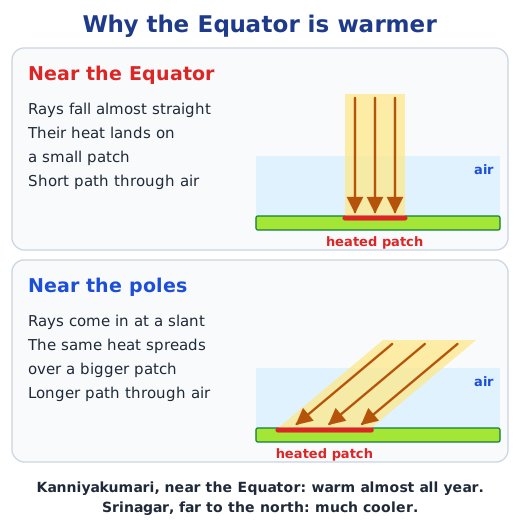
Five factors work together. Latitude: near the Equator the Sun’s rays fall almost straight and concentrate their heat, so Kanniyakumari is warm all year while Srinagar is much cooler. Altitude: the air cools as height rises. Nearness to the sea: the sea moderates temperature, so coastal places have mild summers and winters. Winds carry heat, cold or moisture. Topography: mountains block or lift winds. A small area can even have its own microclimate, like a city that traps heat. Read more in factors that shape climate.
The monsoons
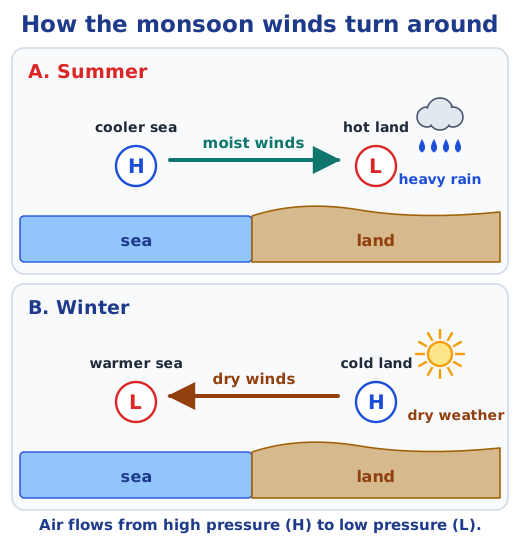
The word monsoon comes from the Arabic mausim, season. In summer the Asian landmass heats up faster than the ocean, a low-pressure area forms over it, and moist winds blow in from the sea and drop heavy rain. In winter the land cools faster and the winds reverse. The southwest monsoon reaches India’s southern tip at the start of June and covers the whole country by mid-July, soaking the western slopes of the Western Ghats. The northeast monsoon of winter is mostly dry, but brings rain to parts of east and south India. Mawsynram in Meghalaya gets about 11,000 mm of rain a year, more on average than anywhere else on Earth. Read the monsoons.
Climate and our lives
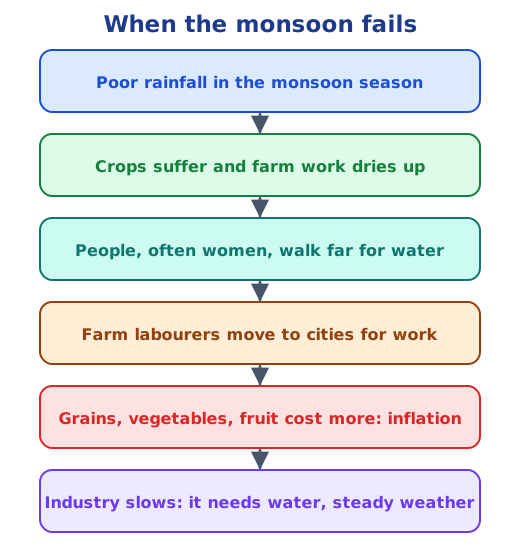
Many festivals, from Baisakhi and Onam to Bihu and Pongal, follow the seasons and the harvest, and ragas such as Meghamalhar celebrate the rains. People have long read nature’s signs: Konkan fishermen expect the monsoon when fish rise to the surface. The climate also drives the economy. When the monsoon fails, crops suffer, water runs short, labourers move to cities and food prices rise.
Climates and disasters
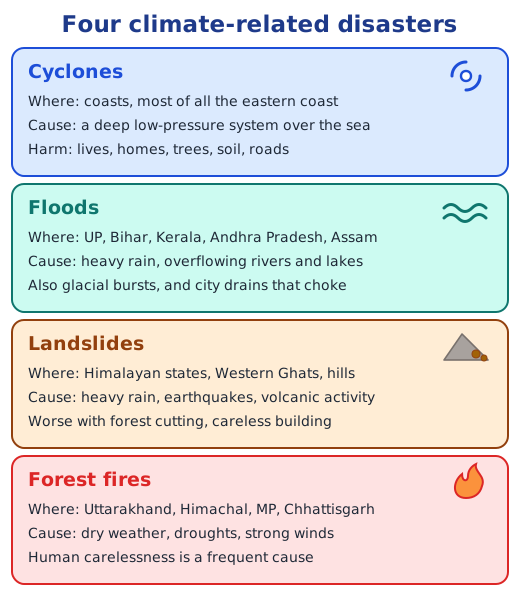
India’s weather can turn extreme. Cyclones strike the coasts, especially the eastern coast; floods hit Assam, Bihar, Uttar Pradesh, Kerala and Andhra Pradesh, and glacial bursts strike the Himalayas; landslides are common in the hills during the monsoon; and forest fires spread in dry, windy weather. Human actions, such as cutting forests and building carelessly, often make them worse. Read climate disasters and climate change.
Climate change
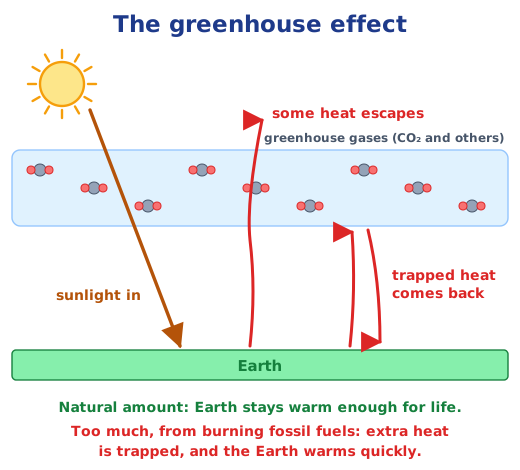
Climate change means significant, long-term changes in temperature, rainfall and weather events. In the distant past natural processes drove it, but since the 19th century human activities, above all burning fossil fuels, have released large amounts of greenhouse gases that trap extra heat and cause rapid global warming. Early in 2025, India was 1 to 3°C warmer than normal, which cut the winter short and kept it mild. Governments promote mitigation, such as cutting emissions, planting trees and using renewable energy, and communities build resilience.
Before we move on
India’s climate is shaped by its geography, the monsoon is vital to farming and livelihoods, and understanding climate helps us prepare for disasters and a warming world. Answers to the Big Questions, every Let’s Explore and all seven questions and activities are in the NCERT solutions for Chapter 3.
Key terms
| Term | Meaning |
|---|---|
| Weather | What we experience from hour to hour or day to day: rain, bright sunshine, wind, heat or dryness. It keeps changing. |
| Climate | The pattern of weather a region experiences over a long period, at least several decades; it is usually described over 30 years or more. |
| Ritus | The six traditional seasons of India: vasanta (spring), grishma (summer), varsha (rainy season), sharad (autumn), hemanta (pre-winter) and shishir (winter). |
| Latitude | Distance north or south of the Equator. Places at low latitudes are warmer; places at high latitudes, near the poles, are colder. |
| Altitude | Height above sea level. Temperature falls as altitude rises, which is why hill stations are cool. |
| Topography | The physical surface features of an area, such as mountains, hills, valleys, slopes and coasts. |
| Microclimate | The climate of a small area that differs from the region around it, such as an enclosed valley or an urban heat island. |
| Monsoon | From the Arabic mausim, season: winds over the Indian Ocean region that reverse with the seasons, and the rains they bring. |
| Cyclone | A storm around an intense low-pressure centre, with strong winds, heavy rain and a calm, cloudless eye. |
| Greenhouse effect | Carbon dioxide and other gases in the atmosphere trapping heat, which keeps the Earth warm enough to support life. |
| Mitigation | Actions that slow global warming by tackling what causes climate change, such as using renewable energy. |
| Resilience | The ability of people and communities to bear a hardship, such as a disaster, and recover from it quickly. |
Topics in this chapter
Practice
-
What is climate?
Show answer
Answer: (b) The pattern of weather over several decades
-
Ooty and Coimbatore are at almost the same latitude. Why is Ooty cooler?
Show answer
Answer: (b) It is higher up
-
Which word does ‘monsoon’ come from?
Show answer
Answer: (b) Arabic mausim, season
-
Which place gets more rain on average than any other place on Earth?
Show answer
Answer: (b) Mawsynram
-
What is the calm, cloudless centre of a cyclone called?
Show answer
Answer: (a) The eye
-
Which human activity has driven most climate change since the 19th century?
Show answer
Answer: (b) Burning fossil fuels
Questions students ask
What are the main topics of Class 7 SST Chapter 3?
Weather, seasons and climate, with the six ritus; the types of climates in India; the factors that shape climate (latitude, altitude, nearness to the sea, winds and topography) and microclimates; the monsoons; climate and our lives, from festivals to monsoon failure; climate-related disasters such as cyclones, floods, landslides and forest fires; and climate change.
Is Climates of India in the new NCERT Class 7 book?
Yes. It is Chapter 3 of Exploring Society: India and Beyond, the Class 7 Social Science textbook Part 1 (Reprint 2026-27), on pages 45 to 66, in the theme India and the World: Land and the People. It follows Understanding the Weather, the chapter on the elements of weather and how they are measured.
What is the difference between weather and climate?
Weather is what we experience from hour to hour or day to day, such as rain, sunshine or wind, and it keeps changing. Climate is the long-term pattern of weather in a region, described over three decades or more. A single cool day in May is weather; Mumbai’s hot, humid summers and heavy monsoon rains year after year are its climate.
Why is India’s climate so diverse?
India stretches over many latitudes, from near the Equator in the south to the cold north. Its land rises from sea-level coasts to the high Himalayas, it has a long coastline and a vast interior, and it has mountains, deserts and plateaus that block or channel winds. Together these factors give it alpine, temperate, subtropical, arid, semi-arid and tropical climates.
Stuck on a question?
Take a photo and Lagnever AI explains it step by step. Try it for 7 days for ₹2.
Get it on Google Play Open in browser
For parents: after the trial, the plan renews monthly by UPI or card autopay. You can cancel anytime in the app.