
The monsoons: how they form and why they matter
Answer in short
Monsoons are seasonal winds that reverse direction. In summer the land heats faster than the sea, so low pressure forms over it and moist sea winds blow inland, bringing heavy rain: the southwest monsoon. In winter the land cools faster, the winds blow from land to sea, and the mostly dry northeast monsoon follows.
Stuck on a question? Take a photo and Lagnever AI explains it step by step. Try it for 7 days for ₹2. Get it on Google Play
What the word means
In the monsoon months rivers swell, the soil gets soaked, crops grow and life flourishes, so this season lies at the heart of life in India. The word comes from the Arabic mausim, meaning season. Strictly, it names the winds that change with the seasons across a wide stretch of the Indian Ocean and the lands bordering it, from South Asia to Africa and Australia. Because the summer winds bring heavy rain, the word is commonly used for the rains rather than the winds.
How the monsoon forms
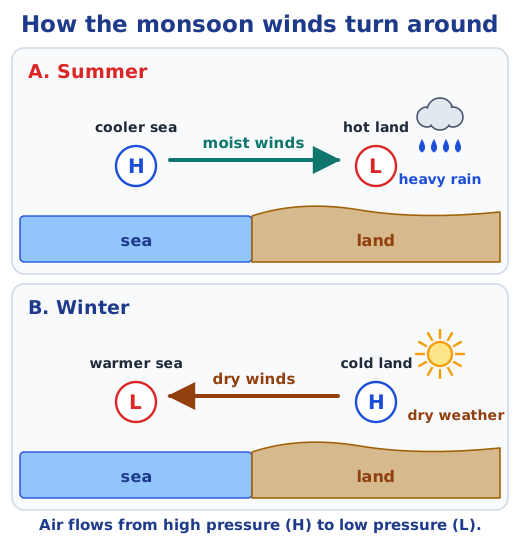
The mechanism is complex, but it rests on a simple fact: land heats up and cools down faster than the ocean. When summer starts, the huge landmass of Asia warms up and a strong low-pressure system develops over it. Air moves from where pressure is high to where it is low, so winds are pulled in from the cooler ocean, where pressure is high, towards the hot land. Laden with moisture, they drop it over the land as heavy rain once it condenses. In winter the pattern reverses: the land cools down faster than the ocean, so the land has high pressure and the warmer ocean lower pressure. The winds now blow from the land to the ocean and bring dry conditions to much of Asia.
The southwest monsoon
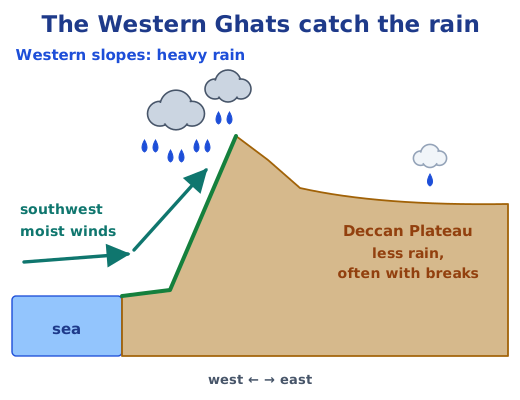
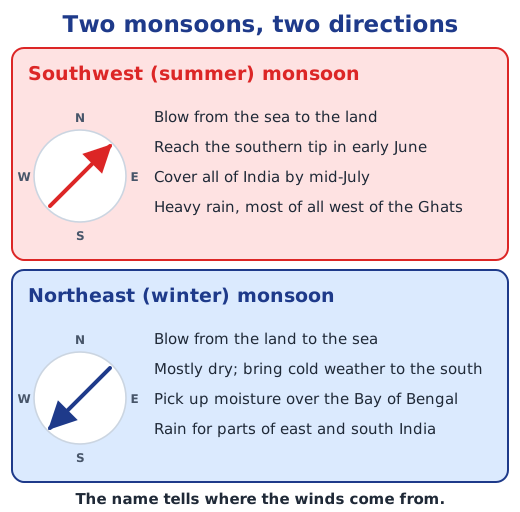
In India the monsoon rains usually reach the southern tip in early June and move north over several weeks, until they cover the whole subcontinent by mid-July. The progress is not smooth. The Western Ghats stand in the way like a wall: their western slopes get heavy rain, while the Deccan Plateau to the east gets less, often with breaks. Because these winds come from the southwest, this is called the summer or southwest monsoon.
The northeast monsoon
When winter comes near, the winds turn around and blow out from the land towards the ocean. These dry winds bring cold weather to south India, but the part of them that crosses the Bay of Bengal picks up some moisture and carries rain to some parts of eastern and southern India. We call this the winter or northeast monsoon.
Record rain and monsoon music
Mawsynram, in Meghalaya, gets more rain on average than any other place on Earth: about 11,000 mm a year, or 11 metres of water. The monsoon has also inspired many ragas in both Carnatic and Hindustani classical music, such as Meghamalhar and Amruthavarshini.
Reading nature’s signs
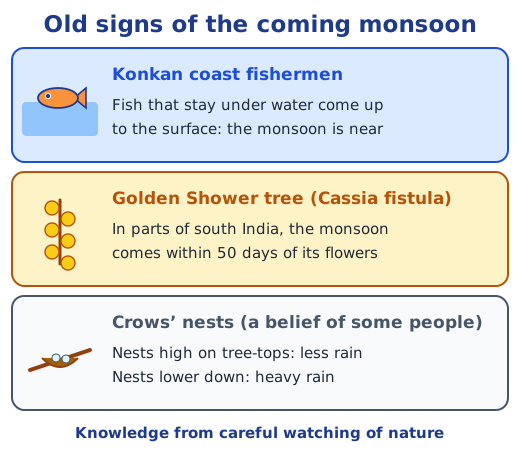
Predicting the monsoon has always mattered in India, so people watched nature closely and built up traditional knowledge, a heritage worth preserving. Fishermen on the Konkan coast expect the monsoon when fish that usually keep to deeper water start showing up at the surface. In parts of south India, people say that once the Golden Shower tree (Cassia fistula) blooms, the rains follow within 50 days. Some communities believe that crows building their nests high on tree-tops means less rain, while lower nests mean heavy rain.
When the monsoon fails
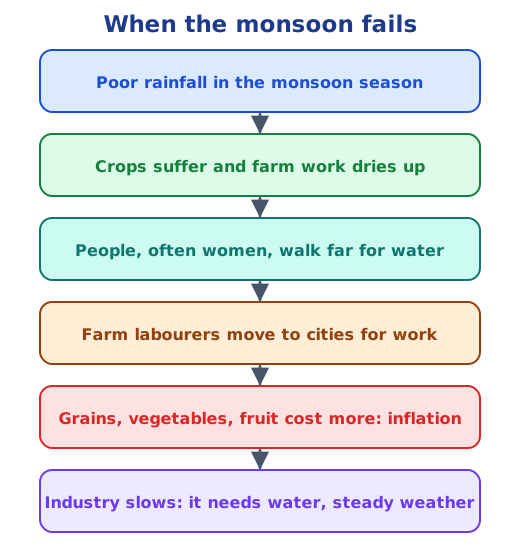
The climate shapes culture, with many festivals tied to the seasons and the harvest, and it shapes the economy too. A monsoon failure means poor rainfall in the monsoon season. Agriculture suffers, people (generally women) have to walk long distances for water, and farm labourers are likely to move to the cities. Grains, vegetables and fruit become costlier, which fuels inflation, and industries that depend on predictable weather and water also suffer.
Why it matters
The monsoon fills reservoirs, feeds crops and sets the rhythm of the year for millions. The land and sea effects behind it are explained in factors that shape climate, and the floods and landslides that heavy rain can bring in climate disasters and climate change. Answers to every question are in the NCERT solutions for Chapter 3; see all of the Chapter 3 notes.
Practice
-
Why do winds blow from the sea to the land in summer?
Show answer
Answer: (b) Low pressure forms over the hot land
-
By when do the monsoon rains usually cover all of India?
Show answer
Answer: (c) Mid-July
-
Which raga is linked with the monsoon rains?
Show answer
Answer: (a) Meghamalhar
-
Why do the western slopes of the Western Ghats get more rain than the Deccan Plateau?
Show answer
Answer: The moist southwest winds from the sea meet the Ghats as a barrier. As they rise up the western slopes, much of their moisture falls as rain. Little is left when they reach the Deccan Plateau to the east, so it gets less rain, often with breaks.
-
What happens when the monsoon fails?
Show answer
Answer: Crops suffer, people (usually women) walk long distances for water, farm labourers may move to cities, and grains, vegetables and fruit become costlier, which fuels inflation. Industries that need water and steady weather are hit too.
Questions students ask
What are monsoons?
Strictly, monsoons are winds that change with the seasons across a wide stretch of the Indian Ocean and the lands bordering it, from South Asia to Africa and Australia. They blow from the sea to the land in summer and from the land to the sea in winter. Because the summer winds bring heavy rain, the word monsoon is commonly used for the rainy season itself.
What is the difference between the southwest and the northeast monsoon?
The southwest or summer monsoon blows from the sea to the land, reaches India’s southern tip at the start of June and covers the country by mid-July, bringing most of India’s rain. The northeast or winter monsoon blows from the land to the sea; it is mostly dry and cold, but the part crossing the Bay of Bengal brings rain to parts of east and south India.
How did people predict the monsoon in the past?
By watching nature. Fishermen on the Konkan coast expect the monsoon when fish that normally stay deep come up to the surface. In parts of south India people say the rains come no more than 50 days after the Golden Shower tree blooms. Some communities believe crows nesting high on tree-tops means less rain, and lower nests heavy rain.
Stuck on a question?
Take a photo and Lagnever AI explains it step by step. Try it for 7 days for ₹2.
Get it on Google Play Open in browser
For parents: after the trial, the plan renews monthly by UPI or card autopay. You can cancel anytime in the app.