
Climate disasters and climate change
Answer in short
India faces climate-related disasters such as cyclones, floods, landslides and forest fires, which harm lives, farms, homes and economies. Climate change, a long-term shift in temperature, rainfall and weather events, is now driven mainly by burning fossil fuels, which adds greenhouse gases that trap extra heat. Mitigation and resilience help communities prepare.
Stuck on a question? Take a photo and Lagnever AI explains it step by step. Try it for 7 days for ₹2. Get it on Google Play
When weather turns extreme
India’s varied weather can bring extreme events: cyclones, floods, landslides and other climate-related disasters. They take lives, disrupt farming, damage roads, bridges and buildings, and upset local economies. Knowing how and where they strike helps us prepare.
Cyclones
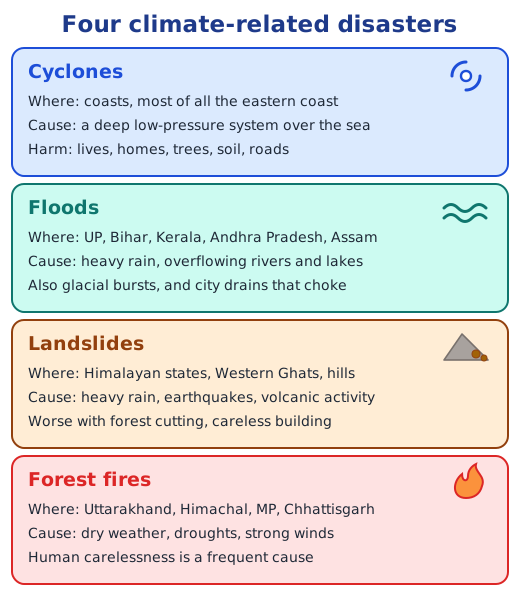
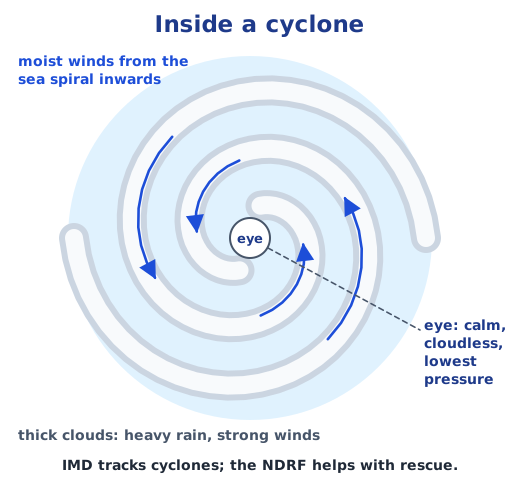
Every year several cyclones hit the Indian coast, especially the eastern coast. Some have been highly destructive: they killed people and animals, damaged property and infrastructure, uprooted trees and washed away soil. A cyclone begins when the air pressure over the sea drops well below that of the surrounding areas. Air flows into this low-pressure area from all around, bringing moisture from the sea. If the low is intense and the winds are fast, a cyclone forms: the moist winds build clouds and swirl inwards around a calm, cloudless centre, the eye of the cyclone. The India Meteorological Department (IMD) tracks cyclones, from how they form and grow to where they will reach land. The National Disaster Response Force (NDRF), with battalions at 12 places in India, is trained to rescue and evacuate people in cyclones, floods and landslides.
Floods
A flood happens when water spills onto land that is normally dry. Heavy rain may produce more run-off than the land can absorb, or rivers and lakes may fill until they overflow or burst their banks. Floods are frequent in the monsoon, and Assam, Bihar, Uttar Pradesh, Kerala and Andhra Pradesh face them most. In the Himalayas, floods also come from glacial lakes, held back by walls of rock and ice and fed by melting glaciers. When glaciers melt faster than usual, which happens more and more often, or when heavy rain falls, the water can smash through that wall: a glacial burst. In 2013 a glacial burst in Uttarakhand, set off by days of heavy rain, was followed by landslides; the area around the Kedarnath temple was destroyed and some 6,000 people died, many of whom were pilgrims. Cities flood too, when drains are overburdened, buildings block waterways, and concrete and asphalt stop water soaking into the ground.
Landslides
In a landslide, rock, soil or debris suddenly gives way and falls down a slope, usually set off by heavy rain, an earthquake or volcanic activity. They happen often in the mountain states of Uttarakhand, Himachal Pradesh, Arunachal Pradesh and Sikkim, and in the Western Ghats, mostly during the monsoon. Human activities have made them more likely: cutting down forests, building without approved methods, and putting up so many buildings that they block the natural flow of water.
Forest fires
A forest fire is a fire out of control that races through trees, grass and bushes, helped along by dry weather, droughts or strong winds; human carelessness often starts one. They break out often in states with large forests or grasslands, such as Madhya Pradesh, Chhattisgarh, Uttarakhand and Himachal Pradesh, and in mountain ranges such as the Western Ghats. Fires destroy forests, harm wildlife, damage the ecosystem, pollute the air and force local communities to move, so their cost is both environmental and economic.
Climate change
Climate change means significant, long-term changes in the climate, of the whole planet or of a region: shifts in temperature, rainfall and weather events. Over millions of years natural processes drove such changes. From the 19th century onwards, though, human activities have been the main driver: burning fossil fuels (coal, petroleum and natural gas, formed from plants and animals buried millions of years ago), cutting forests, harmful industrial practices and wasteful consumption.
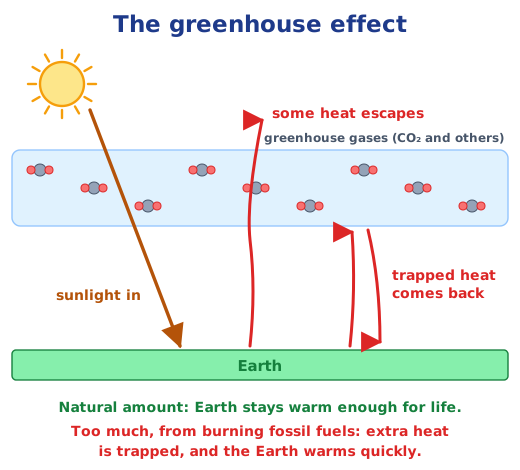
Why do fossil fuels matter? Carbon dioxide and some other gases are a normal part of the Earth’s carbon cycle; released slowly, they hold back some of the Sun’s heat. This natural greenhouse effect keeps the Earth warm enough for life. But industry, transport and farming have poured out these greenhouse gases in huge quantities within only a few hundred years. The extra gases trap extra heat, causing rapid global warming and upsetting climate patterns that plants, animals and people adapted to over thousands of years.
Warming in India, and what we can do
Rising temperatures are already felt in many parts of India. Early in 2025, temperatures across India were 1 to 3°C higher than usual, giving a far shorter, gentler winter than normal, which affected farm output and many small-scale industries. Understanding how climate change and disasters are linked helps us prepare: through environment-friendly practices, and by building resilience, the ability to bear a shock and recover quickly, and adaptation in communities. Governments, including India’s, promote mitigation: planting trees, cutting the emissions of greenhouse gases, using more renewable energy, using energy more efficiently and encouraging sustainable lifestyles, ones that can be kept up for a long time. These steps often clash with the wish for faster economic growth and more consumption.
Why it matters
Disasters and a warming climate affect everyone, and good choices by individuals, communities and governments reduce the harm. How India’s climates come about is explained in factors that shape climate, and the rains that can bring floods in the monsoons. Answers to every question, including the disaster essay, are in the NCERT solutions for Chapter 3; see all of the Chapter 3 notes.
Practice
-
What is the eye of a cyclone?
Show answer
Answer: (b) Its calm, cloudless centre
-
What is a glacial burst?
Show answer
Answer: (b) Water in a glacial lake breaking through its barrier
-
Which of these is a step of climate mitigation?
Show answer
Answer: (b) Using more renewable energy
-
Why do many cities flood after heavy rain?
Show answer
Answer: Their drains may be overburdened, and poorly planned buildings may stand on waterways and block the flow of water. Concrete and asphalt also stop rainwater from soaking into the ground, so it collects on the surface.
-
Give two natural and two human causes of landslides.
Show answer
Answer: Natural: heavy rain and earthquakes (volcanic activity can also trigger them). Human: cutting down forests, and building roads and houses without approved methods, or so many buildings that they block the natural flow of water.
Questions students ask
Which disasters are linked to India’s climate?
Cyclones, which strike the coasts every year, especially the eastern coast; floods, common in the monsoon in Assam, Bihar, Uttar Pradesh, Kerala and Andhra Pradesh, and caused in the Himalayas by glacial bursts; landslides in hilly regions; and forest fires in dry, windy weather. They affect lives, farms, buildings, roads and local economies.
How is a cyclone formed?
Sometimes the air pressure near the sea becomes much lower than in the areas around it. Air rushes in from all sides, bringing moisture from the sea. When this low-pressure system is intense and the winds are fast, a cyclone may form: the winds build clouds and swirl inwards around a calm, cloudless centre called the eye.
What causes climate change today?
Mainly human activities since the 19th century: burning fossil fuels such as coal, petroleum and natural gas, cutting down forests, harmful industrial practices and wasteful consumption. They release carbon dioxide and other greenhouse gases much faster than the natural carbon cycle, so the atmosphere traps extra heat and the planet warms quickly.
Stuck on a question?
Take a photo and Lagnever AI explains it step by step. Try it for 7 days for ₹2.
Get it on Google Play Open in browser
For parents: after the trial, the plan renews monthly by UPI or card autopay. You can cancel anytime in the app.