
Class 7 Social Science Chapter 6: The Age of Reorganisation Notes
This chapter in five lines
The Age of Reorganisation covers roughly 200 BCE to 300 CE, after the Maurya empire broke up around 185 BCE. New kingdoms such as the Shungas, Satavahanas and Chedis rose, the Cholas, Cheras and Pandyas flourished in the south, and the Indo-Greeks, Shakas and Kushanas came from outside. Trade, art and Sanskrit and Sangam literature grew as cultures mixed.
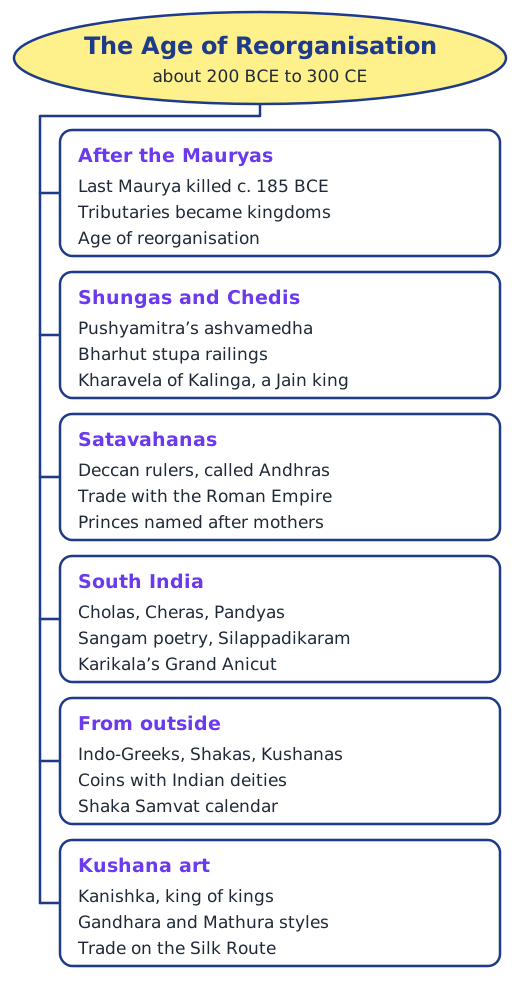
What is this chapter about?
Bhavisha and Dhruv, back from their visit to the Maurya empire, travel again with their time machine, Itihasa, and find a collection of artworks so different from one another that they seem to come from many kingdoms at once. They are right. This chapter covers a long stretch, roughly from 200 BCE to 300 CE, and asks three Big Questions: why this time is called an age of reorganisation, what values guided its rulers, and how invaders from outside became part of Indian society.
After the Mauryas
Little is known about Ashoka’s successors, but around 185 BCE the last Maurya emperor was killed by his own commander-in-chief, Pushyamitra Shunga, barely fifty years after Ashoka. The empire split into many kingdoms, often the old tributaries, and the weakened north-west was exposed to invasions. Some scholars call this the age of reorganisation, because regions were regrouped into new kingdoms that constantly competed for power. They gained ground through matrimonial alliances or through war, and border lands were fought over again and again. Alongside the fighting came a burst of art, architecture and literature.
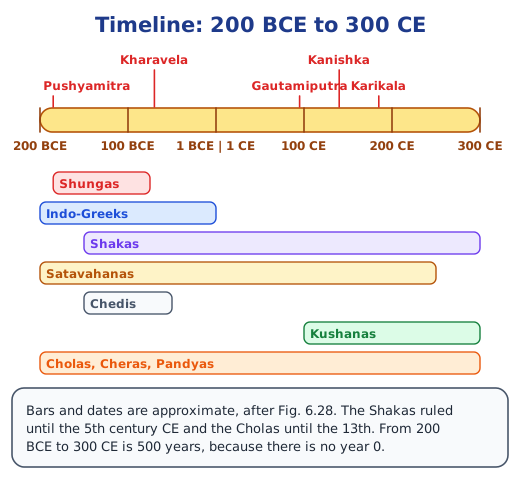
The Shungas
Pushyamitra Shunga founded the Shunga dynasty, which ruled parts of north and central India. To proclaim his power he performed the ashvamedha yajna, the Vedic horse ritual. His kingdom was smaller than the Maurya empire, but he guarded it against invaders and, after some early fighting, stayed on friendly terms with the Greeks; about a century after him the dynasty ended. Vedic rituals revived, other schools of thought kept flourishing, and Sanskrit became a favoured language for philosophy and literature: Patanjali compiled the Yoga Sutras in this period. The Shungas also added carved railings and reliefs to the Bharhut stupa in Madhya Pradesh. Read kingdoms after the Mauryas.
The Satavahanas and the Chedis
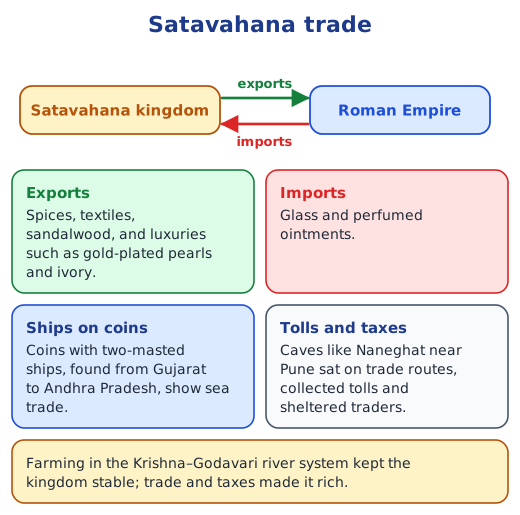
South of the Shungas, the Satavahanas, sometimes called the Andhras, ruled much of the Deccan, starting in the 2nd century BCE, with capitals such as Amaravati and Pratishthana (Paithan). Farming in the Krishna–Godavari valley made them stable, and their coins, found from Gujarat to Andhra Pradesh, show ships, a sign of sea trade, which stretched all the way to the Roman Empire. Princes were often named after their mothers: Gautamiputra Satakarni was the son of Queen Gautami Balashri. Inscriptions at Naneghat near Pune describe a queen who performed Vedic rituals, and they contain early Brahmi numerals. In Kalinga, the Chedi king Kharavela, a follower of Jain teachings, recorded his deeds year by year in the Hathigumpha inscription near Bhubaneswar and called himself a respecter of every sect.
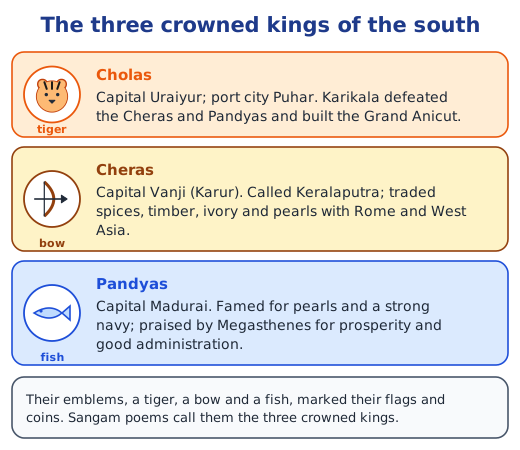
Kingdoms of the south
From about the 3rd century BCE to the 3rd century CE, three kingdoms dominated the south: the Cholas, Cheras and Pandyas. Ashoka’s empire had stopped short of them. Poets of this time composed Sangam literature, the oldest in south India, and the poems call these rulers the three crowned kings. The Chola king Karikala built the Grand Anicut on the Kaveri, which still waters the ‘rice bowl of the South’. The Cheras, with their capital at Vanji (Karur), traded spices, timber, ivory and pearls with Rome and West Asia, and the Pandyas of Madurai were famed for pearls and their navy. The epic Silappadikaram, about Kannagi and her anklet, travels through all three kingdoms. Read Cholas, Cheras and Pandyas.
Rulers who came from outside
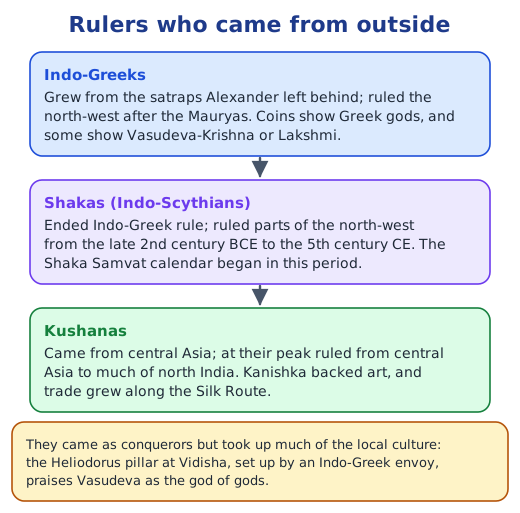
In the north-west, the satraps Alexander had left behind grew into the Indo-Greek kingdoms. They came as conquerors but took up much of the local culture: some of their coins show Vasudeva-Krishna or Lakshmi, and an Indo-Greek envoy named Heliodorus set up a pillar near Vidisha praising Vasudeva. The Shakas, or Indo-Scythians, ended Indo-Greek rule; the Shaka Samvat calendar, now India’s national calendar, began in their time. The Kushanas came from central Asia, and their greatest king, Kanishka, put both the Buddha and Shiva on his coins. Read Indo-Greeks, Shakas and Kushanas.
Trade and art
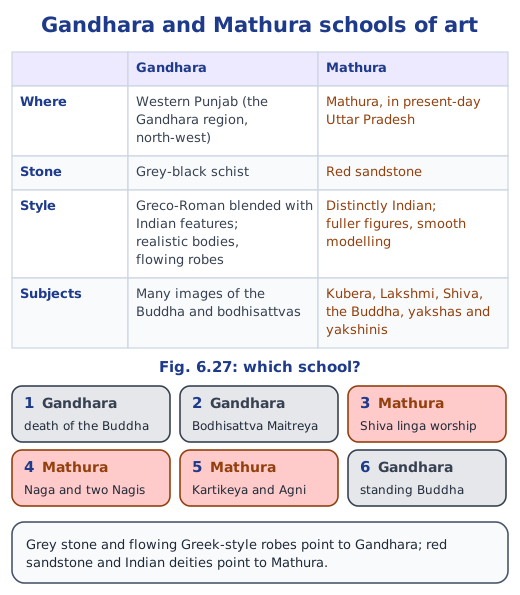
The Kushanas controlled key stretches of the Silk Route, so trade tied India to China, central Asia, Persia and the Mediterranean world. Two great schools of art developed. Gandhara art, from the north-west, blended Greco-Roman and Indian features and was carved in grey-black schist, with many fine images of the Buddha. Mathura art used red sandstone, was distinctly Indian and showed deities such as Kubera, Lakshmi and Shiva. Across the whole period, styles met and mixed, Indian themes stayed dominant, and Sanskrit literature flourished.
Before we move on
After the Mauryas, many big and small kingdoms rose, and conflicts at home combined with invasions to reorganise political power. Yet this was also an age of cultural dialogue, new styles in art, architecture and coins, booming trade, and rulers who prided themselves on protecting all schools of thought. Answers to every question are in the NCERT solutions for Chapter 6.
Key terms
| Term | Meaning |
|---|---|
| Age of reorganisation | A name some scholars give to the centuries after the Mauryas, when regions were regrouped into new kingdoms that kept competing for power. |
| Matrimonial alliance | A bond between two kingdoms made through a marriage between their royal families, often a king giving his daughter in marriage to a neighbouring royal family. |
| Ashvamedha yajna | A Vedic ritual in which a horse, followed by soldiers, wandered from land to land; lands it crossed unchallenged counted as the king’s, and anyone who stopped it had to fight. |
| Bharhut stupa | A Buddhist stupa in present-day Madhya Pradesh to which the Shungas added carved railings and reliefs from the Buddha’s life, among the earliest Buddhist art. |
| Satavahanas | A powerful Deccan dynasty, sometimes called Andhras, ruling from the 2nd century BCE with capitals such as Amaravati and Pratishthana (Paithan); they traded with the Roman Empire. |
| Hathigumpha inscription | A Brahmi inscription in a cave near Bhubaneswar recording, year by year, the deeds of the Chedi king Kharavela of Kalinga. |
| Sangam literature | The oldest literature of south India: collections of Tamil poems about love, heroism and generosity, linked to assemblies (sangam) of poets. |
| Silappadikaram | ‘The Tale of the Anklet’, an epic composed soon after the Sangam collections; Kannagi proves her husband’s innocence, and the story centres on justice. |
| Grand Anicut (Kallanai) | A water diversion system on the Kaveri, just downstream of Srirangam island, built under the Chola king Karikala and still used for irrigation. |
| Indo-Greeks | Rulers in the north-west who grew out of the satraps Alexander left behind; their coins show Greek gods and sometimes Indian deities. |
| Shaka Samvat | A calendar from the time of the Shakas, 78 years behind the Gregorian calendar (79 from January to March); India adopted it as its national calendar in 1957. |
| Gandhara and Mathura schools | Two styles of Kushana-period art: Gandhara blended Greco-Roman and Indian features in grey-black schist, while Mathura was distinctly Indian, in red sandstone. |
Topics in this chapter
Practice
-
Who founded the Shunga dynasty?
Show answer
Answer: (b) Pushyamitra Shunga
-
Which dynasty ruled much of the Deccan and is sometimes called the Andhras?
Show answer
Answer: (b) Satavahanas
-
The Hathigumpha inscription records the deeds of which king?
Show answer
Answer: (b) Kharavela
-
Which Chola king built the Grand Anicut on the Kaveri?
Show answer
Answer: (a) Karikala
-
How many years is the Shaka Samvat behind the Gregorian calendar for most of the year?
Show answer
Answer: (b) 78
-
Which school of art used red sandstone?
Show answer
Answer: (b) Mathura
Questions students ask
What are the main topics of Class 7 SST Chapter 6?
The break-up of the Maurya empire and why the period is called the age of reorganisation; the Shungas and the ashvamedha yajna; the Satavahanas, their trade and their custom of naming princes after mothers; Kharavela of the Chedis; the Cholas, Cheras and Pandyas, Sangam literature and Silappadikaram; and the Indo-Greeks, Shakas and Kushanas with the Gandhara and Mathura schools of art.
Is The Age of Reorganisation in the new NCERT Class 7 SST book?
Yes. It is Chapter 6 of Exploring Society: India and Beyond, the Class 7 Social Science textbook Part 1 (Reprint 2026-27), on pages 117 to 144, in the history theme ‘Tapestry of the Past’. It follows The Rise of Empires and comes before The Gupta Era: An Age of Tireless Creativity.
Why is the period after the Mauryas called the age of reorganisation?
After the Maurya empire broke up around 185 BCE, the old regions were regrouped into many new kingdoms, often former tributaries, that kept competing for power, while invaders came in from the north-west. The political map of India changed greatly, and so did people’s lives, as cultures mixed and trade and art grew.
What values guided the rulers of this age?
Many rulers took pride in protecting every school of thought: Kharavela called himself a respecter of every sect, the Satavahanas gave land to Vedic scholars and to Jaina and Buddhist monks, and Pandya inscriptions speak of the subjects’ welfare. Works for the people, such as Karikala’s Grand Anicut, and justice, the theme of Silappadikaram, were also valued.
Stuck on a question?
Take a photo and Lagnever AI explains it step by step. Try it for 7 days for ₹2.
Get it on Google Play Open in browser
For parents: after the trial, the plan renews monthly by UPI or card autopay. You can cancel anytime in the app.