
Kingdoms after the Mauryas
Answer in short
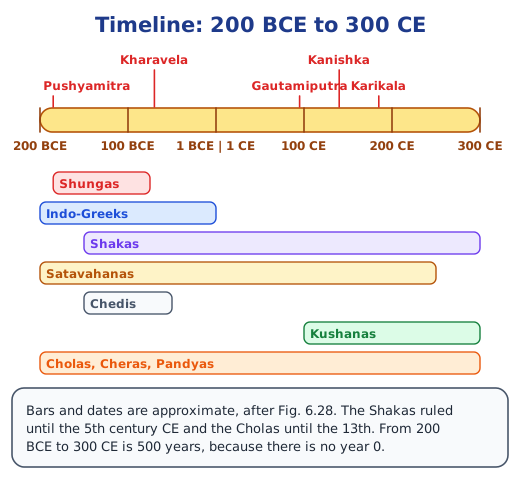
After the last Maurya emperor was killed around 185 BCE, new kingdoms rose. The Shungas under Pushyamitra ruled parts of north and central India and revived Vedic rituals. The Satavahanas ruled the Deccan and traded with Rome. In Kalinga, the Chedi king Kharavela, a follower of Jain teachings, respected every school of thought.
Stuck on a question? Take a photo and Lagnever AI explains it step by step. Try it for 7 days for ₹2. Get it on Google Play
The empire breaks up
Very little is known about the emperors who came after Ashoka. Around 185 BCE the last of them was killed by his commander-in-chief, Pushyamitra Shunga, and the Maurya empire fell apart only about half a century after Ashoka’s death. Many kingdoms appeared across the subcontinent, often the old tributary kingdoms that had once accepted Maurya overlordship. Rulers tried to gain land through marriage alliances with neighbouring royal families or through war, and the borderlands were always contested, since holding them kept a kingdom safe from attack.
The Shungas
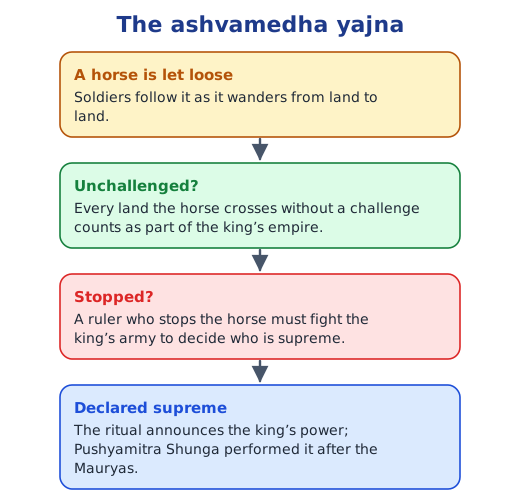
Pushyamitra founded the Shunga dynasty, which ruled parts of north and central India. To show that he was a mighty ruler, he performed the ashvamedha yajna: a horse, followed by soldiers, roamed from land to land, every territory it crossed unchallenged counted as his, and anyone who stopped it had to fight. His kingdom was smaller than the Maurya empire, but he protected it from invaders and, after an early campaign against the Greeks, kept friendly relations with them. A century later the dynasty was gone.
Vedic rituals revived under the Shungas, though other schools of thought continued to thrive. Sanskrit became a preferred language for philosophy and literature, and Patanjali compiled the Yoga Sutras in this period. The Shungas also supported art: at the Bharhut stupa in Madhya Pradesh, probably begun in Ashoka’s time, they added railings and reliefs carved with scenes from the Buddha’s life, counted among the earliest Buddhist art.
The Satavahanas
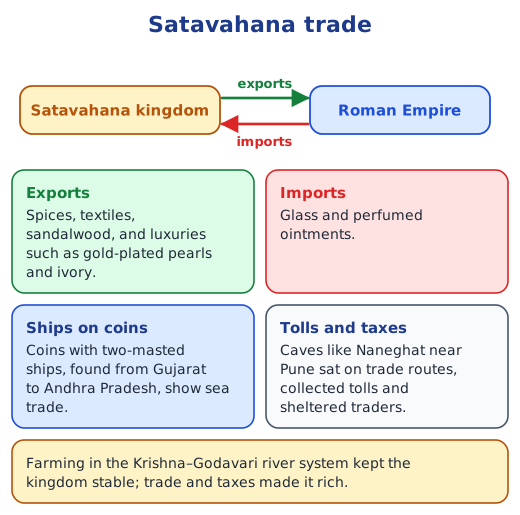
To the south of the Shungas, the Satavahanas, sometimes called the Andhras, held much of the Deccan, beginning in the 2nd century BCE: roughly today’s Andhra Pradesh, Telangana and Maharashtra, with capitals that changed over time, the most famous being Amaravati and Pratishthana (Paithan). Farming in the Krishna–Godavari river system kept the kingdom stable, and trade made it rich. Their coins, found from Gujarat to Andhra Pradesh, show two-masted ships; spices, textiles, sandalwood, gold-plated pearls and ivory went as far as the Roman Empire, while glass and perfumed ointments came in. Caves such as Naneghat near Pune, on a busy trade route, served as toll posts and rest houses for traders.
Satavahana princes were often named after their mothers. Gautamiputra Satakarni means Satakarni, son of Gautami; his mother, Queen Gautami Balashri, granted land to Buddhist monks, and an important inscription at Nashik was carved on her orders. Inscriptions at Naneghat describe another queen, a widow, who performed Vedic rituals, even the ashvamedha, and gave land, cows, horses and silver coins to priests, scholars and monks. These inscriptions also contain early Brahmi numerals, some shaped much like ours. The Satavahanas worshipped Vasudeva (Krishna) yet granted land to Vedic scholars and to Jaina and Buddhist monks, and they supported the Buddhist caves at Karla. Their empire broke up in the 3rd century CE, weakened by loose central control and economic decline.
Kharavela of the Chedis
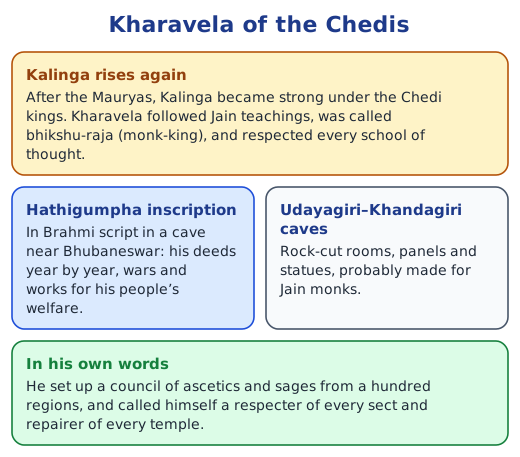
After the Mauryas, Kalinga, the land of Ashoka’s famous war, became strong again under the Chedi kings. Kharavela, the most famous of them, followed Jain teachings and was sometimes called the monk-king, yet he respected every school of thought. His Hathigumpha inscription, in Brahmi script in a cave near Bhubaneswar, records his deeds year by year: his victories, his works for his people, and a council of sages and ascetics drawn from a hundred regions. The rock-cut rooms, panels and statues of the Udayagiri–Khandagiri caves show the craftsmen’s skill.
Why it matters
These kingdoms show how India was rebuilt after a great empire fell, and how rulers took pride in protecting every belief. Life in the far south is in Cholas, Cheras and Pandyas, and the rulers who came from outside are in Indo-Greeks, Shakas and Kushanas. Answers to every question are in the NCERT solutions for Chapter 6; see also the full Chapter 6 notes.
Practice
-
Around which year was the last Maurya emperor killed?
Show answer
Answer: (c) 185 BCE
-
Which Satavahana king was named after his mother?
Show answer
Answer: (b) Gautamiputra Satakarni
-
Where is the Hathigumpha inscription?
Show answer
Answer: (a) Near Bhubaneswar
-
What did the Satavahanas export to the Roman Empire?
Show answer
Answer: Spices, textiles and sandalwood, and luxury goods such as gold-plated pearls and ivory. In return they imported glass and perfumed ointments.
-
Why is Kharavela remembered as a ruler who respected all faiths?
Show answer
Answer: Though he followed Jain teachings, he called himself one who respects every sect and repairs every temple, and he gathered a council of sages and ascetics drawn from a hundred regions.
Questions students ask
Who were the Shungas?
The Shungas ruled parts of north and central India after the Mauryas. Their founder, Pushyamitra Shunga, had been the Maurya commander-in-chief; he performed the ashvamedha yajna, guarded his kingdom against invaders and later kept friendly ties with the Greeks. The Shungas revived Vedic rituals, supported art and literature, and added carved railings to the Bharhut stupa.
Why were the Satavahanas rich?
Farming in the Krishna–Godavari river system gave them a stable base, and trade made them rich. Their merchants sent spices, textiles, sandalwood, pearls and ivory as far as the Roman Empire, coins show sea-going ships, and tolls and taxes on trade, collected at places such as the Naneghat caves, added to their income.
What is the Hathigumpha inscription?
It is an inscription in Brahmi script in one of the Udayagiri caves near Bhubaneswar. It records, year after year, the achievements of the Chedi king Kharavela of Kalinga, including his military campaigns and his works for the welfare of his people, and praises him as a respecter of every sect.
Stuck on a question?
Take a photo and Lagnever AI explains it step by step. Try it for 7 days for ₹2.
Get it on Google Play Open in browser
For parents: after the trial, the plan renews monthly by UPI or card autopay. You can cancel anytime in the app.