
Indo-Greeks, Shakas and Kushanas
Answer in short
The Indo-Greeks, Shakas and Kushanas came into India from the north-west after the Mauryas. They arrived as conquerors but absorbed Indian culture: Indo-Greek coins show Vasudeva-Krishna, the Shaka Samvat became India’s national calendar, and the Kushana king Kanishka put the Buddha and Shiva on his coins and backed new schools of art.
Stuck on a question? Take a photo and Lagnever AI explains it step by step. Try it for 7 days for ₹2. Get it on Google Play
Invaders from the north-west
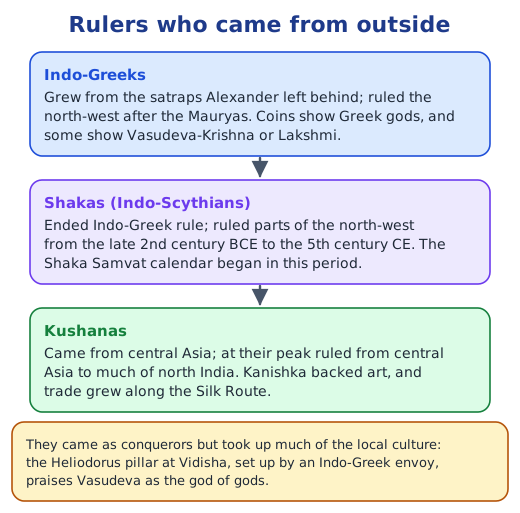
While new kingdoms grew inside the subcontinent, rulers from outside also arrived through the north-west and took over parts of the north-west, the north and central India. This began as a legacy of Alexander’s short campaign: while retreating from the Indus plains he left satraps behind, and over time they set up their own kingdoms and came to be known as the Indo-Greeks. Once the Mauryas declined, the north-west, roughly today’s Pakistan and Afghanistan, lay open to them.
Conquerors who took up local culture
The Indo-Greeks came as conquerors, but the rich local culture changed them, and Greek and Indian ways mixed in government, art, language and daily life. Near Vidisha in Madhya Pradesh stands the Heliodorus pillar, named after an Indo-Greek ambassador whose inscription praises Vasudeva as the god of gods and names three immortal precepts: self-restraint, charity and consciousness. Most of what we know about Indo-Greek rulers comes from their coins of gold, silver, copper and nickel, which usually show a king on one side and Greek gods on the other, though some show Indian deities such as Vasudeva-Krishna and Lakshmi.
The Shakas and their calendar
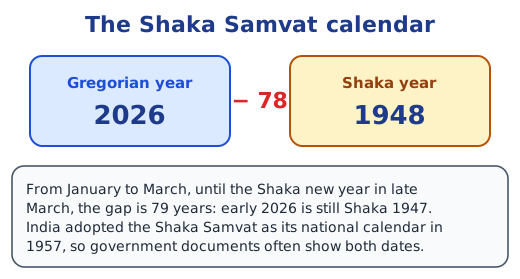
The Shakas, also called Indo-Scythians, ended Indo-Greek rule. They ruled parts of the north-west from late in the 2nd century BCE until the 5th century CE, and held power until the Kushanas arrived. The Shaka Samvat calendar developed in this period. It runs 78 years behind the Gregorian calendar, 79 from January to March, and in 1957 India adopted it as its national calendar: 2026 CE is mostly Shaka 1948.
The Kushanas and Kanishka
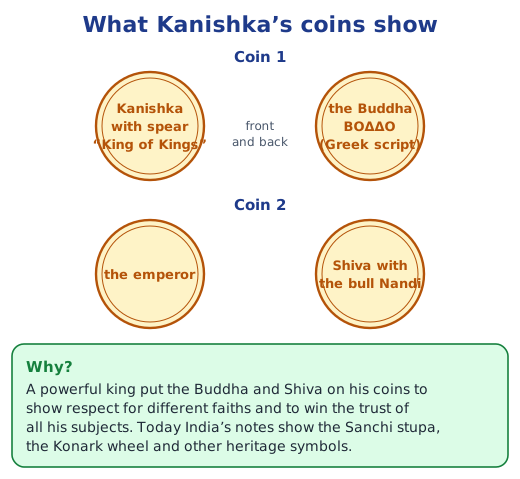
The Kushanas came from central Asia and probably reached India in the 2nd century CE, as the book says. At their peak they ruled from central Asia to large parts of north India, and their rule brought a great mixing of cultures. Their most powerful king was probably Kanishka. A famous headless statue, 1.85 metres tall, shows him in a long coat and heavy boots, holding a weapon; its Brahmi inscription calls him the great king, king of kings and son of God. On one of his coins Kanishka holds a spear, and the other side shows the Buddha, named BOΔΔO in Greek letters; another coin shows Shiva with the bull Nandi. A mighty king honouring different faiths on his coins says much about his values.
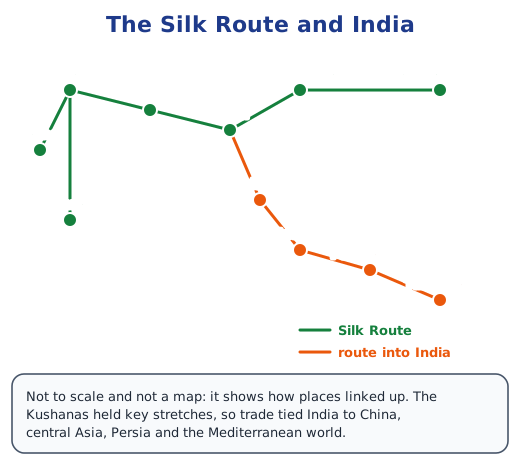
The Kushanas controlled important stretches of the Silk Route, so trade linked India with China, central Asia, Persia and the Mediterranean world.
Gandhara and Mathura art
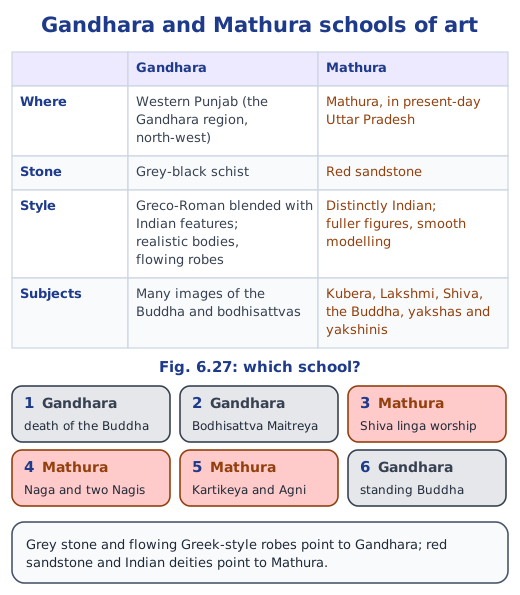
Kushana-period art is famous for mixing Indian and Greek styles. The Gandhara school grew up in the western Punjab region and mixed Indian features with Greco-Roman ones; its sculptors carved grey-black schist into Buddha images with lifelike bodies and flowing robes. The Mathura school, from the Mathura region of Uttar Pradesh, used red sandstone, showed less Greek influence, and made fuller, smoothly modelled figures of Indian deities such as Kubera, Lakshmi and Shiva, as well as the Buddha and yakshas. Deities such as Surya began to look more human, laying the ground for later temple art.
Why it matters
The story of these rulers shows that India’s past is a tapestry woven through meeting and mixing over time, not the work of one kingdom alone. The kingdoms that grew up within India are in kingdoms after the Mauryas and Cholas, Cheras and Pandyas. Answers to every question are in the NCERT solutions for Chapter 6; see also the full Chapter 6 notes.
Practice
-
Who set up a pillar near Vidisha praising Vasudeva?
Show answer
Answer: (b) Heliodorus
-
In which year did India adopt the Shaka Samvat as its national calendar?
Show answer
Answer: (c) 1957
-
Where did the Kushanas originally come from?
Show answer
Answer: (a) Central Asia
-
What do Kanishka’s coins show besides the emperor?
Show answer
Answer: One shows the Buddha, named BOΔΔO in Greek script, and another shows Shiva with the bull Nandi, which suggests respect for different faiths.
-
What is the year 2026 CE in the Shaka Samvat?
Show answer
Answer: 1948 for most of the year (2026 − 78). From January to March, before the Shaka new year, it is still 1947, a gap of 79 years.
Questions students ask
Who were the Indo-Greeks?
When Alexander withdrew from the Indus plains, he left governors called satraps in charge; in time they set up independent kingdoms and came to be called Indo-Greeks. After the Mauryas declined, they held the north-west, roughly today’s Pakistan and Afghanistan. Their coins, found by archaeologists, are our main source about them; some show Indian deities.
What is the Shaka Samvat?
It is a calendar developed in the time of the Shakas, or Indo-Scythians. It runs 78 years behind the Gregorian calendar, or 79 from January to March. In 1957 India adopted it as the Indian National Calendar, which is why some government publications give dates in both calendars.
Who was Kanishka?
Kanishka was probably the most powerful ruler of the Kushana dynasty, which came from central Asia and at its peak ruled from central Asia to large parts of north India. A headless statue calls him the great king, king of kings and son of God. He encouraged art and culture, and his coins carry the Buddha and Shiva.
Stuck on a question?
Take a photo and Lagnever AI explains it step by step. Try it for 7 days for ₹2.
Get it on Google Play Open in browser
For parents: after the trial, the plan renews monthly by UPI or card autopay. You can cancel anytime in the app.