
NCERT Solutions Class 7 Social Science Chapter 6: The Age of Reorganisation
Answers to every question in Chapter 6, The Age of Reorganisation, of Exploring Society: India and Beyond, the Class 7 Social Science textbook Part 1 (Reprint 2026-27): the Big Questions, every Let’s Explore, Let’s Remember and Think About It, the questions on the coins and art, and all six Questions and activities. Page numbers follow the book (pages 117–144). Short notes: Chapter 6 notes.
The Big Questions (page 117)
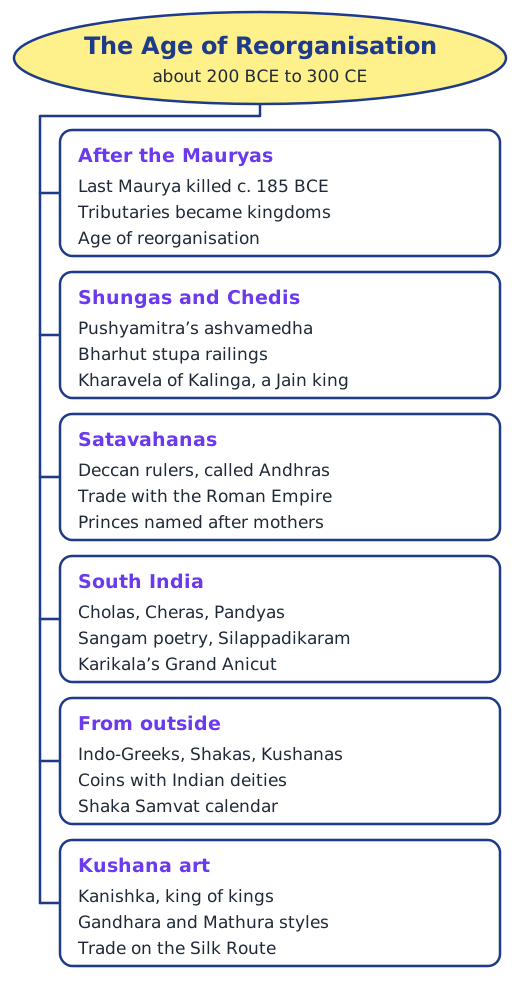
1. Why is the period after the Mauryas called the ‘Age of Reorganisation’? After the last Maurya emperor was killed around 185 BCE, the empire broke up. Old regions, often former tributaries, were regrouped into many new kingdoms that kept competing for power, while invaders came in from the north-west. The political map of India changed greatly, and life changed too, as cultures mixed and trade and art flourished.
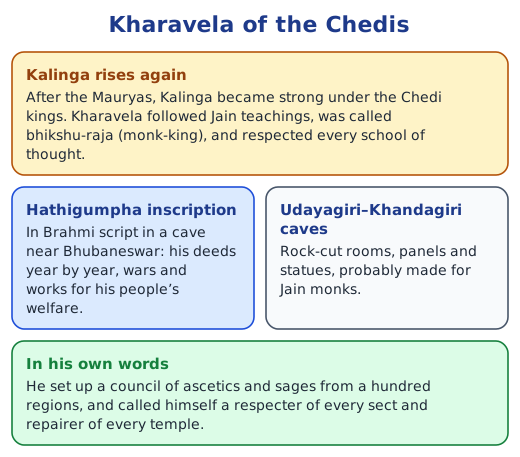
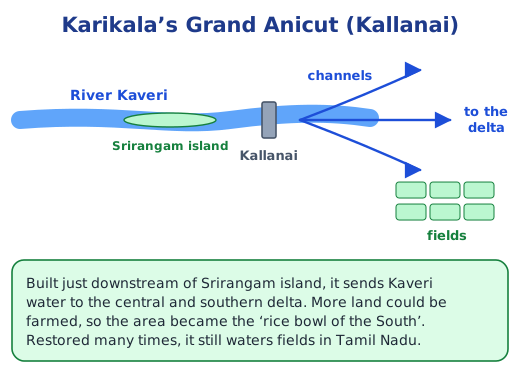
2. What values guided the emperors of that period? Rulers took pride in protecting every school of thought: Kharavela called himself one who respects every sect and repairs every temple; the Satavahanas granted land to Vedic scholars and to Jaina and Buddhist monks; Pandya inscriptions speak of the subjects’ welfare; and Kanishka honoured both the Buddha and Shiva on his coins. Welfare works, such as Karikala’s Grand Anicut, and justice, the theme of Silappadikaram, were also valued. The book calls this protection of all beliefs part of the ‘Indian ethos’.
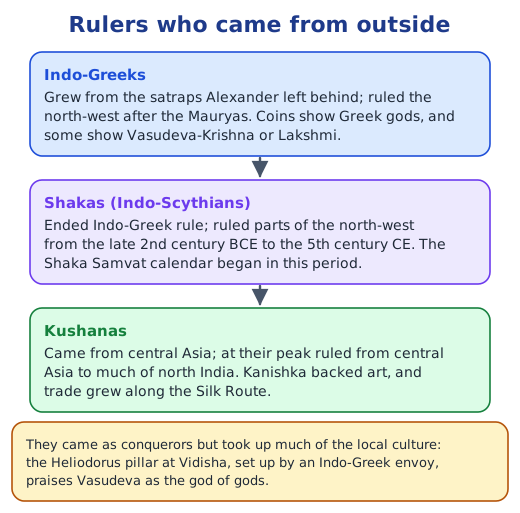
3. How did foreign invaders assimilate into Indian society? They came as conquerors but adopted the local culture. Some Indo-Greek coins show Vasudeva-Krishna and Lakshmi, and the Indo-Greek envoy Heliodorus praised Vasudeva on his pillar. The Shaka Samvat calendar began in the Shaka period and is now India’s national calendar. The Kushanas put the Buddha and Shiva on their coins and supported the Gandhara and Mathura schools, where Greek and Indian styles blended but Indian themes stayed dominant.
Let’s Explore (page 118)
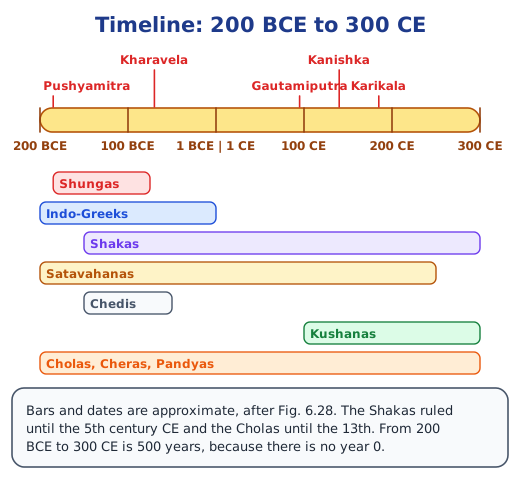
A timeline from the first year of the 2nd century BCE to the last year of the 3rd century CE. It runs from 200 BCE to 300 CE. That is 500 years: 200 years before the Common Era (200 BCE to 1 BCE) and 300 years after it (1 CE to 300 CE), because there is no year 0. Mark on it: Pushyamitra Shunga about 185 BCE; the Shungas, Indo-Greeks, Shakas, Satavahanas and Chedis in the 2nd and 1st centuries BCE; Kharavela in the 1st century BCE; Gautamiputra Satakarni, Kanishka and Karikala in the 1st and 2nd centuries CE; and the Kushanas from about the 2nd century CE.
Let’s Remember (page 119)
The change from BCE to CE. BCE years count down towards the start of the Common Era (200 BCE comes before 100 BCE), and CE years count up (100 CE comes before 200 CE). The year 1 BCE is followed directly by 1 CE; there is no year 0, so a span across the line is found by adding the BCE years and the CE years.
Let’s Explore (page 120)
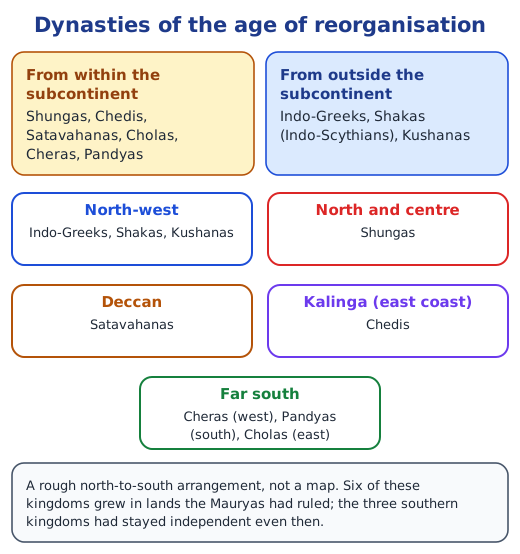
How many kingdoms in the area the Mauryas had ruled? On the map of the post-Maurya period, six: the Indo-Greeks, Shakas, Kushanas, Shungas, Satavahanas and Chedis. The Cholas, Cheras and Pandyas lay outside the Maurya empire. These six did not all rule at the same moment; the map brings the whole age together.
Let’s Explore (page 124)
The two figures on the right of the Bharhut panel. They seem to be playing wind instruments, one held sideways like a flute and the other like a horn, so they were probably musicians. They wear turbans, earrings, armlets and patterned clothes, which suggests skilled, well-dressed performers, perhaps at a festival or procession. Other details: a large round design like a lotus or wheel with a pot-like shape inside, rosettes, a net-like border along the bottom and a background of rocks. (The panel is open to interpretation; compare ideas in class.)
The collage in Fig. 6.6. Clothes: men in dhotis, turbans and sashes, women in draped garments with heavy belts; a warrior figure on a pillar. Jewellery: earrings, necklaces of beads, armlets, bangles (including bronze bangles coated with gold) and ornaments in the hair. Objects of daily use: a carved ivory comb, a vase, a fan. People clearly dressed with care, and craftsmen worked in ivory, metal, terracotta and beads.
Think About It (page 126)
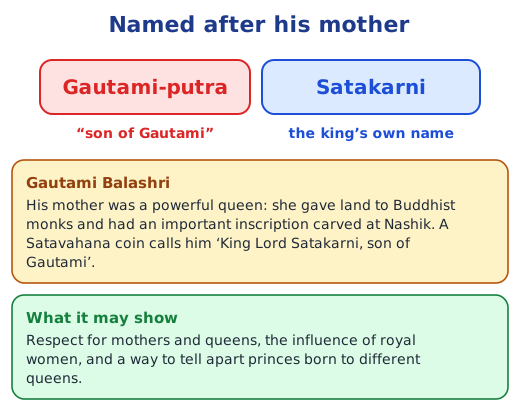
What could a mother’s name at the start of a king’s name signify? It shows the respect given to mothers and the important place of royal women: Gautamiputra Satakarni’s mother, Gautami Balashri, was a powerful queen who made gifts and had inscriptions carved. It may also have helped tell apart princes born to different queens of the same king.
Which Brahmi numerals look like ours? The 7 and the 9 look quite like our 7 and 9, and the 6 a little. The 1 (one stroke) and 2 (two strokes) look different because they are written lying down, though our 2 grew from two strokes joined together. The 4 and the 10 look very different; 10 had its own sign, since there was no zero and place value yet.
Think About It (page 127)
A goldsmith who carved a stone yaksha. It suggests that skilled craftspeople were not limited to one trade: a goldsmith could also work in stone, perhaps because the fine skills of shaping, measuring and decorating carried across materials. Artisans were valued enough to sign their work, and patrons hired the most skilled hands available.
Think About It (page 129)
How did artisans cut such regular rock chambers with a chisel and hammer? They marked straight guide lines on the rock with cords and measuring rods, worked from the top downwards so that no scaffolding was needed, checked levels with plumb lines and water, and used iron chisels of different sizes, hammers and mallets, with teams of skilled workers over many years. As a sculptor of that time, the tools would be iron chisels, a hammer, a mallet, a measuring cord or rod, a plumb line and abrasives for smoothing.
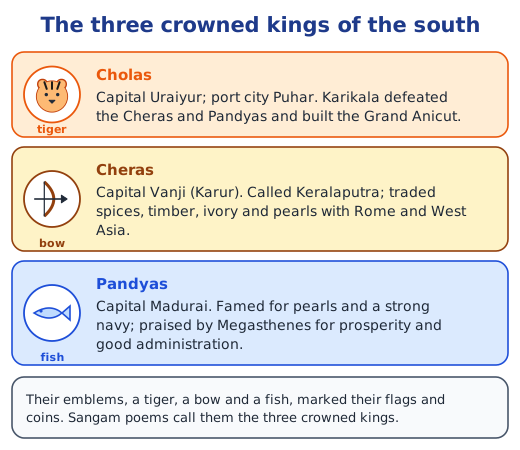
The symbols beside the southern kingdoms on the map. They are royal emblems: a tiger for the Cholas, a bow for the Cheras and a fish for the Pandyas. Used on flags, seals and coins, they gave each kingdom a clear identity, like a badge.
Think About It (page 132)
The statue of King Karikala. He sits high on a large, decorated elephant, upright and confident, in rich royal clothes and a crown, with a calm, commanding expression. The elephant, the height, the fine clothes and the steady posture all show power, wealth and authority.
Think About It (page 133)
How do historians uncover trade between distant kingdoms? From coins found far from where they were made (Roman coins in south India, Indian coins abroad); from goods and pottery dug up at ports; from inscriptions and literature, such as Sangam poems describing foreign ships; from travellers’ and merchants’ accounts, such as Megasthenes’ Indika; and from shipwrecks and seals.
The emblem on the Chera coin: the bow (with an arrow), the royal emblem of the Cheras.
Think About It (page 134)
Why were pearls important in trade? Pearls were rare and beautiful, so they had high value, yet they were small and light, easy to carry over long distances and to store. Distant markets such as Rome paid well for them, and kings valued them as royal treasure, so a pearl-rich kingdom like the Pandyas could grow wealthy.
Let’s Explore (page 135)
Why might Indo-Greek coins show Vasudeva-Krishna or Lakshmi? The rulers wanted to win the trust of their Indian subjects and show respect for local beliefs; some of them, like Heliodorus, may also have come to worship these deities themselves. Coins passed through everyone’s hands, so they were a good way to send this message.
Let’s Explore (page 136)
Kanishka’s statue. He wears a long, heavy coat or tunic and big padded boots and holds a large weapon. Such clothing suits a cold, dry climate like central Asia’s, where the Kushanas came from, and the weapon and size show a strong warrior king.
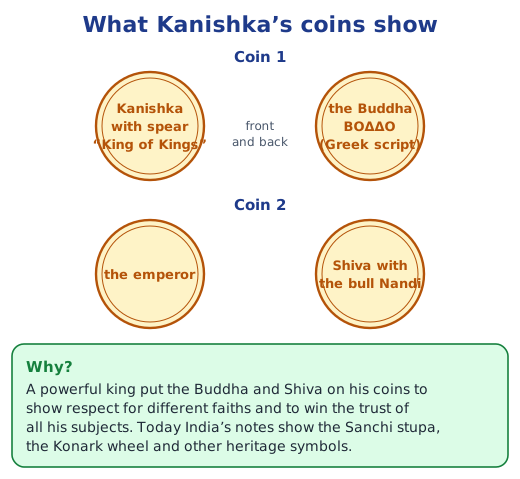
Who appears on the coins besides the emperor? The Buddha (named BOΔΔO in Greek script) on the first coin, and Shiva with the bull Nandi on the second.
Reflect (page 137)
Why would a powerful ruler put the Buddha and Shiva on his coins? To show respect for the different faiths of his subjects, win their loyalty and present himself as a ruler for everyone; it also shows that he valued harmony among beliefs. Modern examples of symbolic currency: India’s coins and notes carry the lion capital of Sarnath as the national emblem, and the notes show heritage sites such as the Konark sun temple’s wheel, the Ellora caves, Hampi, Rani ki Vav, the Sanchi stupa and the Red Fort.
Think About It (page 137)
Where is Gandhara? In the north-west of the subcontinent, around the Peshawar valley and Taxila in present-day Pakistan, reaching into eastern Afghanistan. In the Mahabharata, it reminds us of Gandhari, the princess of Gandhara who married Dhritarashtra and was the mother of the Kauravas, and of her brother Shakuni.
Let’s Explore (page 140)
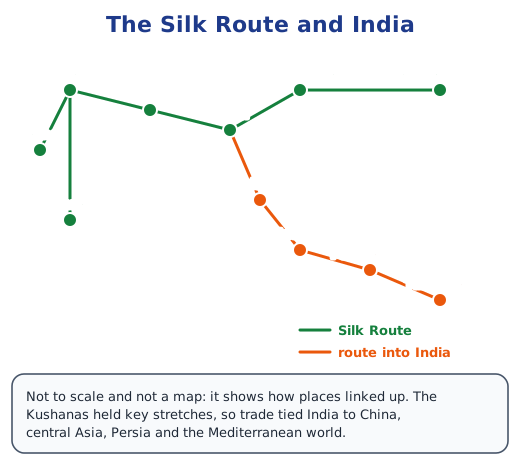
Which school of art does each artefact in Fig. 6.27 belong to?
- 6.27.1, the death of the Buddha: Gandhara, grey stone, crowded mourners with Greek-style robes and faces.
- 6.27.2, Bodhisattva Maitreya: Gandhara, dark schist, flowing robes and realistic body.
- 6.27.3, Shiva linga worshipped by Kushana devotees: Mathura, red sandstone and an Indian theme.
- 6.27.4, a Naga between two Nagis: Mathura, reddish sandstone, Indian deities, dated to Kanishka’s 8th year.
- 6.27.5, Kartikeya and Agni: Mathura, red sandstone and Indian gods.
- 6.27.6, standing Buddha: Gandhara, dark grey stone with deep, flowing folds of the robe.
Questions and activities (page 143)
1. Why was the post-Maurya era called the era of reorganisation? When the Maurya empire broke up around 185 BCE, its regions were regrouped into many new kingdoms, such as the Shungas, Satavahanas and Chedis, often the old tributaries, which kept competing through wars and marriage alliances. At the same time the Indo-Greeks, Shakas and Kushanas entered from the north-west, while the Cholas, Cheras and Pandyas grew in the south. Political power was reorganised again and again, the map changed, and cultures mixed in art, coins and literature.
2. A note on Sangam literature (about 150 words). Sangam literature is the oldest body of literature in south India. Many poets composed it from about the 3rd century BCE to the 3rd century CE, and it gave the period its name, the Sangam Age. The word sangam comes from the Sanskrit sangha, an association or gathering, and refers to assemblies of poets. The literature is made up of several collections, or anthologies, of Tamil poems. With great skill and delicacy, the poems express personal feelings such as love and social values such as heroism and generosity. They speak of the three ‘crowned kings’, the Cholas, Cheras and Pandyas, and describe busy cities, trade and daily life. Historians use them as an important source for the society and culture of the time. Soon after the Sangam collections came the epic Silappadikaram, whose theme is justice and the ruler’s duty to protect it.
3. Rulers who included their mother’s name in their title. The Satavahana kings, the clearest example in this chapter being Gautamiputra Satakarni, ‘Satakarni, son of Gautami’, named after his mother Queen Gautami Balashri. Satavahana princes were often given their mothers’ names. This honoured the mothers, showed the important place and influence of royal women such as Gautami Balashri, and may have helped tell apart princes born to different queens.
4. A note of about 250 words on one kingdom (example: the Satavahanas). I chose the Satavahanas because they combined trade, faith and art in a remarkable way. Sometimes called the Andhras, they ruled much of the Deccan, starting in the 2nd century BCE, roughly today’s Andhra Pradesh, Telangana and Maharashtra, with famous capitals at Amaravati and Pratishthana (Paithan). Farming in the fertile Krishna–Godavari valley gave the kingdom a steady base. Trade made it rich: Satavahana merchants sent spices, textiles, sandalwood, gold-plated pearls and ivory as far as the Roman Empire and brought back glass and perfumed ointments. Their coins, found from Gujarat to Andhra Pradesh, show two-masted ships, proof of sea trade and good shipbuilding. Tolls collected at places such as the Naneghat caves added to their income. The Satavahanas were devoted to Vasudeva, yet they granted land to Vedic scholars and to Jaina and Buddhist monks and supported the Buddhist caves at Karla. Royal women were powerful: Gautamiputra Satakarni was named after his mother, Queen Gautami Balashri, and the Naneghat inscriptions describe a widowed queen who performed Vedic rituals and gave generous gifts. Those inscriptions even include early Brahmi numerals, part of the evidence that our numerals began in India. The empire broke up in the 3rd century CE through weak central control and economic decline. The Satavahanas show how a kingdom could grow strong through farming, trade and respect for every belief. (After presenting, tally which kingdoms your classmates chose.)
5. My own kingdom (a sample answer). I would call it the Kingdom of Nadi, with a river and a book as its royal emblem: the river for water and farming, the book for learning. I would take the title ‘Rakshaka of the People’ rather than ‘king of kings’. Its values: justice for all, respect for every belief, care for nature and learning for every child. Rules: every village keeps a water tank and plants trees; markets have fair weights checked by officers; anyone may bring a complaint to an open court each month; no one is punished without proof. Unique features: a library in every town, festivals of all faiths celebrated together, and a council of farmers, traders, teachers and craftspeople that advises the ruler.
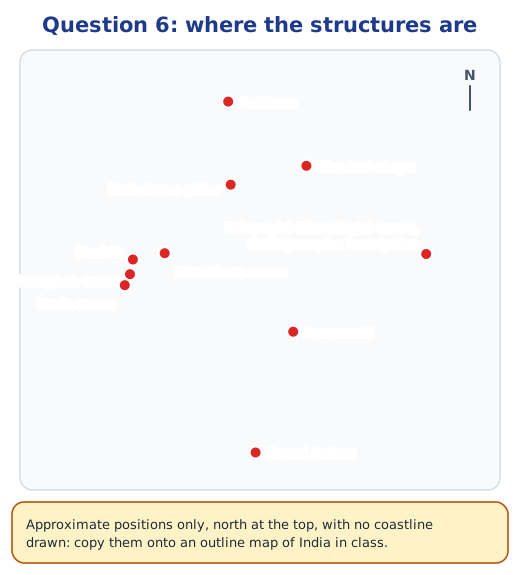
6. Ancient structures on a map. Mark these approximately on an outline map of India: the Bharhut stupa (Madhya Pradesh, near Satna); the Heliodorus pillar (near Vidisha, Madhya Pradesh); Mathura (Uttar Pradesh), home of the Mathura school; the Naneghat caves (near Pune), the Karla caves (near Lonavala), the Pitalkhora caves and the Nashik inscription (all in Maharashtra); Amaravati (Andhra Pradesh); the Udayagiri–Khandagiri caves with the Hathigumpha inscription (near Bhubaneswar, Odisha); and the Grand Anicut (on the Kaveri near Srirangam and Tiruchirappalli, Tamil Nadu).
Short notes and more practice are on the topic pages: kingdoms after the Mauryas, Cholas, Cheras and Pandyas and Indo-Greeks, Shakas and Kushanas.
Practice
-
Which of these dynasties came from outside the subcontinent?
Show answer
Answer: (b) Kushanas
-
What was the royal emblem of the Cheras?
Show answer
Answer: (c) Bow
-
Which school of art used grey-black schist?
Show answer
Answer: (b) Gandhara
-
How many years does a timeline from 200 BCE to 300 CE cover?
Show answer
Answer: 500 years: 200 years from 200 BCE to 1 BCE, and 300 years from 1 CE to 300 CE, since there is no year 0.
-
Name two rulers of this chapter who protected all schools of thought.
Show answer
Answer: Kharavela, who called himself a respecter of every sect, and the Satavahana kings, who gave land to Vedic scholars and to Jaina and Buddhist monks. Kanishka, who put the Buddha and Shiva on his coins, is another example.
Stuck on a question?
Take a photo and Lagnever AI explains it step by step. Try it for 7 days for ₹2.
Get it on Google Play Open in browser
For parents: after the trial, the plan renews monthly by UPI or card autopay. You can cancel anytime in the app.