
Cholas, Cheras and Pandyas
Answer in short
The Cholas, Cheras and Pandyas were the three ‘crowned kings’ of south India from about the 3rd century BCE to the 3rd century CE, when Sangam poetry flourished. The Chola king Karikala built the Grand Anicut on the Kaveri, the Cheras traded spices and pearls with Rome, and the Pandyas of Madurai were famed for pearls.
Stuck on a question? Take a photo and Lagnever AI explains it step by step. Try it for 7 days for ₹2. Get it on Google Play
Three kingdoms of the south
In southern India, from about the 2nd or 3rd century BCE to the 3rd century CE, three strong kingdoms rose to prominence: the Cholas, the Cheras and the Pandyas. They often competed with one another, yet together they made the region rich in trade and culture. Ashoka’s empire had stopped at their borders; his edicts mention them, so they stayed independent even at the peak of Maurya power. Kharavela of Kalinga claims to have beaten an alliance of southern kings, but no one knows where that battle was fought, and there is no sign that he marched into the south.
The Sangam Age
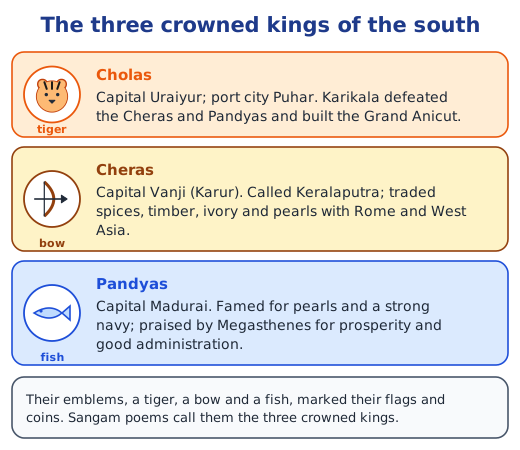
Many poets lived in this period, and their works, together called Sangam literature, gave the era its name, the Sangam Age. The word sangam comes from the Sanskrit sangha, meaning an association or a coming together, here an assembly of poets. These collections of poems are the oldest literature of south India. With great skill and delicacy they express personal feelings such as love and social values such as heroism and generosity, and historians study them to understand the society of the time. The Sangam poems speak of three ‘crowned kings’: the Cholas, the Cheras and the Pandyas.
The Cholas and the Grand Anicut
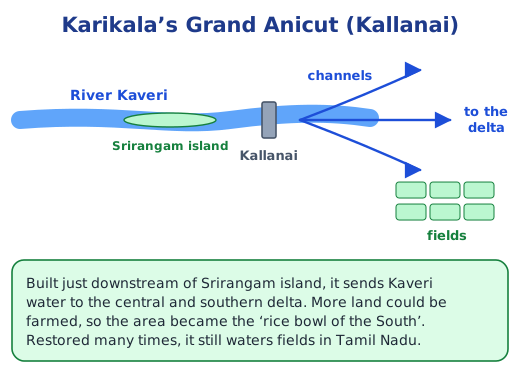
The Cholas ruled parts of south India for a very long time, from the 3rd century BCE until the 13th century CE. Their king Karikala is said to have defeated the Cheras and Pandyas together and made himself supreme. He also worked for his people. His most famous project is the Kallanai or Grand Anicut, a water diversion system built at a carefully chosen point on the Kaveri, just downstream of Srirangam island. It sends river water to the central and southern Kaveri delta, so much more land could be farmed, and the area came to be called the ‘rice bowl of the South’. It has been restored many times and is still in use, watering the fields of millions of people in Tamil Nadu.
Silappadikaram
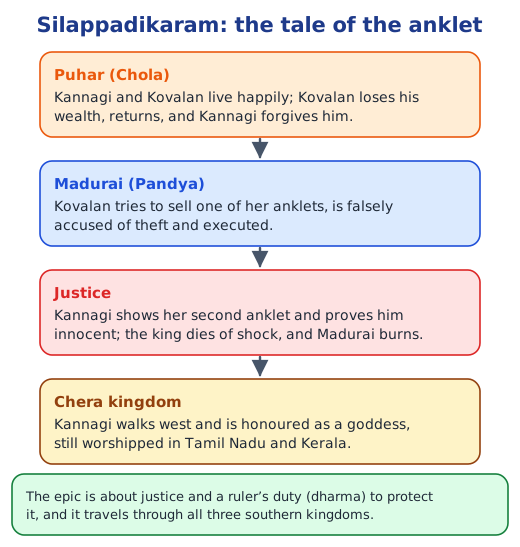
Soon after the Sangam collections came the epic Silappadikaram, ‘The Tale of the Anklet’. Kannagi lives happily with her husband Kovalan in Puhar, the rich Chola port also known as Kaveripattinam. Kovalan loses his wealth, comes back, and Kannagi forgives him. In Madurai, the Pandya capital, he tries to sell one of her anklets, is wrongly accused of theft and put to death by the king. Kannagi proves his innocence with her second anklet; the king dies of shock, and Madurai is destroyed by fire. She then walks west to the Chera kingdom, where she is honoured as a goddess, and she is still worshipped in Tamil Nadu and Kerala. The poem is about justice and a ruler’s duty to protect it, and it carries the reader through all three kingdoms and their busy cities.
The Cheras
The Cheras, also called Keralaputra (sons of Kerala), ruled Kerala and the western part of Tamil Nadu from their capital, Vanji, today’s Karur. They encouraged Tamil literature and supported Sangam poets. Their kingdom became a hub for exporting spices, timber, ivory and pearls, and it traded widely with the Roman Empire and West Asia. Chera kings issued coins, some showing their royal emblem, the bow.
The Pandyas
The Pandyas ruled parts of Tamil Nadu and nearby regions from their capital at Madurai, a rule going back several centuries BCE. Megasthenes, in his Indika, describes their kingdom as prosperous and well run, trading with distant powers such as the Greeks and Romans. The Pandyas were famous for pearls, Kharavela says hundreds of pearls reached him from their land, and they were an important naval power. Their inscriptions speak of the kings’ care for their subjects’ welfare and their support for all schools of thought and belief.
Why it matters
The southern kingdoms show how farming, trade and poetry went together, and how ideas of justice and welfare guided rulers. The kingdoms of the north and the Deccan are in kingdoms after the Mauryas, and the rulers from outside in Indo-Greeks, Shakas and Kushanas. Answers to every question are in the NCERT solutions for Chapter 6; see also the full Chapter 6 notes.
Practice
-
What was the capital of the Pandyas?
Show answer
Answer: (b) Madurai
-
Which kingdom was also called Keralaputra?
Show answer
Answer: (b) Cheras
-
What is Silappadikaram about?
Show answer
Answer: (b) Kannagi and her anklet
-
Why is the Kaveri delta called the ‘rice bowl of the South’?
Show answer
Answer: Karikala’s Grand Anicut diverted Kaveri water into the middle and south of the delta, so much more land could be farmed, especially for rice.
-
Why were pearls an important trade item for the Pandyas?
Show answer
Answer: Pearls were rare and valuable but small and easy to carry, so they suited long-distance trade, and distant buyers such as the Romans prized them; even Kharavela says he received hundreds of Pandya pearls.
Questions students ask
What is Sangam literature?
It is the oldest literature of south India: several collections of Tamil poems, linked to assemblies (sangam, from the Sanskrit sangha) of poets. The poems express personal feelings such as love and social values such as heroism and generosity, and historians use them to learn about the society of the time, which is called the Sangam Age.
Who was Karikala?
Karikala was a Chola king who is said to have defeated the combined forces of the Cheras and Pandyas. He carried out many projects for his people, the most famous being the Kallanai or Grand Anicut on the Kaveri, just downstream of Srirangam island, which is still used for irrigation.
What is the story of Silappadikaram?
Kannagi and her husband Kovalan live in Puhar, the Chola port. After losing his wealth, Kovalan returns to her and they go to Madurai, where he is falsely accused of theft while trying to sell her anklet, and executed. Kannagi proves his innocence with her second anklet; the Pandya king dies of shock and Madurai burns. She is honoured as a goddess in the Chera land.
Stuck on a question?
Take a photo and Lagnever AI explains it step by step. Try it for 7 days for ₹2.
Get it on Google Play Open in browser
For parents: after the trial, the plan renews monthly by UPI or card autopay. You can cancel anytime in the app.