
Class 7 Social Science Chapter 7: The Gupta Era: An Age of Tireless Creativity Notes
This chapter in five lines
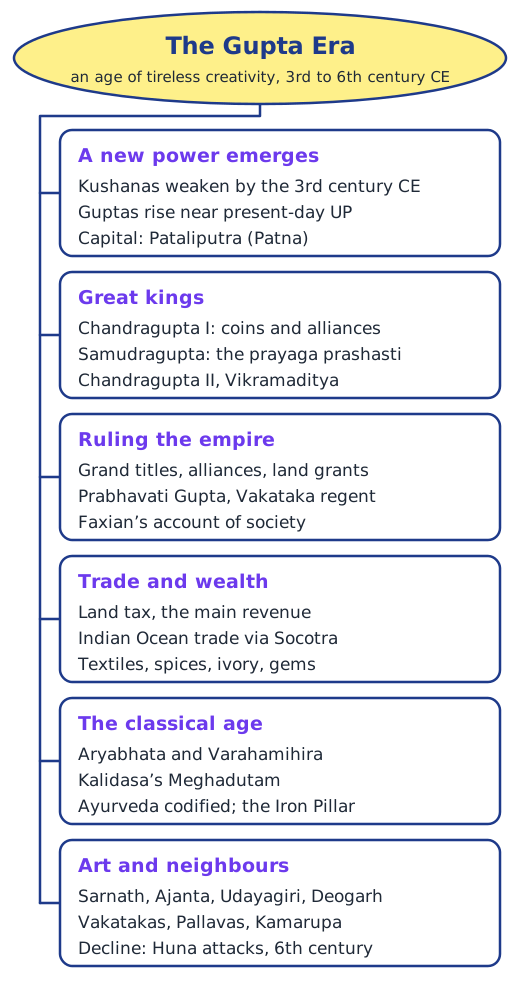
The Gupta Era covers roughly the 3rd to 6th century CE, when the Gupta dynasty built a large empire in the north with its capital at Pataliputra. Kings such as Samudragupta and Chandragupta II grew it through wars, alliances and land grants. Long peace and rich trade supported great work in literature, science, medicine, metalwork and art, so the period is often called India’s classical age.
What is this chapter about?
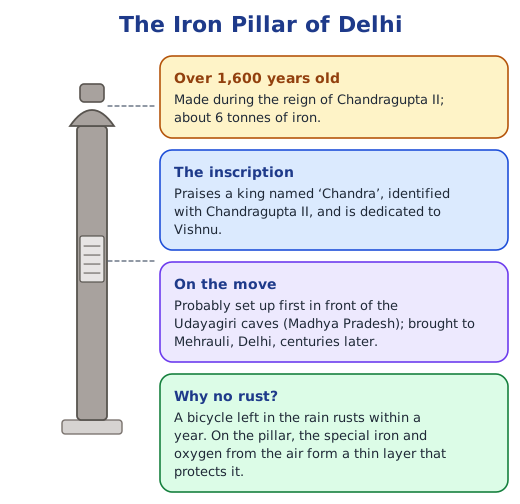
In Mehrauli, Delhi, stands an iron pillar more than 1,600 years old that has still not rusted. It was made in the reign of Chandragupta II, a Gupta king, and its inscription praises a ruler named ‘Chandra’. The chapter follows Bhavisha and Dhruv into his age, from about the 3rd to the 6th century CE, and asks three questions: who the Guptas were and why their time is called the ‘classical age’, what was happening in the rest of the subcontinent, and which great figures of this period still matter.
A new power emerges
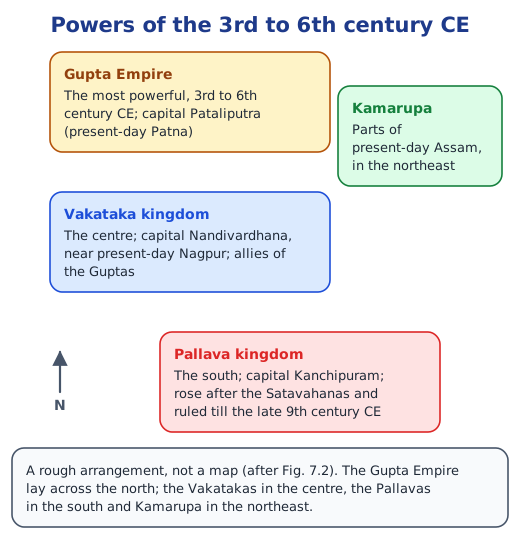
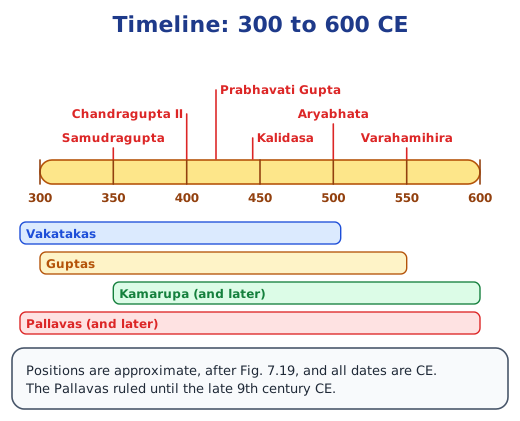
The Kushana Empire in the north and north-west was weakening by the 3rd century CE, and new kingdoms appeared. The Guptas began as regional rulers somewhere near present-day Uttar Pradesh and grew into the most powerful empire of the age, with its capital at Pataliputra (present-day Patna). Around them were the Vakatakas in the centre, the Pallavas in the south and the Kamarupa kingdom in the northeast. Read the Gupta Empire.
The great Gupta kings
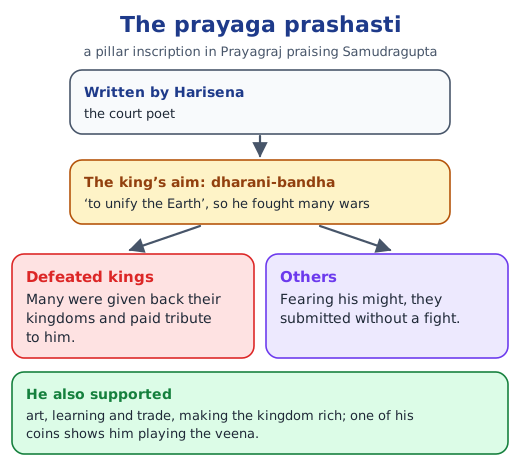
Chandragupta I laid the foundation with his coins and alliances; one gold coin shows him with his queen, Kumaradevi. His son Samudragupta is praised in the prayaga prashasti, a pillar inscription in Prayagraj written by the court poet Harisena. It says the king wanted dharani-bandha, to ‘unify the Earth’, and fought many wars; many defeated kings were given back their kingdoms and paid him tribute, while others gave in without a fight. He also supported art, learning and trade, and a coin shows him playing the veena. His son Chandragupta II, also called Vikramaditya, was a devotee of Vishnu. Historians add the ‘II’ because his grandfather had the same name. At its height, the empire reached across much of today’s northern and western India and into central and eastern India.
A traveller’s view
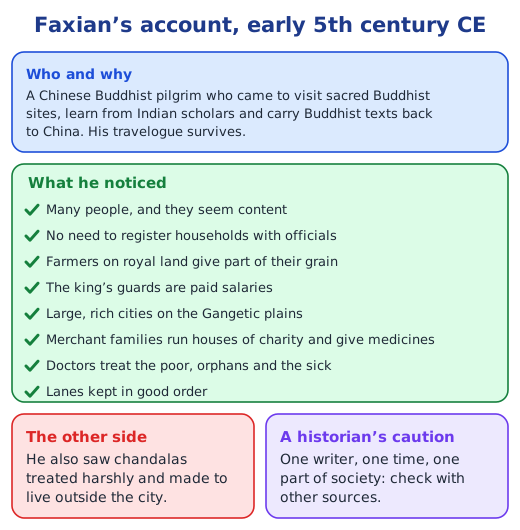
Faxian, a Chinese Buddhist pilgrim, came in the early 5th century CE to visit sacred sites, learn from Indian scholars and take Buddhist texts home. In his travelogue he describes a large and contented population, people who did not have to register their households, farmers who gave part of their grain for royal land, salaried royal guards, rich cities on the Gangetic plains, and charity houses where the poor, orphans and the sick got food, medicine and care. He also records that the chandalas were treated harshly and kept outside the city. Such an account is precious, but it shows one writer’s view of one part of society, so historians check it against other sources.
Running and enriching the empire
Gupta kings took grand titles such as maharajadhiraja, samrat and chakravartin. They held their empire together by conquest, diplomacy and marriage alliances: Chandragupta II’s daughter Prabhavati Gupta married into the Vakataka family and later ruled that kingdom as regent. Instead of controlling everything from the centre, they split the empire into provinces and handed land to priests, chieftains and local rulers, recording the grants on copper plates. Land tax was the main source of revenue, with fines and taxes on mines, irrigation, trade and crafts. Trade reached the Mediterranean world, Southeast Asia and China, with textiles, spices, ivory and gemstones as exports; on Socotra Island in the Arabian Sea, pottery and Brahmi inscriptions show Indian traders living there for centuries.
The classical age
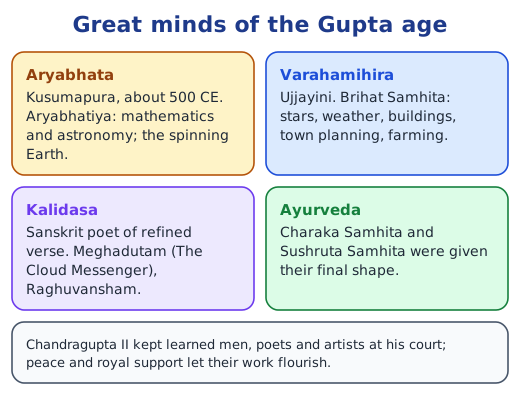
Peace and wealth allowed the Gupta rulers to support scholars and artists, and some historians call this India’s ‘classical age’. Aryabhata, at Kusumapura around 500 CE, suggested that the Earth turns on its axis, explained eclipses and gave the length of a year within minutes of the modern value. Varahamihira of Ujjayini wrote the Brihat Samhita on subjects from astronomy and weather to town planning and farming. Kalidasa wrote refined Sanskrit poetry, including Meghadutam, the Cloud Messenger. Ayurveda was codified in the Charaka Samhita and Sushruta Samhita, and the rust-resistant Iron Pillar shows the skill of the metalworkers. Read the classical age: arts and sciences.
The quest for beauty
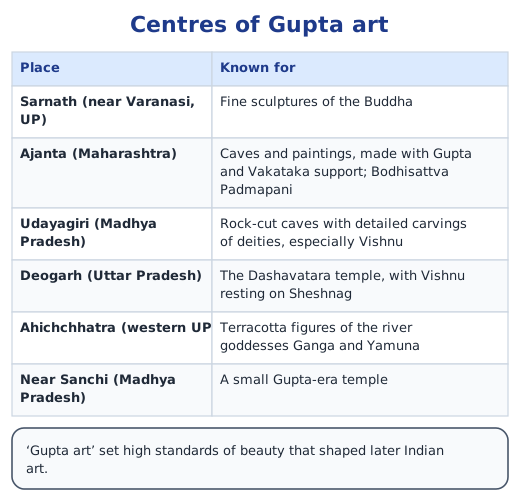
Gupta rulers created conditions in which art thrived. Sarnath, near Varanasi, became famous for sculptures of the Buddha; the Ajanta caves in Maharashtra were carved and painted with Gupta and Vakataka support; and Udayagiri in Madhya Pradesh has rock-cut caves with detailed carvings of deities. The Dashavatara temple at Deogarh and the terracotta river goddesses Ganga and Yamuna from Ahichchhatra are other examples of ‘Gupta art’, which set high standards for later times.
Decline, and the kingdoms around
By the 6th century CE, the Hunas from Central Asia attacked again and again, while powerful regional rulers rose inside the empire, and Gupta power declined. Meanwhile, the Pallavas ruled parts of what are now Tamil Nadu, Karnataka, Telangana and Andhra Pradesh from Kanchipuram, ‘the city of a thousand temples’, and the Kamarupa kingdom of the Varman dynasty ruled the Brahmaputra valley. Samudragupta had defeated rulers of both but let them keep their thrones in return for tribute. Read Vakatakas, Pallavas and Kamarupa.
Before we move on
The Guptas held their empire together through wars, land grants and marriage alliances; their age saw remarkable work in art, literature, science and mathematics; and the Vakatakas, Pallavas and Varmans made the period culturally rich beyond the Gupta lands. Answers to every question are in the NCERT solutions for Chapter 7.
Key terms
| Term | Meaning |
|---|---|
| Gupta dynasty | A ruling family that rose near present-day Uttar Pradesh as the Kushana Empire weakened and ruled a large empire from Pataliputra between the 3rd and 6th centuries CE. |
| Prayaga prashasti | A pillar inscription in Prayagraj, written by the court poet Harisena, that praises the achievements of Samudragupta. |
| Dharani-bandha | ‘Unifying the Earth’, the aim that the prayaga prashasti gives for Samudragupta’s many wars. |
| Vikramaditya | Another name of Chandragupta II, the Gupta ruler in whose reign the Iron Pillar of Delhi was made and art and learning flourished. |
| Tribute | Payment and service that a defeated or weaker king gave to a more powerful ruler in return for keeping his throne. |
| Regent | A person who governs a kingdom for a monarch who cannot rule yet, as Prabhavati Gupta did for her young sons in the Vakataka kingdom. |
| Land grant | Land given by the king to local rulers, priests or chieftains, recorded on copper plates; many such plates have been found. |
| Classical age | A name some historians give the Gupta period for its achievements in literature, science, medicine and art during a long peace. |
| Codified | Arranged or written in an organised, systematic way, as Ayurveda was in texts like the Charaka Samhita and Sushruta Samhita. |
| Outcaste | Someone rejected by a social group; Faxian saw the chandalas treated as outcastes and made to live outside the city. |
| Ghatika | A centre of learning, first seen under the Satavahanas, that helped Kanchipuram grow into a seat of learning under the Pallavas. |
| Maharajadhiraja | ‘Great king of kings’, one of the grand titles, with samrat and chakravartin, that Gupta rulers used to claim supreme power. |
Topics in this chapter
Practice
-
Which Gupta ruler was also known as Vikramaditya?
Show answer
Answer: (c) Chandragupta II
-
Who wrote the prayaga prashasti?
Show answer
Answer: (b) Harisena
-
What was the main source of revenue of the Guptas?
Show answer
Answer: (c) Land tax
-
Which island in the Arabian Sea shows evidence of Indian traders?
Show answer
Answer: (b) Socotra
-
Which capital was called ‘the city of a thousand temples’?
Show answer
Answer: (c) Kanchipuram
-
Who estimated the length of a year as 365 days, 6 hours, 12 minutes and 30 seconds?
Show answer
Answer: (b) Aryabhata
Questions students ask
What are the main topics of Class 7 SST Chapter 7?
The rise of the Guptas; the rulers Chandragupta I, Samudragupta and Chandragupta II; Faxian’s account of society; how the empire was governed and where it traded; the ‘classical age’ of Aryabhata, Varahamihira, Kalidasa and Ayurveda; Gupta art at Sarnath, Ajanta and Udayagiri; the empire’s decline; and the Vakatakas, Pallavas and Kamarupa.
Is The Gupta Era in the new NCERT Class 7 Social Science book?
Yes. It is Chapter 7 of Exploring Society: India and Beyond, the Class 7 Social Science textbook Part 1 (Reprint 2026-27), on pages 145 to 166. It follows The Age of Reorganisation and is the last history chapter of Part 1.
Why is the Gupta period called the classical age?
A long period of peace and a strong economy let the rulers support scholars, poets and artists. Kalidasa wrote in Sanskrit, Aryabhata and Varahamihira advanced mathematics and astronomy, Ayurveda was codified, the rust-resistant Iron Pillar was made, and art at Ajanta and Sarnath set lasting standards. Earlier knowledge was also gathered into texts.
Why did the Gupta Empire decline?
By the 6th century CE, later Gupta rulers faced repeated attacks by the Hunas, a fierce tribe from Central Asia, which weakened their hold on north India. At the same time, powerful regional rulers rose and conflicts broke out inside the empire. The book asks whether this was an end or a turning point.
Stuck on a question?
Take a photo and Lagnever AI explains it step by step. Try it for 7 days for ₹2.
Get it on Google Play Open in browser
For parents: after the trial, the plan renews monthly by UPI or card autopay. You can cancel anytime in the app.