
The Gupta Empire
Answer in short
The Gupta Empire rose in the 3rd century CE near present-day Uttar Pradesh and ruled much of north India from Pataliputra until the 6th century. Samudragupta expanded it through wars and tribute, Chandragupta II strengthened it, and land grants, alliances and trade kept it rich. Huna attacks and regional rivals finally weakened it.
Stuck on a question? Take a photo and Lagnever AI explains it step by step. Try it for 7 days for ₹2. Get it on Google Play
How the Guptas rose
The Kushana Empire, which had spread over the north and north-west of the subcontinent, was losing strength by the 3rd century CE, and new kingdoms appeared in its place. Historians have several theories about where the Guptas came from, but most believe they began as regional rulers in an area near present-day Uttar Pradesh. Over time they became the strongest power of the age, ruling from Pataliputra, present-day Patna, between the 3rd and the 6th centuries CE.
Three generations of kings
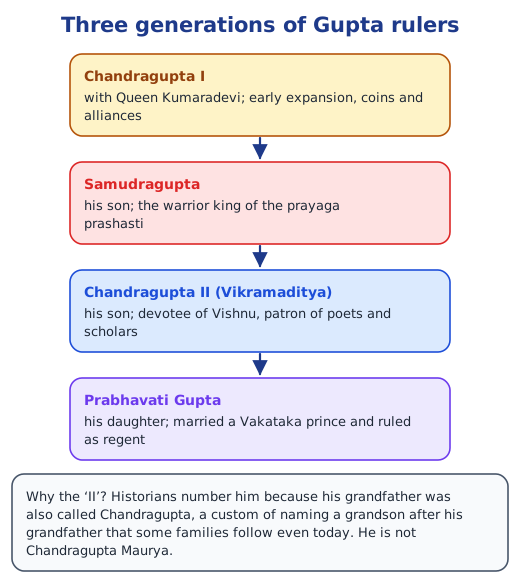
Chandragupta I laid the foundation of the empire. He is remembered for his coins, one of which shows him with his queen, Kumaradevi, and for alliances that strengthened his position. His son Samudragupta was the great warrior of the family. Chandragupta II, Samudragupta’s son, is also called Vikramaditya. He worshipped Vishnu, whose mount Garuda often appears on Gupta inscriptions, and the Iron Pillar of Delhi praises him as a king named ‘Chandra’.
Samudragupta, the warrior king
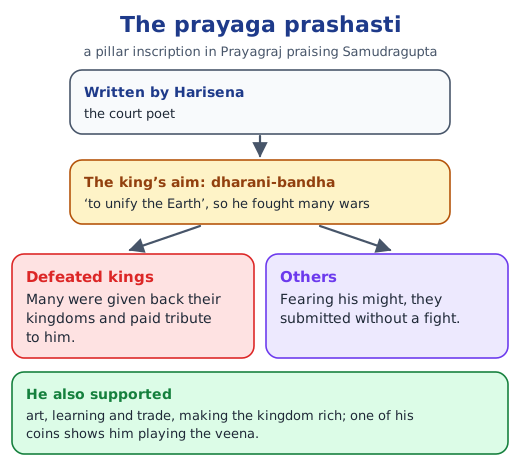
Much of what we know about Samudragupta comes from the prayaga prashasti, an inscription on a pillar in Prayagraj composed by his court poet, Harisena. It says the king’s ambition was dharani-bandha, to ‘unify the Earth’. He fought many wars. Many of the kings he defeated were put back on their thrones and paid him tribute, and others, afraid of his power, gave in without a fight. Harisena also praises him for supporting art, learning and trade, and one of his gold coins shows him seated, playing the veena. Imagine moving an army of soldiers, elephants, horses and cooks across such distances: the tributary kings must have helped supply it.
How far the empire reached
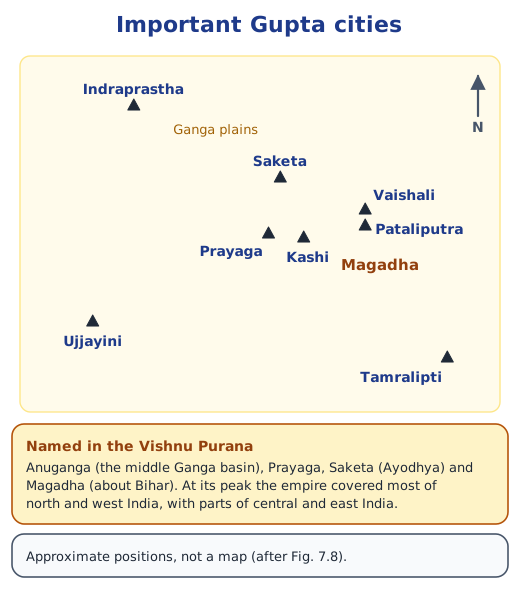
The Vishnu Purana names the core regions of the Guptas: Anuganga, the middle Ganga basin; Prayaga; Saketa, which is Ayodhya; and Magadha, roughly Bihar. At its height, though, the empire was larger, reaching across much of today’s northern and western India and into central and eastern India, with cities such as Pataliputra, Prayaga, Kashi, Vaishali, Ujjayini and the port of Tamralipti.
Titles, alliances and land grants
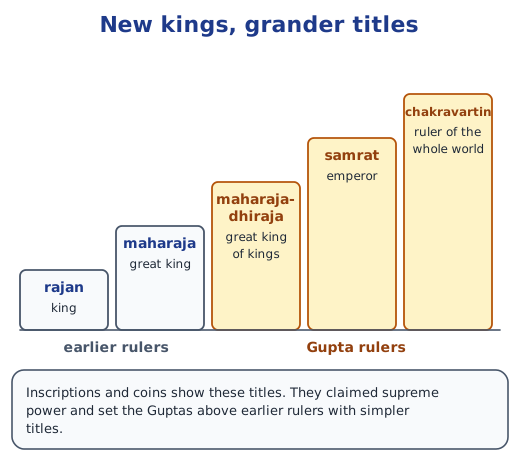
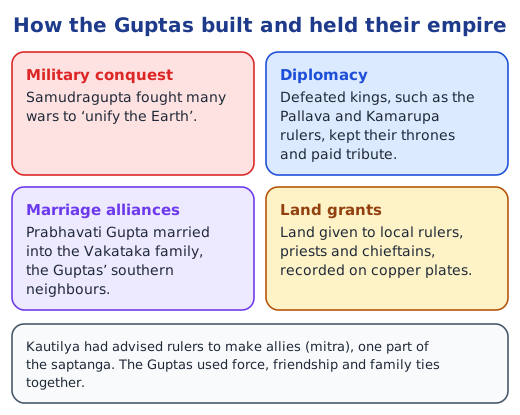
Gupta rulers called themselves maharajadhiraja, samrat and chakravartin, grander titles than the simple rajan or maharaja of earlier kings. Kautilya had advised kings to win allies, and the Guptas used conquest, diplomacy and marriage alliances together. Chandragupta II’s daughter, Prabhavati Gupta, married a Vakataka prince; after his early death she ruled as regent and kept the two families close. Inside the empire, the rulers created provinces and handed land to priests, chieftains and local rulers, carefully recording each grant on a copper plate.
Taxes and trade
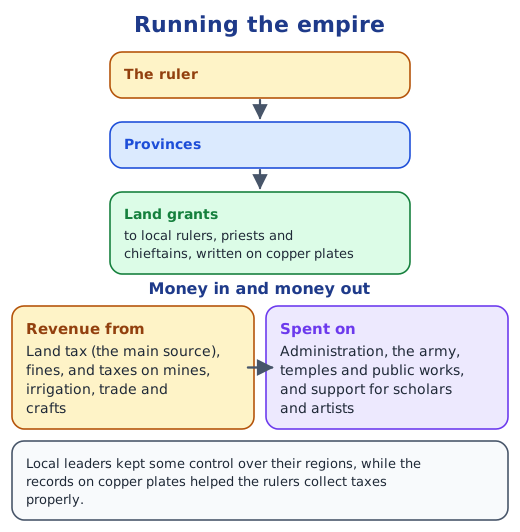
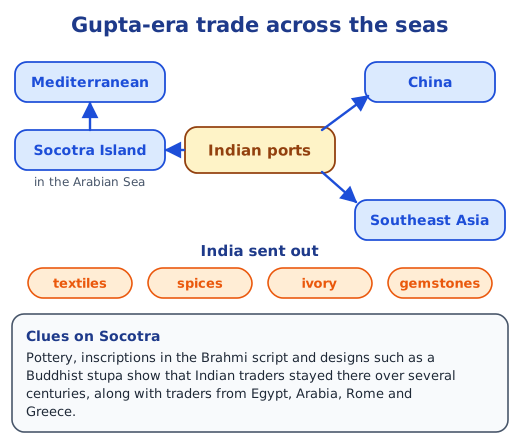
Land tax was the main source of revenue, along with fines and taxes on mines, irrigation, trade and crafts. The money paid for administration, the army, temples and public works, and for scholars and artists. Trade by land and sea kept the empire rich. Indian ports sent textiles, spices, ivory and gemstones to the Mediterranean world, Southeast Asia and China. On Socotra Island in the Arabian Sea, a stop on the way to Mediterranean markets, pottery, Brahmi inscriptions and stupa designs show that Indian traders lived there for centuries alongside traders from Egypt, Arabia, Rome and Greece.
Decline
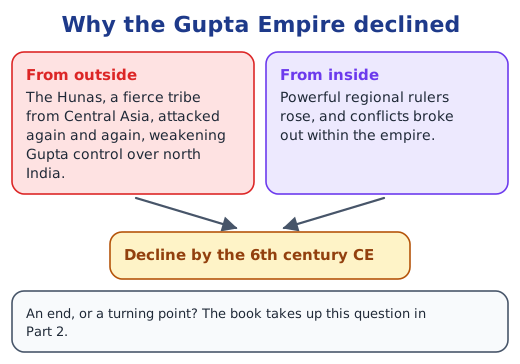
By the 6th century CE the empire was weakening. The Hunas, a fierce tribe from Central Asia, attacked it repeatedly and loosened Gupta control over north India, while strong regional rulers rose and fought inside the empire. Whether this was simply an end, or the start of a new chapter in Indian history, is a question the book takes up in Part 2.
Why it matters
The Gupta Empire shows how a large state could be held together by more than force: by alliances, records on copper plates and shared wealth from trade. The achievements this peace made possible are in the classical age: arts and sciences, and the kingdoms around the Guptas in Vakatakas, Pallavas and Kamarupa. Answers to every question are in the NCERT solutions for Chapter 7; see also the full Chapter 7 notes.
Practice
-
Where was the capital of the Gupta Empire?
Show answer
Answer: (b) Pataliputra
-
What does ‘dharani-bandha’ mean?
Show answer
Answer: (b) Unifying the Earth
-
On what were Gupta land grants recorded?
Show answer
Answer: (c) Copper plates
-
Name three ways the Guptas built and held their empire.
Show answer
Answer: Military conquest, as in Samudragupta’s wars; diplomacy, letting defeated kings keep their thrones for tribute; and marriage alliances, such as Prabhavati Gupta’s marriage into the Vakataka family. Land grants recorded on copper plates also helped.
-
Why did the Gupta Empire decline?
Show answer
Answer: From the 6th century CE, the Hunas of Central Asia attacked it again and again, and powerful regional rulers rose, causing conflicts inside the empire.
Questions students ask
Who were the Guptas?
The Guptas were a dynasty that rose as regional rulers near present-day Uttar Pradesh when the Kushana Empire weakened in the 3rd century CE. From their capital Pataliputra they built the most powerful empire of the time, covering much of northern and western India and some of central and eastern India.
What does the prayaga prashasti tell us about Samudragupta?
Written by the court poet Harisena on a pillar in Prayagraj, it praises Samudragupta’s aim to ‘unify the Earth’ and his many wars. It says many defeated kings got their kingdoms back and paid him tribute, others submitted out of fear, and that he supported art, learning and trade.
How was the Gupta Empire governed?
The rulers split the empire into provinces and made grants of land to priests, chieftains and local rulers, writing each grant on copper plates. This kept accurate records, helped collect taxes, and let local leaders keep some control. Land tax was the main revenue, spent on administration, the army, temples and public works, and scholars.
Stuck on a question?
Take a photo and Lagnever AI explains it step by step. Try it for 7 days for ₹2.
Get it on Google Play Open in browser
For parents: after the trial, the plan renews monthly by UPI or card autopay. You can cancel anytime in the app.