
Vakatakas, Pallavas and Kamarupa
Answer in short
While the Guptas ruled the north, the Vakatakas held the centre from Nandivardhana and became Gupta allies through Prabhavati Gupta’s marriage. The Pallavas ruled the south from Kanchipuram, and the Kamarupa kingdom of the Varmans ruled the Brahmaputra valley. Samudragupta defeated Pallava and Kamarupa rulers but let them keep their thrones for tribute.
Stuck on a question? Take a photo and Lagnever AI explains it step by step. Try it for 7 days for ₹2. Get it on Google Play
Kingdoms beside the Guptas
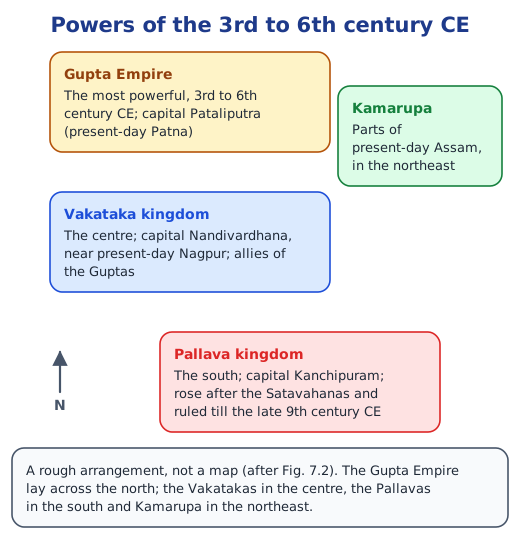
The Gupta Empire was the strongest power of its age, but it was not alone. Between the 3rd and 6th centuries CE, the Vakatakas ruled the centre of the subcontinent, the Pallavas rose in the south and the Kamarupa kingdom flourished in the northeast. Some of these kingdoms fought each other to grow, while others became friends; Kautilya had advised rulers to make allies, and the Guptas did so too.
The Vakatakas and Prabhavati Gupta
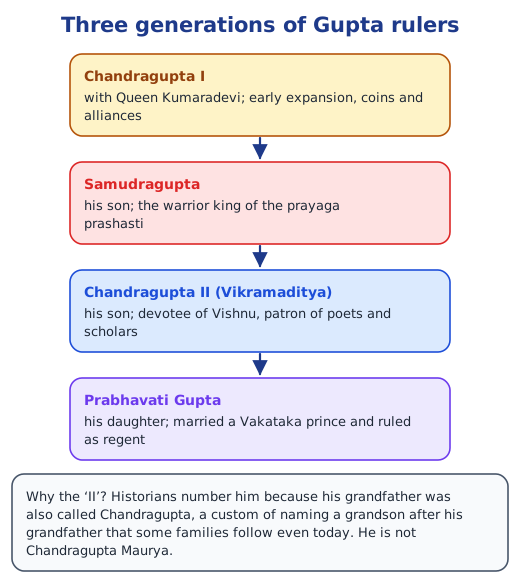
From Nandivardhana, close to today’s Nagpur, the Vakatakas held the middle of the subcontinent; they were the Guptas’ neighbours to the south. The two families were joined by marriage: Prabhavati Gupta, daughter of Chandragupta II, married a Vakataka prince. He died young, and she governed as regent until her sons could rule. One of her inscriptions calls her the ‘mother of two kings’, since both her sons later sat on the Vakataka throne. During her rule the friendship with the Guptas stayed strong. Like her father, she worshipped Vishnu and is linked with seven temples to him and his avatars, some on Ramagiri (Ramtek hill) in present-day Maharashtra. A painting in the book, an artist’s reimagining, shows her holding court.
The Pallavas of Kanchipuram
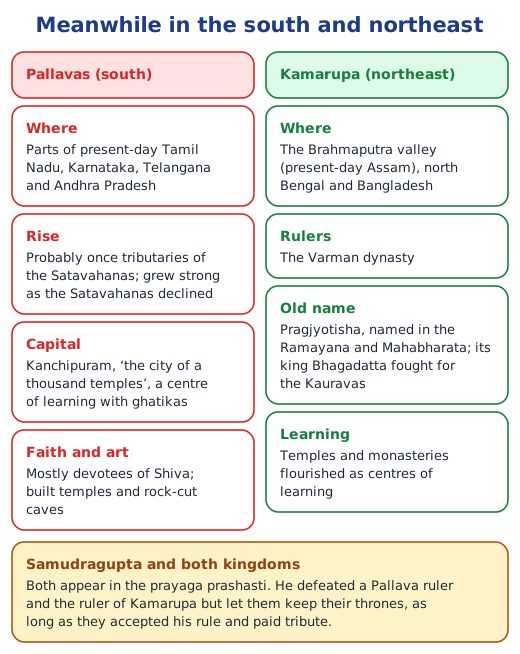
The origins of the Pallavas are not clear, but they were probably once tributaries of the Satavahanas, met in the previous chapter, and to have risen as the Satavahanas weakened. Step by step they took control of areas in what are now Tamil Nadu, Karnataka, Telangana and Andhra Pradesh, and they ruled until the second half of the 9th century CE. Most Pallava kings worshipped Shiva and built magnificent temples and rock-cut caves. Their capital, Kanchipuram, often called ‘the city of a thousand temples’, became one of the great centres of learning in the south, helped by ghatikas, centres of learning that first appeared under the Satavahanas.
Kamarupa in the northeast
In the northeast, the Varman dynasty ruled the Kamarupa kingdom across the Brahmaputra valley, roughly today’s Assam, along with the north of Bengal and of Bangladesh. An old name for this valley is Pragjyotisha, found in the Ramayana and the Mahabharata; the Mahabharata says its king Bhagadatta fought for the Kauravas, and some later rulers claimed him as an ancestor. Kamarupa was a lively cultural and political centre, where temples and monasteries grew into centres of learning.
Samudragupta and his neighbours
Both the Pallavas and Kamarupa appear in the prayaga prashasti. During his campaigns in the south, Samudragupta beat a Pallava ruler yet left the region in local hands; the local kings stayed on their thrones, provided they accepted him as overlord and sent tribute. He treated the ruler of Kamarupa in the northeast the same way. This pattern, defeat followed by tribute rather than direct rule, kept the peace and appears again and again in Indian history.
One timeline, four powers
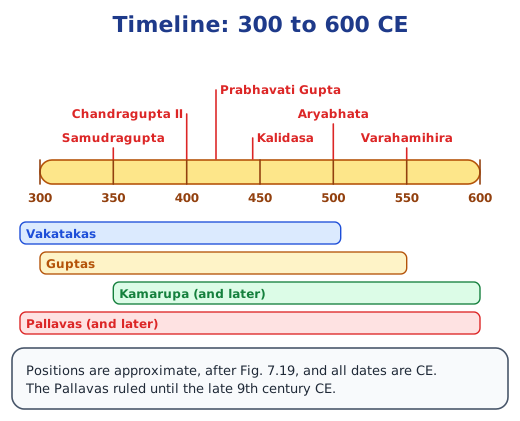
Placed on one timeline, the four powers overlap. The Vakatakas ruled until about 500 CE and the Guptas from about 300 to 550 CE, while Kamarupa and the Pallavas carried on well beyond 600 CE. The great figures of the age, from Samudragupta and Prabhavati Gupta to Kalidasa, Aryabhata and Varahamihira, all lived within these three centuries.
Why it matters
These kingdoms show that the Gupta age was rich across the whole subcontinent, not only in the north: Kanchipuram and Kamarupa were centres of learning in their own right. The empire itself is in the Gupta Empire, and its science and art in the classical age: arts and sciences. Answers to every question are in the NCERT solutions for Chapter 7; see also the full Chapter 7 notes.
Practice
-
Who ruled the Vakataka kingdom as regent?
Show answer
Answer: (b) Prabhavati Gupta
-
Which dynasty ruled the Kamarupa kingdom?
Show answer
Answer: (a) The Varmans
-
What was a ghatika?
Show answer
Answer: (b) A centre of learning
-
Where did the Pallavas rule?
Show answer
Answer: In the south, over parts of what are now Tamil Nadu, Karnataka, Telangana and Andhra Pradesh, with their capital at Kanchipuram.
-
What was Pragjyotisha?
Show answer
Answer: An old name of Assam’s Brahmaputra valley, mentioned in the Ramayana and the Mahabharata; the Mahabharata names its king Bhagadatta, who fought for the Kauravas.
Questions students ask
Who were the Vakatakas?
The Vakatakas held the middle of the subcontinent and ruled from Nandivardhana, close to today’s Nagpur. They were allies of the Guptas: Chandragupta II’s daughter Prabhavati Gupta married a Vakataka prince and, after his early death, ruled the kingdom as regent. The Ajanta caves were carved with Vakataka and Gupta support.
Who were the Pallavas and where did they rule?
The Pallavas were a southern dynasty, probably once tributaries of the Satavahanas, who grew strong as the Satavahanas declined. They ruled parts of what are now Tamil Nadu, Karnataka, Telangana and Andhra Pradesh from Kanchipuram until the late 9th century CE, built temples and rock-cut caves, and were mostly devotees of Shiva.
What was the Kamarupa kingdom?
Kamarupa was a kingdom in the northeast ruled by the Varman dynasty. It covered the Brahmaputra valley, roughly today’s Assam, along with the north of Bengal and of Bangladesh. Its temples and monasteries were centres of learning, and its old name, Pragjyotisha, appears in the Ramayana and Mahabharata.
Stuck on a question?
Take a photo and Lagnever AI explains it step by step. Try it for 7 days for ₹2.
Get it on Google Play Open in browser
For parents: after the trial, the plan renews monthly by UPI or card autopay. You can cancel anytime in the app.