
NCERT Solutions Class 7 Social Science Chapter 7: The Gupta Era: An Age of Tireless Creativity
Answers to every question in Chapter 7, The Gupta Era: An Age of Tireless Creativity, of Exploring Society: India and Beyond, the Class 7 Social Science textbook Part 1 (Reprint 2026-27): the Big Questions, the Think About It question, all six Let’s Explore activities and all seven Questions and activities. Page numbers follow the book (pages 145–166). Short notes: Chapter 7 notes.
The Big Questions (page 145)
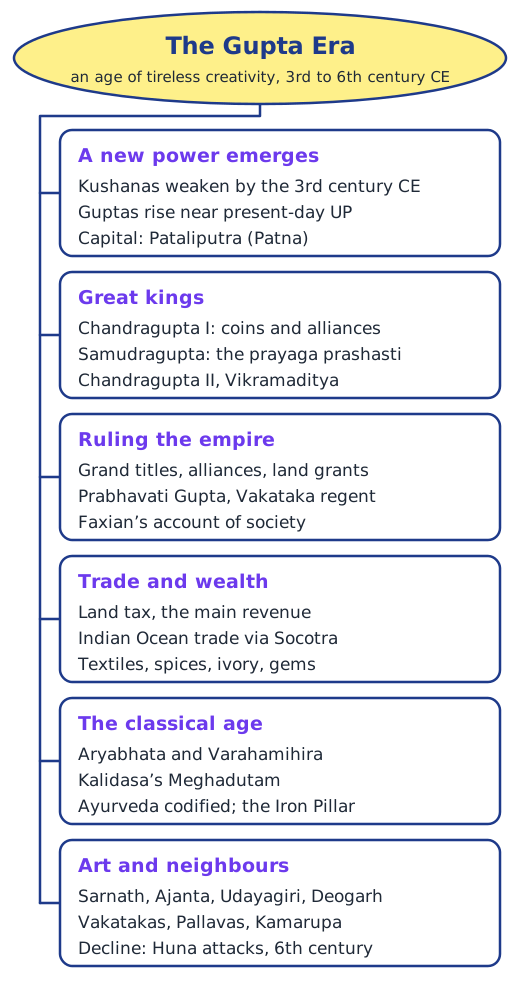
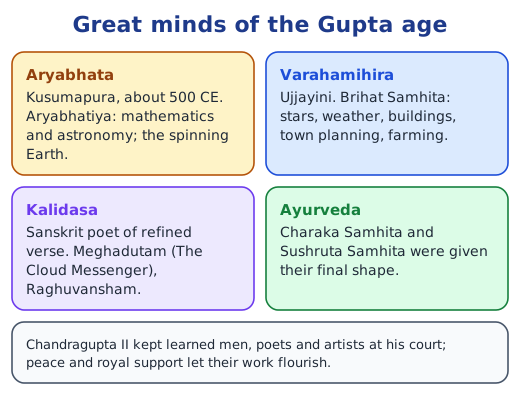
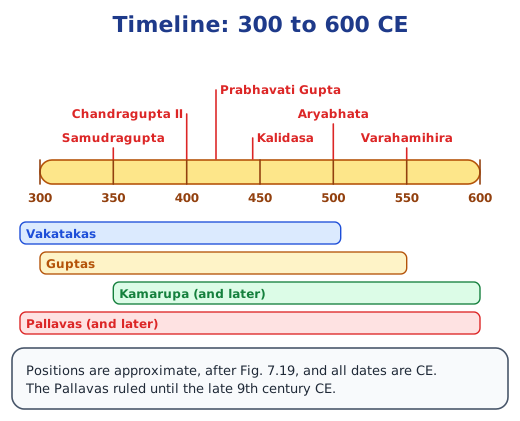
1. Who were the Guptas? Why is the Gupta period called the ‘classical age’? The Guptas were a dynasty that rose as regional rulers near present-day Uttar Pradesh as the Kushana Empire weakened in the 3rd century CE. From Pataliputra they built the strongest empire of the age, which lasted until the 6th century CE, under kings such as Chandragupta I, Samudragupta and Chandragupta II. The period is called the ‘classical age’ because a long peace and a strong economy let rulers support scholars and artists: Kalidasa’s Sanskrit poetry, Aryabhata’s and Varahamihira’s mathematics and astronomy, the codified Ayurveda texts, the rust-resistant Iron Pillar and the art of Sarnath and Ajanta set standards that later ages looked back to.
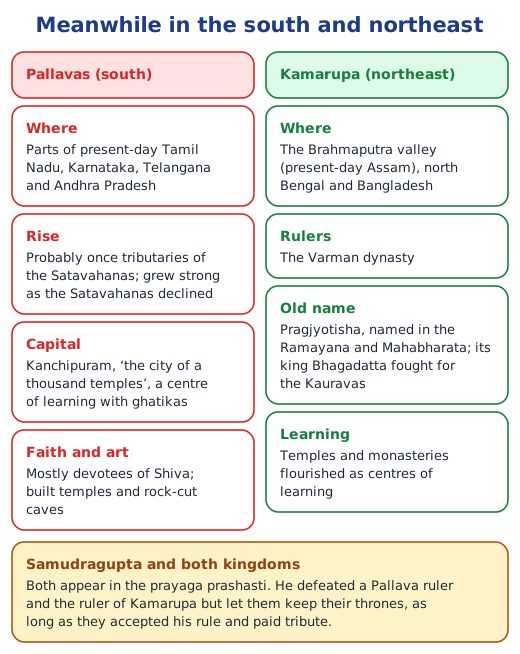
2. What was happening in the rest of the subcontinent? Other kingdoms flourished at the same time. The Vakatakas ruled the centre from Nandivardhana and became Gupta allies through marriage; the Pallavas ruled the south from Kanchipuram, a centre of temples and learning; and the Kamarupa kingdom of the Varman dynasty ruled the Brahmaputra valley in the northeast. Samudragupta defeated Pallava and Kamarupa rulers but left them on their thrones in return for tribute.
3. Who were some great figures of this period, and why do their stories matter today? Samudragupta, Chandragupta II and the regent Prabhavati Gupta; the traveller Faxian; Aryabhata, who said the Earth turns on its axis; Varahamihira, whose Brihat Samhita covered astronomy, weather and town planning; and the poet Kalidasa. Their stories matter because their ideas still shape mathematics, astronomy, medicine, literature and art in India, and because they show how creativity grows when knowledge is valued.
Think About It (page 150)
Why did kings proclaim their achievements in inscriptions? Inscriptions on stone pillars, rocks and metal last for centuries, so a king’s deeds would be remembered long after his death. Set up in public places, they were read out and seen by many people, which spread the king’s fame and his claim to rule. They also showed his devotion and generosity. We should remember that court poets such as Harisena wrote them to praise the king, so they paint a flattering picture and need checking against other sources.
Let’s Explore (page 151): the sources so far
- The Iron Pillar and its inscription: a king named ‘Chandra’, Chandragupta II, devoted to Vishnu; and the metalworkers’ skill, since it has not rusted in 1,600 years.
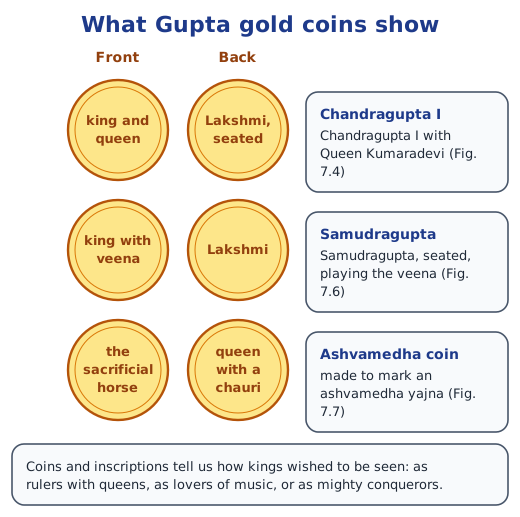
- The gold coin of Chandragupta I and Kumaradevi: the importance of his queen and alliances, and the worship of Lakshmi, on the back.
- The prayaga prashasti by Harisena: Samudragupta’s aim to unify the Earth, his wars, how he treated defeated kings, and his support for art, learning and trade.
- Samudragupta’s veena coin: his love of music.
- The ashvamedha coin: that kings performed this yajna to claim supreme power and marked it with special coins.
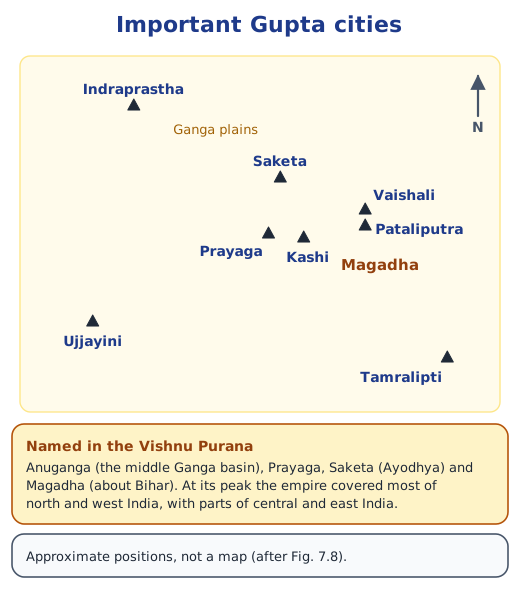
- The Vishnu Purana, a literary source: the core regions of the empire, Anuganga, Prayaga, Saketa and Magadha.
Let’s Explore (page 151): states and Union territories
Laying the shaded area of Fig. 7.8 over a political map, the empire covers all or part of about a dozen present-day states and Union territories: Punjab, Chandigarh, Haryana, Delhi, Rajasthan, Gujarat, Uttar Pradesh, Uttarakhand, Madhya Pradesh, Bihar, Jharkhand and West Bengal, with its edges touching Himachal Pradesh, Chhattisgarh and Odisha. Counts of about 11 to 15 are reasonable, because the border on a small map is approximate and some states are only partly covered; that is why classmates may get different numbers.
Let’s Explore (page 153): Faxian’s account
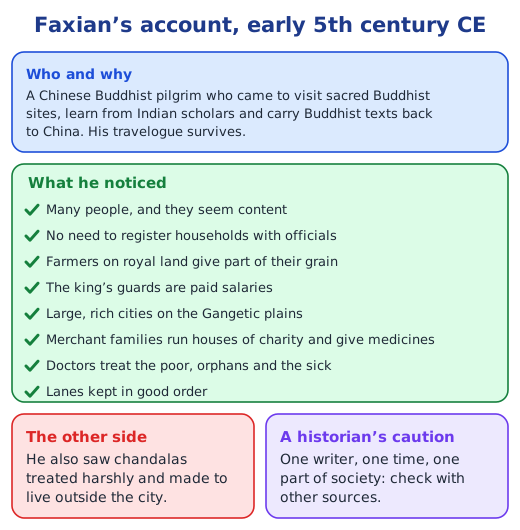
Key features of the society he describes: a large and contented population; little interference from officials, since households did not have to be registered; farmers of royal land paying a share of their grain; salaried royal guards and attendants; large, prosperous cities on the Gangetic plains whose people valued kindness and right conduct; merchant families running charity houses that gave food and medicine; care for the poor, orphans and the sick, with doctors treating the needy; wealthy merchants, including foreign ones, with fine homes; and well-kept lanes. Elsewhere he also notes the harsh treatment of chandalas, who had to live outside the city. Different readers may stress different features, which is why historians compare several sources.
Let’s Explore (page 155): Prabhavati Gupta’s court
In the painting (an artist’s reimagining), Prabhavati Gupta sits on a carved throne, wearing a crown, rich red garments and jewellery, with a small child on her lap. An attendant behind her holds a chauri, a sign of royalty; turbaned men, one with a document, stand or kneel before her with folded hands; and the hall has carved pillars. These details suggest that she ruled as regent for her young son, that ministers and scholars reported to her and respected her authority, and that her court was rich and well organised. They also show that a woman could hold real power in this period.
Let’s Explore (page 159): interview questions
For Aryabhata: How did you work out that the Earth turns on its axis? How did you measure the length of a year so accurately without modern instruments? What causes eclipses, and why do people fear them? How did you estimate the size of the Earth? Which method of calculation do you think students should learn first?
For Varahamihira: How did you collect knowledge on so many subjects for the Brihat Samhita? How can people forecast the weather by watching nature? What makes a good plan for a town? Which crops did farmers ask you about most? How do you decide whether an old idea is right?
Let’s Explore (page 160): which deities?
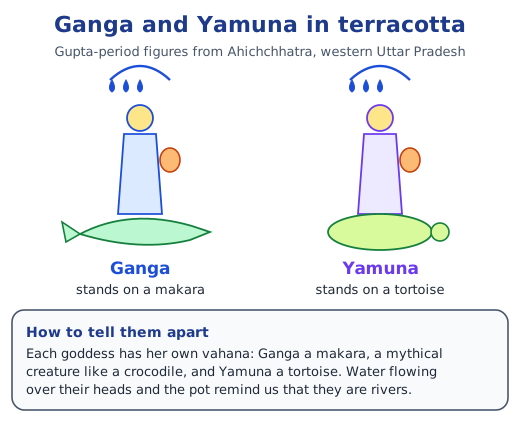
Fig. 7.15.1 is Shiva: a face carved on a linga, with matted hair and a crescent moon. Fig. 7.15.2 is Vishnu: a crowned figure with a large halo and four arms holding his emblems, such as the conch. The third image, as the caption says, shows the river goddesses Ganga, standing on a makara, and Yamuna, standing on a tortoise.
Questions and activities (pages 165–166)
1. A letter from Pataliputra (sample).
Greetings from Pataliputra! Life here is vibrant and full of excitement. Just yesterday, I witnessed a long line of boats on the Ganga unloading cotton cloth, spices and ivory for the market, while merchants from distant lands bargained in many languages. The city is huge, and its lanes are swept and kept in order. Near the market, a charity house set up by a merchant family gives food and medicine at no cost, and a doctor there treats the poor and the sick. Farmers who work the king’s land came in with a share of their grain, and the royal guards, who are paid salaries, kept watch at the gates. In the evening I went to a temple of Vishnu, where people were talking about the king’s victories that a court poet had written on a pillar. Gold coins with the king and Lakshmi change hands in the shops. Scholars at the court discuss the stars and the turning of the Earth, and someone recited a new poem in Sanskrit about a cloud carrying a message. Not everyone shares this comfort, though: the chandalas must live outside the city walls, and I felt sad to see that. Still, there is peace, trade and learning everywhere, and every day brings something new to see. Write back soon and tell me how life is in your town!
2. Chandragupta II was also known as Vikramaditya.
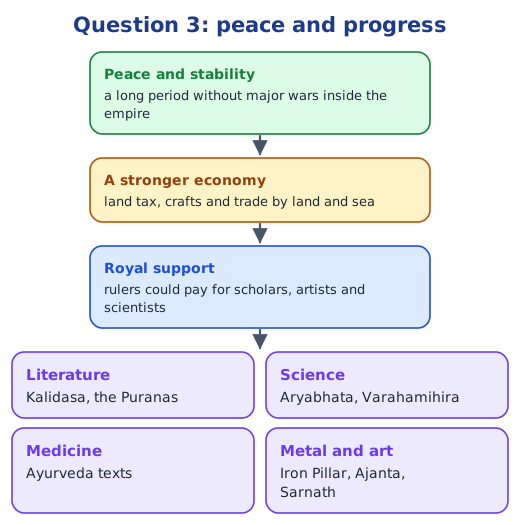
3. Peace and progress in the Gupta empire. The statement fits the Gupta period well. A long peace and stability strengthened the economy through land tax, crafts and trade by land and sea, so the rulers could support scholars, artists and scientists. Chandragupta II kept poets and learned men at his court. In literature, Kalidasa wrote his Sanskrit poems and many major Puranas took shape; in science, Aryabhata and Varahamihira advanced mathematics and astronomy; in medicine, Ayurveda was codified; in metalwork, the Iron Pillar was made; and in art, Sarnath, Ajanta and Udayagiri flourished. Earlier knowledge was also collected into texts. Peace was not the only cause, since wealth and royal patronage mattered too, and when the Huna attacks began, the empire weakened.
4. A scene from Chandragupta II’s court (sample script). Roles: King Chandragupta II, a minister, Kalidasa, Varahamihira, a merchant, a messenger from the Vakataka court.
Messenger: Maharajadhiraja, Princess Prabhavati sends greetings from the Vakataka court. The friendship of our two kingdoms stays strong.
King: Tell her that her father is proud of her. Minister, what news from the provinces?
Minister: The land grants are recorded on copper plates, and the land tax has come in well this year.
Merchant: Maharaja, our ships are back from Socotra with news of traders from Egypt and Rome, who want more of our cloth and spices.
Varahamihira: The signs in the sky and the winds suggest good rains, so the farmers can sow on time.
Kalidasa: Then let me recite a few lines about the clouds that bring them.
King: Wisdom and knowledge make a kingdom strong. Let scholars and poets always find a place in this court.
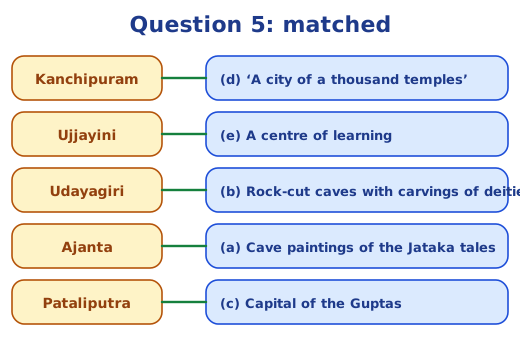
5. (1) Kanchipuram – (d) ‘a city of a thousand temples’; (2) Ujjayini – (e) a prominent centre of learning; (3) Udayagiri – (b) rock-cut caves with carvings of Hindu deities, especially Vishnu; (4) Ajanta – (a) cave paintings of the Jataka tales; (5) Pataliputra – (c) capital of the Guptas.
6. Who were the Pallavas and where did they rule? The Pallavas were a southern dynasty whose origins are unclear; they seem to have been tributaries of the Satavahanas and rose as the Satavahanas declined. They gradually ruled parts of what are now Tamil Nadu, Karnataka, Telangana and Andhra Pradesh, with their capital at Kanchipuram, ‘the city of a thousand temples’, until the late 9th century CE. Mostly devotees of Shiva, they built temples and rock-cut caves, and Kanchipuram, with its ghatikas, became a major centre of learning. Samudragupta defeated a Pallava ruler but let the kingdom continue under him in return for tribute.
7. A heritage trip report. Plan the visit with your teachers, then write the report under these headings: the place, where it is and when it was built; why it is historically important; the architecture, such as its plan, materials, pillars, carvings or paintings; the artefacts you saw and what they tell us; interesting facts from guides or labels; and what you learned. End with a reflection on how seeing the site made the past feel real, for example how a temple’s carvings told stories or how an old coin showed a ruler. Add sketches or photos where allowed.
Short notes and more practice are on the topic pages: the Gupta Empire, the classical age: arts and sciences and Vakatakas, Pallavas and Kamarupa.
Practice
-
Which inscription praises Samudragupta?
Show answer
Answer: (b) The prayaga prashasti
-
Which traveller came to India early in the 5th century CE?
Show answer
Answer: (b) Faxian
-
Which place is matched correctly?
Show answer
Answer: (b) Udayagiri: rock-cut caves with carvings of deities
-
Name the two medical texts given their final shape in the Gupta period.
Show answer
Answer: The Charaka Samhita and the Sushruta Samhita, which laid the foundation of Ayurveda.
-
Why did Samudragupta let defeated kings keep their thrones?
Show answer
Answer: Provided they accepted him as overlord and sent tribute, letting them rule was easier than governing distant lands directly, and it kept peaceful relations, as with the Pallavas and Kamarupa.
Stuck on a question?
Take a photo and Lagnever AI explains it step by step. Try it for 7 days for ₹2.
Get it on Google Play Open in browser
For parents: after the trial, the plan renews monthly by UPI or card autopay. You can cancel anytime in the app.