
The classical age: arts and sciences
Answer in short
The Gupta period is called India’s classical age because long peace and royal support produced great work. Aryabhata and Varahamihira advanced mathematics and astronomy, Kalidasa wrote refined Sanskrit poetry, Ayurveda was codified, the Iron Pillar showed skilled metalwork, and Sarnath, Ajanta and Udayagiri set high standards in art.
Stuck on a question? Take a photo and Lagnever AI explains it step by step. Try it for 7 days for ₹2. Get it on Google Play
Why a classical age?
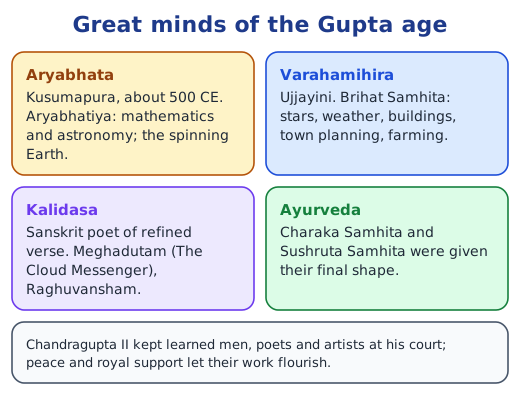
The long peace and stability of the Gupta period strengthened the economy, so the state could support scholars, artists and scientists. Chandragupta II in particular kept learned men, poets and artists around him. Knowledge from earlier times was gathered and written down in many texts, Sanskrit literature and the Puranas flourished, and new advances came in mathematics, astronomy, medicine and metalwork. For these reasons some historians call this the ‘classical age’ of India.
Aryabhata
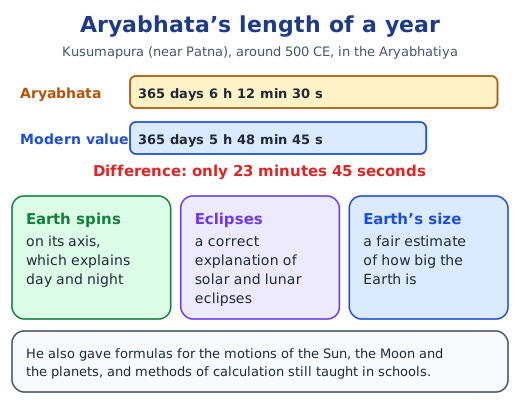
Aryabhata lived around 500 CE in Kusumapura, near present-day Patna, a well-known centre of learning. In a short work called the Aryabhatiya he worked out how the Sun, the Moon and the planets move, and suggested that the Earth turns on its axis, which gives us day and night. He estimated the size of the Earth fairly well and explained solar and lunar eclipses correctly. His length of a year, 365 days, 6 hours, 12 minutes and 30 seconds, is only about 24 minutes more than the modern value. Some of his methods of calculation are still taught in schools, about 1,500 years later.
Varahamihira
Varahamihira, a mathematician and astronomer of the same period, lived in Ujjayini, a city known for learning. His encyclopedia, the Brihat Samhita, ranged over astronomy and astrology, forecasting the weather, architecture and town planning, and even farming. He observed the world closely and reasoned about it while drawing on traditional knowledge, which made him a pioneer in science.
Kalidasa
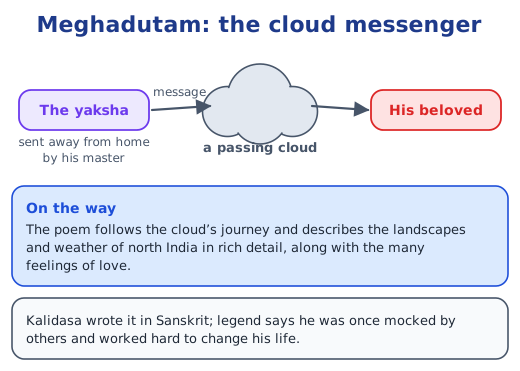
Little is certain about Kalidasa’s life; one legend says that others once mocked him, and this pushed him to work hard and change his life. He became famous for polished Sanskrit poetry. In Meghadutam, the Cloud Messenger, a yaksha sent away from home by his master asks a passing cloud to carry a message to his beloved, and the poem paints the landscapes and weather of north India along the way. The chapter opens with a line from his Raghuvansham: a kingdom grows strong through wisdom and knowledge, not luxury.
Ayurveda
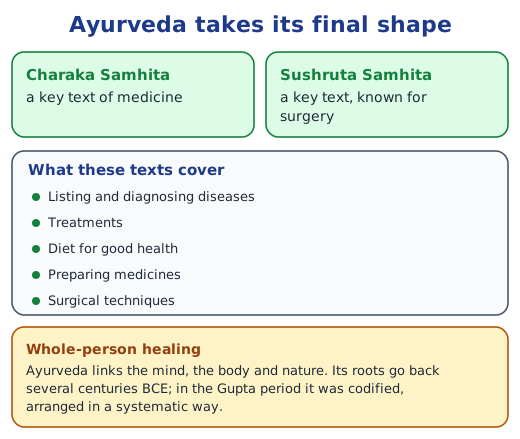
Ayurveda, India’s traditional system of medicine, has roots going back several centuries BCE, but its key texts, the Charaka Samhita and the Sushruta Samhita, were compiled and given their final form in the Gupta period. They cover how to list and diagnose diseases, treatments, the role of diet in good health, preparing medicines, and surgical techniques that were advanced for the time. Ayurveda treats a person as a whole, linking the mind, the body and nature.
Metalwork: the Iron Pillar
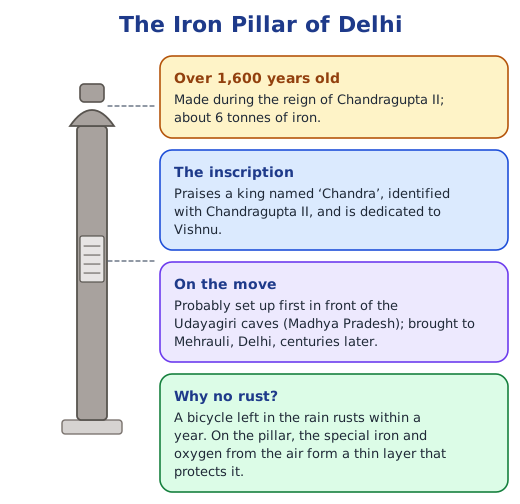
The Iron Pillar of Delhi, about 6 tonnes, was made in the reign of Chandragupta II, probably for Udayagiri, and moved to Mehrauli centuries later. A bicycle left in the rain would rust within a year, yet this pillar has stood in the open for over 1,600 years. Scientists think the special iron and oxygen from the air form a thin layer on its surface that protects it.
The quest for beauty
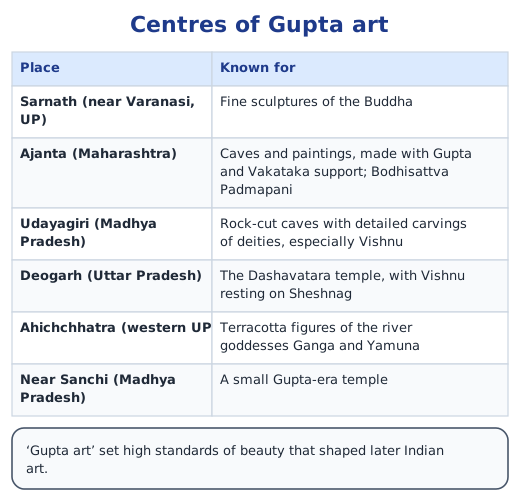
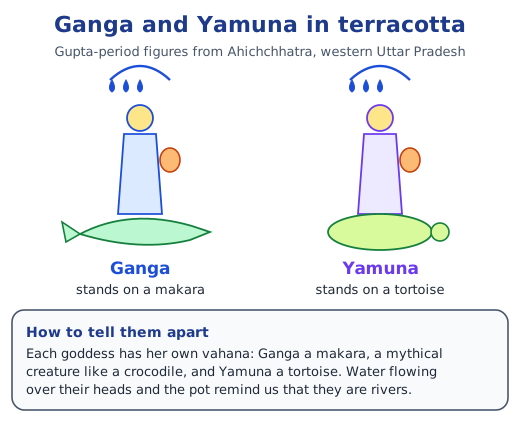
Gupta rulers gave artists room to flourish, and several great centres of art grew up. Sarnath, near Varanasi, is known for its graceful Buddha sculptures; the caves of Ajanta in Maharashtra were carved and painted with Gupta and Vakataka support; and Udayagiri in Madhya Pradesh has rock-cut caves with detailed carvings of deities. At Deogarh, the Dashavatara temple shows Vishnu resting on Sheshnag, and terracotta figures from Ahichchhatra show the rivers Ganga and Yamuna as goddesses, told apart by their mounts.
Why it matters
The ideas and works of this age, from the spinning Earth to Meghadutam and Ajanta, still shape Indian science, literature and art. How the empire that made them possible was built is in the Gupta Empire, and its neighbours are in Vakatakas, Pallavas and Kamarupa. Answers to every question are in the NCERT solutions for Chapter 7; see also the full Chapter 7 notes.
Practice
-
Where did Aryabhata live and work?
Show answer
Answer: (b) Kusumapura
-
Which work tells of a yaksha who sends a message through a cloud?
Show answer
Answer: (b) Meghadutam
-
In the terracotta from Ahichchhatra, what does Ganga stand on?
Show answer
Answer: (b) A makara
-
How close was Aryabhata’s length of a year to the modern value?
Show answer
Answer: His 365 days, 6 hours, 12 minutes and 30 seconds is only 23 minutes 45 seconds longer than the modern 365 days, 5 hours, 48 minutes and 45 seconds.
-
Why has the Iron Pillar not rusted?
Show answer
Answer: Scientists think the special iron used to make it, together with oxygen from the air, forms a thin layer on its surface that protects it from corrosion.
Questions students ask
What did Aryabhata contribute?
Around 500 CE, at Kusumapura near present-day Patna, Aryabhata wrote the Aryabhatiya. He suggested that the Earth turns on its axis, giving day and night, explained solar and lunar eclipses correctly, estimated the size of the Earth, gave formulas for the motions of the Sun, Moon and planets, and described methods of calculation still taught today.
What is Kalidasa’s Meghadutam about?
Meghadutam, ‘The Cloud Messenger’, is a Sanskrit poem about a yaksha who has been sent away from home by his master. He asks a passing cloud to carry a message to his beloved, and the poem describes the landscapes and weather of north India along the cloud’s journey, along with many feelings of love.
What are the main examples of Gupta art?
Sculptures of the Buddha from Sarnath, the caves and paintings of Ajanta, made with Gupta and Vakataka support, the rock-cut caves and carved deities of Udayagiri, the Dashavatara temple at Deogarh, and terracotta figures of Ganga and Yamuna from Ahichchhatra. ‘Gupta art’ set high standards of beauty for later times.
Stuck on a question?
Take a photo and Lagnever AI explains it step by step. Try it for 7 days for ₹2.
Get it on Google Play Open in browser
For parents: after the trial, the plan renews monthly by UPI or card autopay. You can cancel anytime in the app.