
How human actions trigger environmental issues
Answer in short
Human actions such as adding to climate change, cutting forests, overfishing, polluting water and throwing away cheap goods are harming features across the world: coral reefs bleach, the Amazon shrinks, melting permafrost releases greenhouse gases and old clothes pile up in the Atacama. Because the planet is connected, local damage becomes a global problem, but careful action can restore balance.
Stuck on a question? Take a photo and Lagnever AI explains it step by step. Try it for 7 days for ₹2. Get it on Google Play
The third Big Question
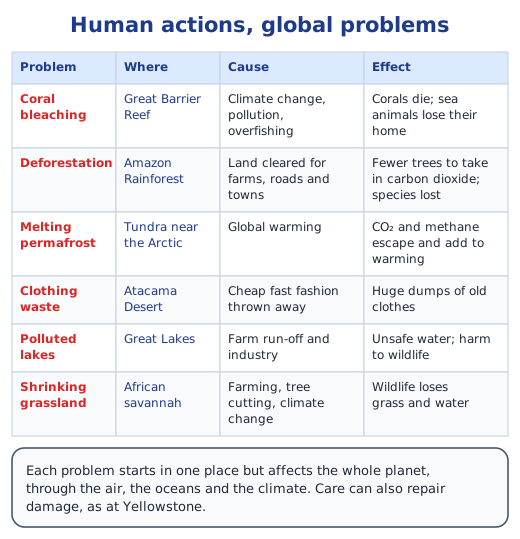
The chapter asks: how do human actions trigger environmental issues? Its world tour answers with examples from almost every stop. Mountains, oceans, forests and deserts give us water, food, oxygen and a steady climate, but when people use them faster than nature can repair them, the balance breaks down.
Coral reefs in danger
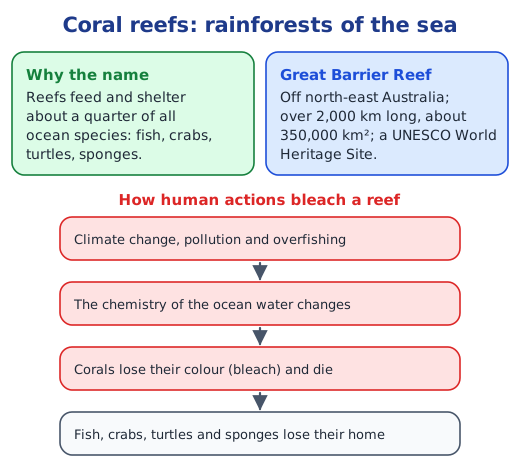
Coral reefs feed and shelter about a quarter of all ocean species, which is why they are called the rainforests of the sea. Climate change, pollution and overfishing are changing the chemistry of the water around them. Stressed corals lose their colour, or bleach, and many die, leaving fish, crabs, turtles and sponges without a home. Even the Great Barrier Reef, a UNESCO World Heritage Site over 2,000 km long, faces these threats, so protecting it is urgent.
Forests and grasslands
The Amazon Rainforest, fed by rivers from the Andes, is called the Lungs of the Earth because its trees take in carbon dioxide and give out oxygen. About 400 indigenous communities live in it and help conserve it. Yet the countries of the region also need land for farms, roads and towns, and the forest is shrinking through deforestation and climate change. In Africa, farming, tree cutting and climate change threaten the savannah grasslands where elephants, lions and zebras live, and in the Andes only about a quarter of the original plants and animals remain.
Frozen ground, dry land and polluted water
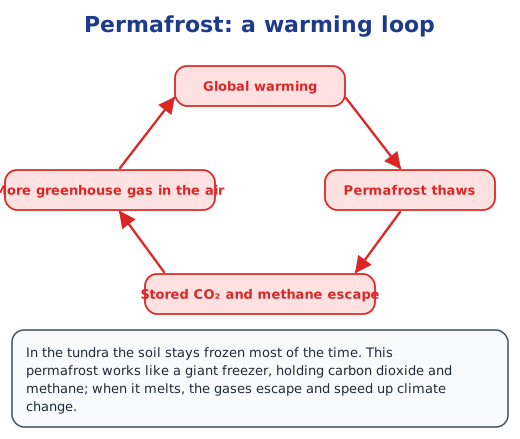
Near the Arctic, the soil of the treeless tundra, the permafrost, stays frozen and locks away carbon dioxide and methane like a giant freezer. Global warming thaws it, the gases escape, and the planet warms further. On the Tibetan Plateau, melting snow is making lakes grow and new ones appear. In Chile’s Atacama Desert, cheap fast fashion has created huge dumps of discarded clothes, and North America’s Great Lakes are polluted by farm run-off and industrial waste.
Repairing the damage
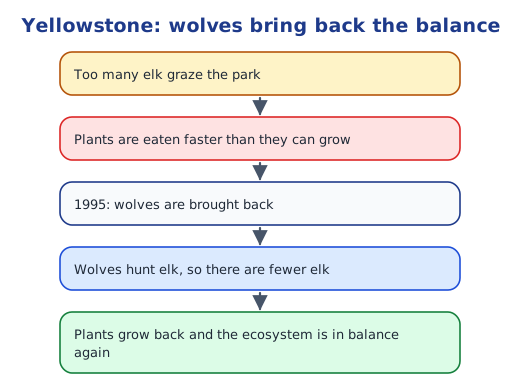
Damage can be reversed when people understand how an ecosystem works. In Yellowstone National Park, in the Rocky Mountains, too many elk were eating the plants. In 1995 wolves were brought back; they hunted the elk, the plants returned, and the ecosystem’s balance was restored. Nature also helps itself: the Eurasian Steppes act as a carbon sink, storing carbon underground. Protecting such places, and the people who care for them, is part of the answer.
Why it is everyone’s problem
The Earth’s features are linked. Dust blown from the Sahara carries phosphorus that feeds the Amazon’s plants, and the southern Indian Ocean shapes India’s monsoon. In the same way, forests cut in one country or gases released from distant tundra change the climate for all. That is why the chapter says that studying world geography helps us manage the planet wisely. Small choices count too: using less, wasting less, and caring for local forests, rivers and lakes are ways in which every one of us can help keep the planet in balance. See the Chapter 1 notes, continents and oceans and the NCERT solutions, including Question 9 on environmental issues.
Practice
-
Coral bleaching is caused mainly by:
Show answer
Answer: (a) changes in ocean water caused by human actions
-
Permafrost is:
Show answer
Answer: (b) soil that stays frozen
-
In 1995 the balance of Yellowstone National Park was restored by bringing back:
Show answer
Answer: (c) wolves
-
How does fast fashion harm the Atacama Desert?
Show answer
Answer: Cheap, trendy clothes are thrown away as soon as fashions change. Mountains of these unwanted clothes are dumped in the Atacama, now one of the quickest-growing clothing dumps on the planet, a problem the UN calls an emergency.
-
Why is the melting of permafrost a problem for the whole world?
Show answer
Answer: Frozen tundra soil holds carbon dioxide and methane. When warming melts it, these greenhouse gases escape into the air and add to global warming, which melts more permafrost, so the loop speeds up climate change everywhere.
Questions students ask
How do human actions trigger environmental issues?
People change natural systems faster than they can recover: forests are cleared for land, seas are overfished, rivers and lakes are polluted by farms and factories, waste is dumped, and greenhouse gases warm the climate. The results include coral bleaching, loss of species, desertification, thawing permafrost and polluted water.
Why is the Amazon called the Lungs of the Earth?
The Amazon is the largest rainforest in the world. Its trees take in huge amounts of carbon dioxide and release oxygen through photosynthesis, so it affects the air and climate of the whole planet. Cutting it down weakens this role.
What can be done to protect places like coral reefs and rainforests?
Reduce pollution and the causes of climate change, limit fishing and logging, protect important areas as parks or heritage sites, support indigenous communities who care for the land, and restore damaged areas, as wolves helped restore Yellowstone.
Stuck on a question?
Take a photo and Lagnever AI explains it step by step. Try it for 7 days for ₹2.
Get it on Google Play Open in browser
For parents: after the trial, the plan renews monthly by UPI or card autopay. You can cancel anytime in the app.