
Forts, palaces, mosques and tombs
Answer in short
Mosques have a prayer hall facing Mecca, often with domes and minarets; India’s Indo-Islamic buildings blend Islamic forms with Indian craft, as at Ahmedabad’s Jama Masjid. Forts such as Mehrangarh and Agra guarded kingdoms and held palaces. Mausoleums like Humayun’s Tomb and the Taj Mahal use symmetry, charbagh gardens, inlay and calligraphy.
Stuck on a question? Take a photo and Lagnever AI explains it step by step. Try it for 7 days for ₹2. Get it on Google Play
Mosques
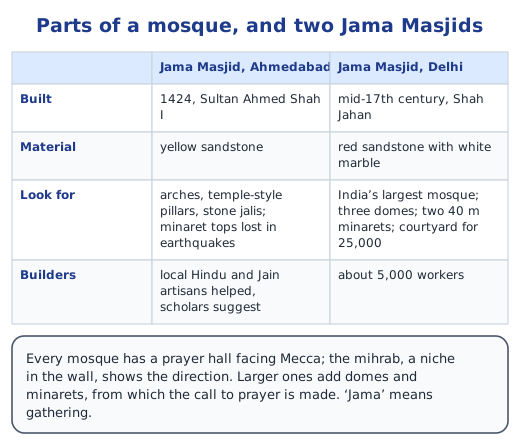
A mosque is where Muslims gather to pray; it also serves for religious education, community meetings and talks. Every mosque has a prayer hall oriented towards Mecca, and a niche in the wall, the mihrab, points the way. Larger mosques add domes and minarets, towers from which the call to prayer is made. Friday prayers matter especially, and a big mosque that hosts them is a Jama Masjid, from jama (gathering) and masjid (mosque).
Sultan Ahmed Shah I built the Jama Masjid of Ahmedabad in 1424, in yellow sandstone. Its front has graceful arches and the stumps of two minarets, whose tops fell in earthquakes; an 1809 sketch shows them whole. Its stone jalis, temple-style pillars without decoration and fine carvings suggest that local Hindu and Jain craftsmen worked on it. Shah Jahan’s Jama Masjid in Delhi, built after he moved his capital to Shahjahanabad in the mid-17th century, is India’s largest mosque: red sandstone with white marble, three gateways, three domes, two 40-metre minarets, and a courtyard for up to 25,000 people, built by about 5,000 workers.
Indo-Islamic architecture
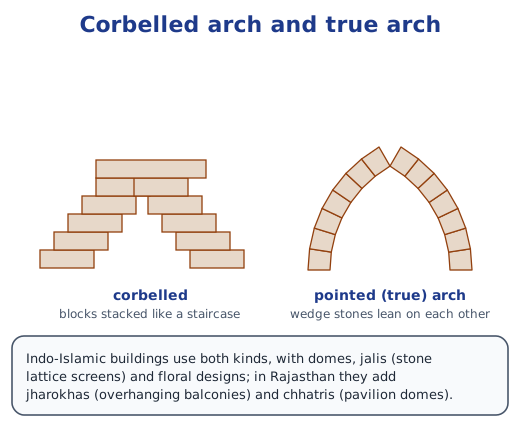
When Islamic building ideas met Indian craftsmanship, a new style grew, called Indo-Islamic. Its features include domes, arches both pointed and corbelled (built of blocks stacked inward like steps), jalis and floral motifs. In Rajasthan, builders added jharokhas, overhanging balconies, and chhatris, small pavilion domes.
Forts and palaces
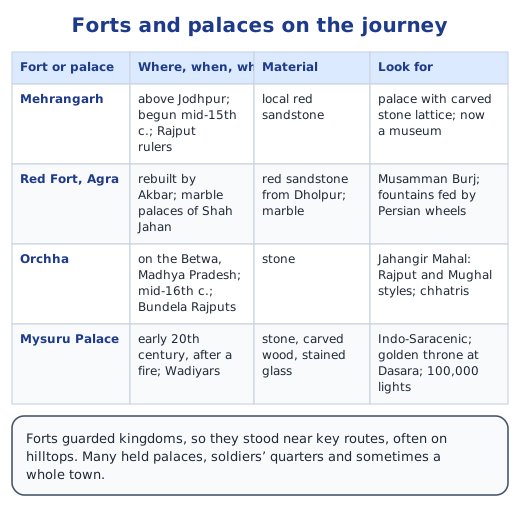
Forts protected kingdoms, so they were placed near important land or sea routes, often on a hill commanding the plains. Many also held palaces and homes for rulers and soldiers, and some a whole town.
- Mehrangarh, above Jodhpur, was begun in the mid-15th century and enlarged by Rajput rulers for about two centuries. It is built of local red sandstone; its palace has royal rooms, quarters for men and women, staff rooms, stables and barracks, and is now a museum. The nearby Jaswant Thada is a cenotaph. Jodhpur’s blue houses use lime mixed with copper sulphate, said to keep termites away.
- The Red Fort at Agra was rebuilt by Akbar in red sandstone from Dholpur, about 60 km away. Shah Jahan, who loved marble, replaced many buildings with marble palaces, and was later imprisoned in one of them, the Musamman Burj, by his son Aurangzeb. British troops destroyed many of its buildings in the 19th century. Persian wheels lifted Yamuna water to tanks on the walls to run its fountains.
- The Orchha complex on the Betwa in Madhya Pradesh, built by the Bundela Rajputs in the mid-16th century, has three main palaces; the Jahangir Mahal mixes Rajput and Mughal styles.
- The Mysuru Palace (Amba Vilas) of the Wadiyars was rebuilt in the early 20th century after a fire, in the Indo-Saracenic style, with carved wooden doors, stained glass and a golden throne shown at Dasara.
Tombs and mausoleums
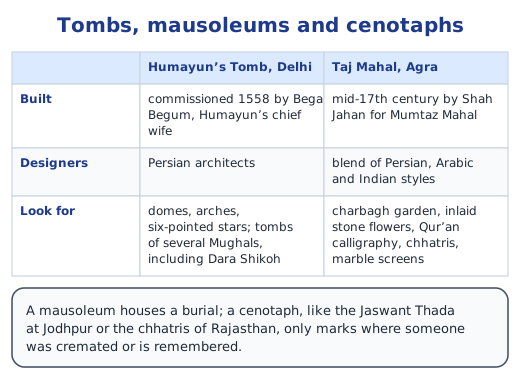
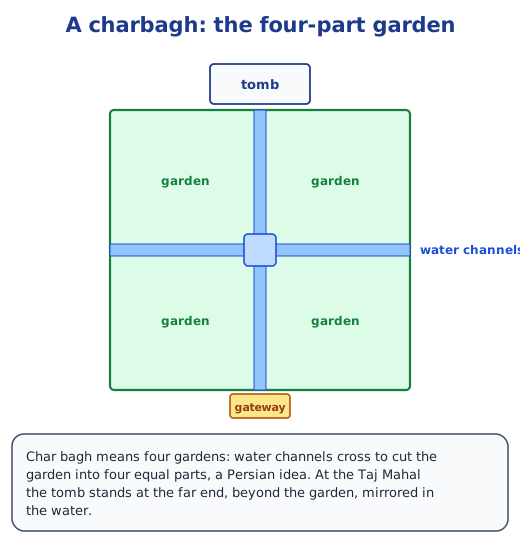
Islam and Christianity bury their dead, and in the Islamic world grand mausoleums were raised for rulers, royal family members and revered mystics, partly as statements of a dynasty’s greatness. Buddhists, Jains and Hindus generally cremate, so ancient India has no tombs of such rulers; medieval cenotaphs only mark cremation sites. These monuments follow strict symmetry, extended into their gardens, with arches, floral motifs, latticework and calligraphy from the Qur’an.
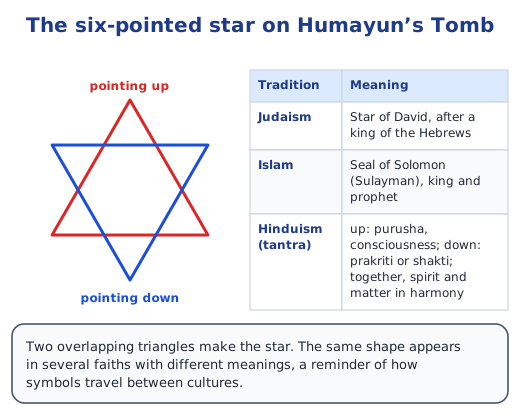
Humayun’s Tomb in Delhi was commissioned in 1558 by Bega Begum, Humayun’s chief wife, and designed by Persian architects who brought Persian taste into Mughal building; several Mughals, including Dara Shikoh, are buried there. Its six-pointed stars are a symbol shared by several faiths. The Taj Mahal, built by Shah Jahan in the mid-17th century for Mumtaz Mahal, blends Persian, Arabic and Indian elements, with delicate inlay of semi-precious stones in white marble. Industrial smoke yellowed its marble in the 1970s, and after an expert committee and a Supreme Court case, polluting industries nearby were banned in the mid-1990s.
See also stupas, rock-cut caves and temples, water structures and stepwells, the chapter notes and the NCERT solutions.
Practice
-
Which Jama Masjid did Sultan Ahmed Shah I build in 1424?
Show answer
Answer: (b) Ahmedabad
-
The red sandstone of the Agra Fort came from:
Show answer
Answer: (b) Dholpur
-
A charbagh is:
Show answer
Answer: (b) a garden divided into four parts
-
Why do scholars think local Hindu and Jain artisans helped build Ahmedabad’s Jama Masjid?
Show answer
Answer: It has intricate stone jalis, pillars in the same style as some temples (but plain) and detailed carvings, features typical of local temple builders, blended with Islamic arches and minarets.
-
How were the Agra Fort’s fountains fed?
Show answer
Answer: Persian wheels lifted water from the Yamuna into tanks on top of the fort walls; from there it ran down through terracotta pipes into fountains, which helped cool the area like natural air-conditioners.
Questions students ask
What are the main parts of a mosque?
A prayer hall oriented towards Mecca, with the mihrab, a niche in the wall, showing that direction. Larger mosques often have one or more domes, minarets from where the call to prayer is made, and a courtyard. A large mosque used for Friday prayers is called a Jama Masjid.
What is special about the Taj Mahal’s design?
It blends three traditions: Persian charbagh gardens and large arched doorways, Arabic calligraphy and geometric patterns, and Indian chhatris, lotus designs and marble screens. Its white marble is inlaid with semi-precious stones in floral designs and seems to change colour through the day.
Why were forts built on hills?
To protect a kingdom from attack. A hilltop fort near an important land or sea route could see the plains below and was hard to reach. Inside, many forts held palaces, homes for rulers and soldiers, stables and sometimes a whole town.
Stuck on a question?
Take a photo and Lagnever AI explains it step by step. Try it for 7 days for ₹2.
Get it on Google Play Open in browser
For parents: after the trial, the plan renews monthly by UPI or card autopay. You can cancel anytime in the app.