
Water structures and stepwells
Answer in short
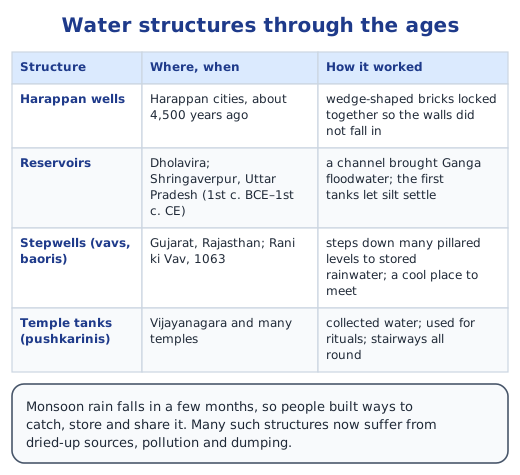
Because India’s rain comes mostly in the monsoon, people built structures to harvest, store and share water. Harappan wells used wedge-shaped bricks that could not cave in, and Dholavira had huge reservoirs. Shringaverpur stored Ganga floodwater in linked tanks. Stepwells such as Rani ki Vav and temple tanks called pushkarinis were also works of art.
Stuck on a question? Take a photo and Lagnever AI explains it step by step. Try it for 7 days for ₹2. Get it on Google Play
Why so many water structures?
In most of India the year’s rain arrives in a few monsoon months. To have water in the dry season, people built structures to harvest, store and distribute it, from the humble village pond to the Grand Anicut on the Kaveri. Because India’s lands differ so much, from the Himalayan foothills and the Thar Desert to the Gangetic plains, the Western Ghats, the Deccan and the Northeast, these structures took many forms.
Harappan wells and reservoirs
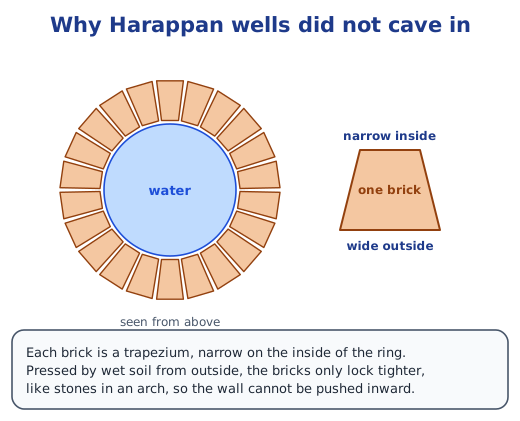
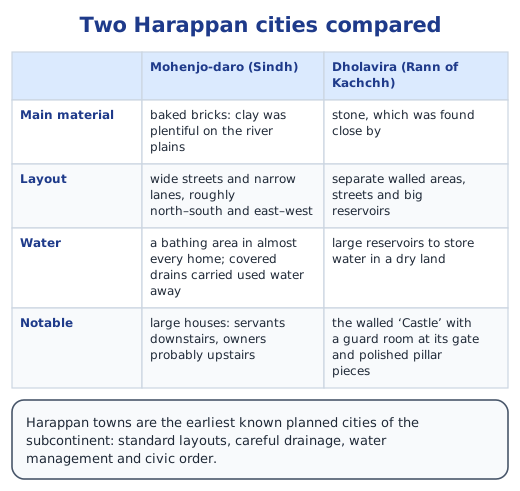
The tradition goes back to the Harappans. Dholavira, in the dry Rann of Kachchh, had very large reservoirs inside its walls. Harappan builders also solved a hard problem: water seeping through the ground pushes on a well’s lining and can make it collapse inward. They lined wells with trapezium-shaped bricks, narrower on the inside of the ring, so that the pressure only pressed them tighter together, the way the stones of an arch hold each other up.
Shringaverpur
Shringaverpur in Uttar Pradesh is the Shringaverapura of the Ramayana, where Rama, Sita and Lakshmana crossed the Ganga as they left for exile. Excavations there uncovered a chain of large connected reservoirs, filled through a channel when the Ganga was in flood (dated to around the 1st century BCE to the 1st century CE). The first one or two tanks let the silt in the floodwater settle before it moved on, a fairly common design, though how the whole system worked is still being studied.
Stepwells
Wells took many forms, lined with bricks, with stone, or with rings of terracotta. In classical times Gujarat and Rajasthan developed stepwells, called vavs or baoris: long flights of steps lead down several storeys to the water. Many are engineering marvels and works of art at once. Rani ki Vav in Gujarat, of about 1063, has several pillared levels and hundreds of fine statues. Besides storing rainwater, a stepwell was a social place where people sat together in the cool and exchanged news.
How a stepwell works
Why build steps so deep? In the dry months the level of water underground falls, sometimes many metres. A stepwell follows it down: as the water sinks, people simply walk further down the flights of steps to reach it, and when the monsoon fills it again the lower levels disappear under water. The stone storeys, pillars and pavilions shade the water, so less of it evaporates in the heat, and the air near the bottom stays much cooler than at the surface. That is why a stepwell was a pleasant place to rest on a summer afternoon, and why so many were decorated like temples.
Temple tanks
Many temples had their own water tanks, pushkarinis, used for collecting water and for water-based rituals. Like stepwells, many are beautiful, with stairways on every side, as at Vijayanagara.
Saving them today
Many old water structures now suffer from dried-up sources, poor maintenance, pollution and waste dumping. Environmentalists, local people and NGOs sometimes work together to revive them, but much remains to be done; cleaning and reusing a local pond or stepwell keeps both water and heritage alive.
Read more in stupas, rock-cut caves and temples and forts, palaces, mosques and tombs, or see the chapter notes and the NCERT solutions.
Practice
-
Why did Harappan wells not cave in?
Show answer
Answer: (b) Their wedge-shaped bricks locked together
-
Shringaverpur’s reservoirs were filled by:
Show answer
Answer: (b) a channel from the Ganga in flood
-
Stepwells were built mainly in:
Show answer
Answer: (b) Gujarat and Rajasthan
-
Why did the first tank at Shringaverpur matter?
Show answer
Answer: Flood water from the Ganga carries silt. In the first reservoir or two the water stood still long enough for the silt to settle, so cleaner water flowed into the next tanks; this was a common design.
-
Why do temple tanks and stepwells have so many steps?
Show answer
Answer: The water level rises and falls with the seasons, so steps let people reach the water at any level. Many people can use them at once, for bathing, rituals or fetching water, and the steps also help in cleaning the tank.
Questions students ask
What is a stepwell?
A stepwell, called vav or baori, is a well reached by long flights of steps that go down several levels to the water. Found mainly in Gujarat and Rajasthan, it stored rainwater and gave people a cool place to sit together. Rani ki Vav in Gujarat, of about 1063, has many pillared levels and hundreds of statues.
Where is Shringaverpur and why is it famous?
Shringaverpur is in Uttar Pradesh. The Ramayana calls it Shringaverapura, where Rama, Sita and Lakshmana crossed the Ganga at the start of their exile. Excavations found large linked reservoirs that a channel filled with Ganga floodwater.
Why did ancient Indians build so many water structures?
Most rain falls in a few monsoon months, so water had to be caught and stored for the rest of the year. Each region, from the Himalayan foothills and the Thar Desert to the Deccan and the Northeast, built structures suited to its land and climate, from village ponds to the Grand Anicut.
Stuck on a question?
Take a photo and Lagnever AI explains it step by step. Try it for 7 days for ₹2.
Get it on Google Play Open in browser
For parents: after the trial, the plan renews monthly by UPI or card autopay. You can cancel anytime in the app.